Book 13: Arrival at Ithaca and Athena’s Counsel
Ὀδύσσεια · Book 13 · Classix Modern English Reading Edition
He finished, and they all fell silent, held spellbound throughout the shadowy hall. Alcinous answered him: “Odysseus, now that you have reached my high-roofed house with its bronze threshold, I do not think you will be driven wandering again before you get home, though you have suffered greatly. Here are my orders to every one of you who always drink the council’s gleaming wine in my halls and listen to the singer. Our guest’s clothing, finely worked gold, and all the other gifts the Phaeacian counselors brought here already lie in a polished chest. Come, let each man give him a great tripod and a cauldron as well. Later we will collect from the people to repay ourselves. It is hard for one man to give so much without return.”
Read Ancient Greek Source (Odyssey.13.1–Odyssey.13.15)
Alcinous’s words pleased them. Each man went home to sleep. When early-born, rosy-fingered Dawn appeared, they hurried to the ship carrying bronze, the strength of men. Mighty Alcinous went through the ship himself and stowed it carefully beneath the benches, so it would not hinder any of the crew when they drove hard at the oars. Then they went to Alcinous’s house to prepare the feast. Mighty Alcinous sacrificed an ox for them to dark-clouded Zeus, son of Cronus, who rules over all. They burned the thigh bones and enjoyed a magnificent feast. Among them sang the inspired singer Demodocus, honored by the people. But Odysseus kept turning his head toward the radiant sun, impatient for it to set. His heart was set on going home.
Read Ancient Greek Source (Odyssey.13.16–Odyssey.13.30)
As a man longs for supper when all day his wine-dark oxen have dragged a jointed plow through a fallow field, and he welcomes the setting sunlight as he goes to his meal, his knees faltering under him—so Odysseus welcomed the setting sunlight. At once he addressed the Phaeacians who loved their oars, speaking especially to Alcinous: “Lord Alcinous, most distinguished of all your people, pour your offerings and send me safely on my way. May joy be yours! Everything my heart desired is now fulfilled: a passage home and welcome gifts. May the gods of heaven make them a blessing to me. When I return, may I find my excellent wife at home and my loved ones unharmed. May you who stay here bring joy to your wedded wives and children. May the gods grant you every kind of excellence, and may no evil come among your people.”
Read Ancient Greek Source (Odyssey.13.31–Odyssey.13.46)
They all approved and urged that the guest be sent on his way: he had spoken fittingly. Then mighty Alcinous said to his herald: “Pontonous, mix a bowl and serve wine to everyone throughout the hall. We will pray to father Zeus and send our guest to his own country.” Pontonous mixed the honey-sweet wine and served it, standing beside each man. From their seats they poured offerings to the blessed gods who hold broad heaven. Noble Odysseus stood, put a two-handled cup into Arete’s hand, and spoke these winged words: “Fare well, my queen, all your days, until old age and death come, as they come to human beings. I am going home. May you delight here in this house in your children, your people, and king Alcinous.”
Read Ancient Greek Source (Odyssey.13.47–Odyssey.13.62)
Noble Odysseus stepped across the threshold. Mighty Alcinous sent a herald with him to lead him to the swift ship and the seashore. Arete sent enslaved women with him too: one carried a freshly washed cloak and tunic, another a sturdy chest, and the third bread and red wine. When they reached the ship and the sea, his noble escorts quickly received and stowed all the food and drink in the hollow hull. On the stern deck they spread a rug and a linen sheet for Odysseus so that he could sleep without waking. He too boarded and lay down in silence. The others took their places in order at the oarlocks and loosed the cable from the pierced mooring stone. As they leaned back and tossed up the sea with their blades, sweet sleep fell over his eyelids: unbroken sleep, most sweet, as close as could be to death.
Read Ancient Greek Source (Odyssey.13.63–Odyssey.13.80)
As four stallions yoked together on a plain spring forward under the lash, lifting high and swiftly covering the course, so her stern rose high, and behind her a great dark wave of the roaring sea seethed. She ran surely and steadily; not even a hawk, swiftest of winged things, could have kept pace. Racing on, she cut through the waves, carrying a man whose counsel was like the gods’. Before this he had suffered many pains in his heart, making his way through men’s wars and the bitter waves. Now he slept without stirring, forgetting all he had suffered. When the brightest star rose, the one that above all announces the light of early-born Dawn, the seagoing ship drew near the island.
Read Ancient Greek Source (Odyssey.13.81–Odyssey.13.95)
In the land of Ithaca there is a harbor of Phorcys, the Old Man of the Sea. Two jutting, sheer headlands bend around it and shield it from the great waves raised by harsh winds outside. Within, well-benched ships can stay without moorings once they have reached their anchorage. At the head of the harbor stands a long-leaved olive tree. Near it is a lovely, shadowy cave sacred to the nymphs called Naiads. Inside are stone mixing bowls and two-handled jars where bees make their nests. There are long stone looms on which the nymphs weave sea-purple cloth, a wonder to see. Water flows there always. The cave has two entrances: the one toward the North Wind is a way down for men; the one toward the South is more divine. Men do not enter there. It is the immortals’ way.
Read Ancient Greek Source (Odyssey.13.96–Odyssey.13.112)
The crew rowed into this harbor, which they knew already. The ship drove up onto land for half her length, so fast had the rowers’ hands propelled her. They stepped from the well-benched ship onto the shore. First they lifted Odysseus from the hollow hull, linen sheet and shining rug and all, and laid him on the sand, still overcome by sleep. Then they carried out the possessions the noble Phaeacians had given him on his journey home, through great-hearted Athena’s influence. They piled everything together by the olive tree’s trunk, away from the path, so that no traveler passing before Odysseus woke would harm his goods.
Read Ancient Greek Source (Odyssey.13.113–Odyssey.13.124)
They themselves turned for home. But the Earth-shaker had not forgotten the threats he first made against godlike Odysseus. He asked Zeus’s counsel: “Father Zeus, I will no longer be honored among the immortal gods when mortal men show me no honor—the Phaeacians, who come from my own line! I said Odysseus would reach home after much suffering. I never meant to take his homecoming away entirely, since you had first promised it and nodded your assent. But they have brought him sleeping over the sea in their swift ship and set him down in Ithaca. They have given him countless gifts, an abundance of bronze and gold and woven clothing—more than Odysseus could ever have carried from Troy if he had returned unharmed with his allotted share of the spoils.”
Read Ancient Greek Source (Odyssey.13.125–Odyssey.13.138)
Cloud-gathering Zeus answered: “Ah, Earth-shaker of wide power, what a thing to say! The gods do not dishonor you. It would be hard to heap insults on one so senior and so great. If any man gives way to his own strength and violence and shows you no honor, vengeance is always yours afterward. Do whatever you wish, whatever pleases your heart.” Poseidon the Earth-shaker answered: “Dark-clouded god, I could quickly do as you say. But I always respect your wishes and shrink from opposing them. Now I want to smash the Phaeacians’ beautiful ship in the misty sea as she returns from her escort, so they will stop and give up carrying people home. And I want to cover their city with a great mountain.” Cloud-gathering Zeus replied: “My friend, this seems best to me: when all the people of the city can see her rowing near, turn her into a stone close to land, shaped like a swift ship, so everyone marvels. And cover their city with a great mountain.”
Read Ancient Greek Source (Odyssey.13.139–Odyssey.13.158)
When Poseidon the Earth-shaker heard that, he went to Scheria, where the Phaeacians lived, and waited. The seagoing ship drew very close, moving swiftly. The Earth-shaker came near, struck her with his flat hand, turned her to stone, and rooted her to the seabed. Then he went away. The Phaeacians, those long-oared men famed for ships, spoke winged words to one another. Looking toward a neighbor, one would say: “Ah, who has stopped our swift ship out at sea as she was rowing home? She was already fully in sight!” So they spoke, but they did not know what had happened.
Read Ancient Greek Source (Odyssey.13.159–Odyssey.13.170)
Alcinous addressed them: “Ah, my father’s ancient prophecies have indeed come upon me! He used to say that Poseidon resented us for carrying everyone home unharmed. One day, he said, he would smash a beautiful Phaeacian ship in the misty sea as she came back from an escort, and cover our city with a great mountain. So the old man said, and now it is all coming true. Come, let us all do as I say. Stop carrying mortals home when any come to our city. Let us sacrifice twelve chosen bulls to Poseidon, in the hope he will pity us and not cover our city with a towering mountain.” Fear seized them, and they prepared the bulls. So the Phaeacian leaders and rulers stood around the altar and prayed to lord Poseidon.
Read Ancient Greek Source (Odyssey.13.171–Odyssey.13.186)
Meanwhile noble Odysseus woke from sleep in his own country, but did not recognize it. He had been away so long, and the goddess Pallas Athena, daughter of Zeus, had poured mist around him. She meant to make him unrecognizable and tell him everything, so that his wife, his townspeople, and his friends would not know him before he had made the suitors pay for all their outrage. So everything looked different to its lord: the long paths, the sheltered harbors, the steep cliffs, and the flourishing trees. He sprang up, stood, and looked at his native land. Then he groaned, slapped his thighs with his open hands, and said in sorrow:
Read Ancient Greek Source (Odyssey.13.187–Odyssey.13.199)
“Ah, whose country have I come to now? Are they violent, savage, and unjust, or welcoming to strangers, with minds that fear the gods? Where can I take all these possessions? Where am I to wander myself? If only I had stayed there with the Phaeacians! I could have gone to another mighty king who would have treated me kindly and sent me home. Now I do not know where to put these things, and I will not leave them here for others to plunder. So the Phaeacian leaders and rulers were not entirely wise or just after all! They have taken me to a different land. They said they would bring me to sunlit Ithaca, but they have not kept their word. May Zeus who guards suppliants punish them! He watches other men too and punishes whoever does wrong. But come, let me count these possessions and see whether they have carried anything off in their hollow ship.”
Read Ancient Greek Source (Odyssey.13.200–Odyssey.13.216)
He counted the beautiful tripods and cauldrons, the gold and fine woven clothing. Nothing was missing. But he mourned his native land as he dragged himself along the shore of the loud-roaring sea, lamenting bitterly. Athena came near in the form of a young shepherd, delicate as a king’s son, with a fine double-folded cloak about the shoulders, sandals on the shining feet, and a spear in the hands. Odysseus was glad to see the figure and came forward, speaking these winged words: “Friend, you are the first person I have met here. Greetings! Do not meet me with any evil intent. Save these possessions and save me. I pray to you as to a god and come to your dear knees. Tell me truly, so I can know: what land is this, what people, what men live here? Is it one of the sunlit islands, or a headland of the rich-soiled mainland sloping toward the sea?”
Read Ancient Greek Source (Odyssey.13.217–Odyssey.13.235)
Bright-eyed Athena answered: “Stranger, you must be a fool or have come from far away to ask about this land. It is not so utterly unknown! Very many people know it, both those who live toward dawn and sunrise and those behind us toward the misty west. It is rugged and no place for driving horses, but not very poor, though it is not broad. Grain grows here in abundance, and wine is produced too. Rain and nourishing dew are always with us. It is good for goats and cattle. There are woods of every kind, and watering places that never fail. So, stranger, the name of Ithaca has reached even Troy, which they say is far from Achaean country.”
Read Ancient Greek Source (Odyssey.13.236–Odyssey.13.249)
Long-suffering noble Odysseus was glad. He rejoiced in his own country, as Pallas Athena, daughter of aegis-bearing Zeus, described it. He spoke these winged words, but did not tell the truth. He held back his real story, always turning his resourceful mind to advantage: “I heard of Ithaca even in broad Crete, far across the sea. Now I have come here myself with these possessions. I left as much again to my children and fled, because I killed Idomeneus’s dear son, swift-footed Orsilochus, who outstripped all the bread-eating men of broad Crete in speed. He wanted to strip me of all my Trojan spoils, for which I had suffered in my heart, making my way through men’s wars and bitter waves. He did this because I had not served his father obediently in Trojan country, but led a band of my own companions.
Read Ancient Greek Source (Odyssey.13.250–Odyssey.13.266)
“With a companion I ambushed him by the road as he came from the fields and struck him with a bronze-tipped spear. Deep darkness covered the sky. No one saw us; I took his life unnoticed. When I had killed him with sharp bronze, I immediately went to a ship and pleaded with its noble Phoenician crew, giving them a welcome share of the spoils. I asked them to take me aboard and land me at Pylos or in holy Elis, where the Epeians rule. But the wind’s force drove them away from there against their will. They did not mean to deceive me. Driven off course, we reached this place by night and rowed hard into the harbor. None of us thought about supper, much as we wanted food. We simply went ashore and lay down by the ship. Sweet sleep came upon me in my exhaustion. They took my possessions from the hollow ship and set them beside me where I lay on the sand. Then they boarded and sailed for well-settled Sidon, leaving me behind in grief.”
Read Ancient Greek Source (Odyssey.13.267–Odyssey.13.286)
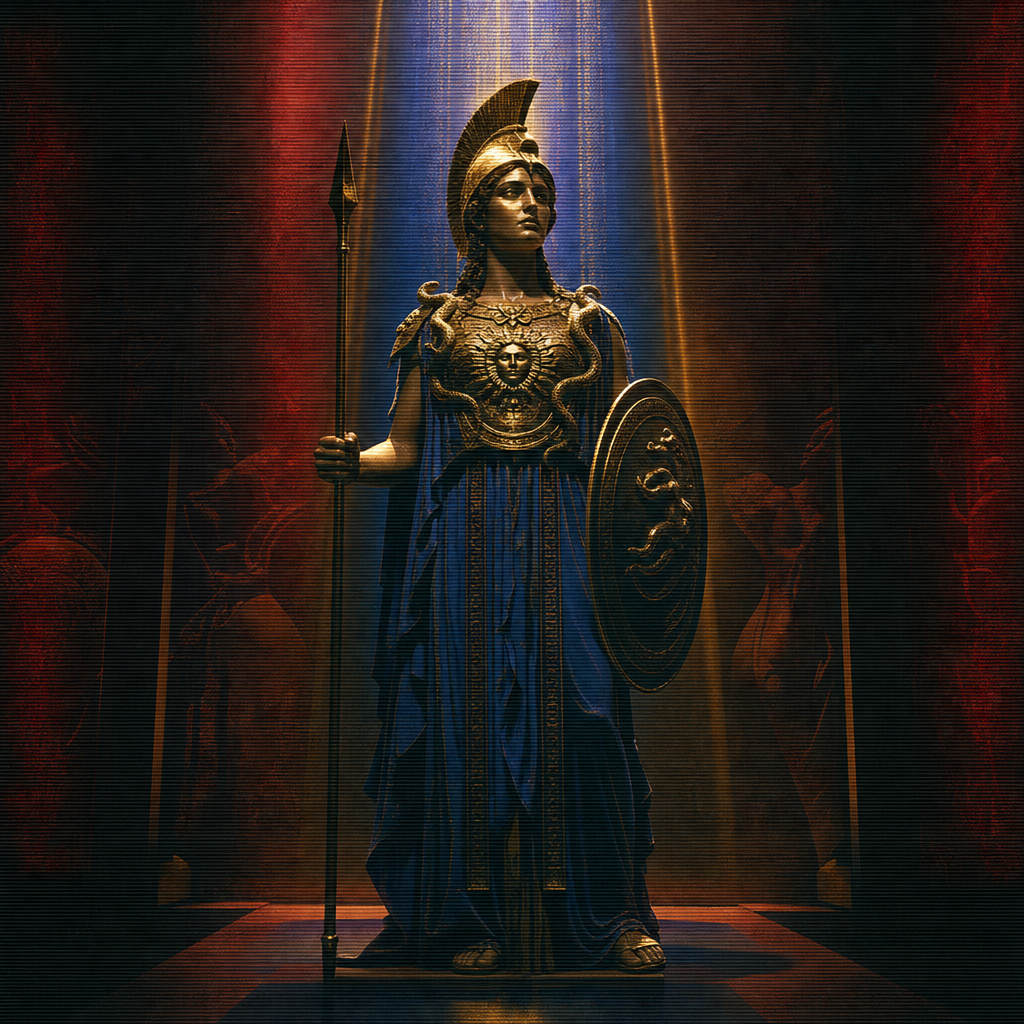
Bright-eyed Athena smiled and stroked him with her hand. Now she had the form of a woman, beautiful and tall, skilled in splendid handiwork. She spoke these winged words: “Anyone who outdid you in every kind of trick would have to be very cunning and deceitful—even a god who met you! Reckless man, full of changing schemes, never tired of tricks! So even in your own country you were not going to give up deceit and the cheating stories dear to you since childhood? Come, let us stop this. We both know how to gain an advantage. You are far the best of all mortals at counsel and speech, while among all the gods I am famed for intelligence and cunning. And yet you did not recognize Pallas Athena, daughter of Zeus! I always stand beside you and guard you through all your hardships. I made all the Phaeacians love you.
Read Ancient Greek Source (Odyssey.13.287–Odyssey.13.302)
“Now I have come here to weave a plan with you and hide the possessions those noble Phaeacians gave you on your journey home, through my judgment and foresight. I will tell you how many sorrows you are fated to endure in your well-built house. You must bear them, even against your will, and tell no one, man or woman, that you have returned from your wanderings. Endure the pain in silence and submit to the violence of men.”
Read Ancient Greek Source (Odyssey.13.303–Odyssey.13.310)
Resourceful Odysseus answered: “Goddess, it is hard for a mortal to recognize you when he meets you, however knowledgeable he is. You take every shape. This I know well: you were kind to me before, while we sons of the Achaeans fought at Troy. But after we sacked Priam’s high city, boarded our ships, and a god scattered the Achaeans, I did not see you, daughter of Zeus, or notice you come aboard my ship to ward off any trouble. I wandered always with a wounded heart until the gods freed me from suffering. Not until I reached the Phaeacians’ rich land did you encourage me with words and lead me to the city yourself. Now I beg you by your father—because I do not think I have reached sunlit Ithaca, but am wandering through some other land. I think you say this to mock me and deceive my mind—tell me if I really have reached my own country.”
Read Ancient Greek Source (Odyssey.13.311–Odyssey.13.328)
Bright-eyed Athena answered: “That is always the way your mind works! That is why I cannot abandon you in your misery: you are courteous, shrewd, and sensible. Another man coming home after wandering would hurry gladly to see his children and wife in his halls. You do not yet care even to learn or ask, until you have tested your wife, who sits just as before in your house, always spending her nights and days in misery and tears. I never doubted it. In my heart I knew you would return, having lost all your companions. But I did not want to fight Poseidon, my father’s brother. He has stored anger against you in his heart, enraged because you blinded his dear son.
Read Ancient Greek Source (Odyssey.13.329–Odyssey.13.343)
“Come, I will show you the place of Ithaca, so you may believe. This is the harbor of Phorcys, the Old Man of the Sea. Here is the long-leaved olive at the head of the harbor. Near it is the lovely, shadowy cave sacred to the nymphs called Naiads. This is the vaulted cavern where you used to offer the nymphs so many complete sacrifices of a hundred victims. And there is Mount Neriton, clothed in woods.” As she spoke, the goddess scattered the mist and the land appeared. Long-suffering noble Odysseus rejoiced in his land and kissed the grain-giving earth. At once he raised his hands and prayed to the nymphs: “Naiad nymphs, daughters of Zeus, I thought I would never see you again. Now I greet you with gentle prayers. We will give you gifts too, as we did before, if Athena, Zeus’s daughter who leads the spoil, graciously lets me live and brings my dear son to manhood.”
Read Ancient Greek Source (Odyssey.13.344–Odyssey.13.360)
Bright-eyed Athena said: “Take heart. Do not let these things trouble you. First let us put your possessions deep inside this marvelous cave, where they will stay safe. Then we will consider how to arrange everything for the best.” The goddess entered the misty cave, searching out its hiding places. Odysseus carried everything closer—the gold, unyielding bronze, and well-made clothes the Phaeacians had given him. Pallas Athena, daughter of aegis-bearing Zeus, stowed them carefully and set a stone across the entrance. Then the two sat by the trunk of the sacred olive and planned death for the arrogant suitors.
Read Ancient Greek Source (Odyssey.13.361–Odyssey.13.373)
Bright-eyed Athena spoke first: “Son of Laertes, descended from Zeus, resourceful Odysseus, consider how to lay hands on the shameless suitors who for three years have lorded it in your hall, courting your godlike wife and offering marriage gifts. Always grieving in her heart for your return, she gives them all hope, sends messages, and makes promises to each man. But her mind is set on other things.” Resourceful Odysseus answered: “Ah, I would indeed have met Agamemnon son of Atreus’s evil fate in my own halls if you, goddess, had not told me everything in order. Come, weave a plan so I can make them pay. Stand beside me yourself and fill me with fearless strength, as when we tore Troy’s shining veil away. If you stood beside me as eagerly as then, bright-eyed goddess, I could fight three hundred men with you, my lady, if you would willingly defend me.”
Read Ancient Greek Source (Odyssey.13.374–Odyssey.13.391)
Bright-eyed Athena answered: “I will certainly be beside you; I will not forget you when we undertake that work. I think more than one of those suitors who eat up your livelihood will spatter the great floor with blood and brains. But come, I will make you unrecognizable to every mortal. I will shrivel the fair skin on your supple limbs, destroy the golden hair on your head, and put a rag around you so loathsome that anyone who sees a man wearing it will recoil. I will blear your eyes, once so beautiful, so that you look disgusting to all the suitors, to your wife, and to the son you left in your house. First go to the swineherd who guards your pigs. He is loyal to you still and loves your son and thoughtful Penelope. You will find him sitting beside the pigs, which feed near Raven Rock and the spring Arethusa, eating satisfying acorns and drinking dark water: these nourish the rich fat of pigs. Stay there and question him about everything while I go to Sparta of the lovely women to summon Telemachus, your dear son, Odysseus. He has gone to spacious Lacedaemon, to Menelaus, to ask for news of you, whether you are still alive.”
Read Ancient Greek Source (Odyssey.13.392–Odyssey.13.415)
Resourceful Odysseus answered: “Why did you not tell him yourself, knowing everything in your mind? Was it so that he too should wander and suffer on the barren sea while others eat up his livelihood?” Bright-eyed Athena answered: “Do not let him weigh too heavily on your mind. I myself guided him, so that he might win a good name by going there. He is in no distress. He sits at ease in the son of Atreus’s house, with abundant comforts at hand. Young men are lying in wait for him in a black ship, eager to kill him before he reaches his own country. But I do not think they will. The earth will cover some of those suitors who eat up your livelihood before that happens.”
Read Ancient Greek Source (Odyssey.13.416–Odyssey.13.428)
Athena touched him with her wand. She shriveled the fair skin on his supple limbs, destroyed the golden hair on his head, and put the skin of an old man all over his body. She bleared his eyes, once so beautiful, and threw a miserable cloak and tunic around him, torn and filthy, stained with acrid smoke. Over him she put the great hairless hide of a swift deer. She gave him a staff and a wretched bag, torn in many places, with a twisted cord for its strap. So, their plans made, the two parted. She went to holy Lacedaemon to find Odysseus’s son.