Book 12: The Sirens, Scylla and Charybdis, and the Cattle of the Sun
Ὀδύσσεια · Book 12 · Classix Modern English Reading Edition
“When our ship had left the current of the river Ocean and reached the swell of the open sea, we came to Aeaea, where early-born Dawn has her home and dancing grounds, and where the Sun rises. We beached the ship on the sand and stepped out onto the seashore. There we fell asleep and waited for bright Dawn. When early-born, rosy-fingered Dawn appeared, I sent companions ahead to Circe’s house to bring back Elpenor’s dead body. We quickly cut logs at the furthest point of the headland and held his funeral in grief, with warm tears streaming down our faces. When the dead man and his armor were burned, we heaped a mound, raised a stone on it, and planted his well-shaped oar on the very top.
Read Ancient Greek Source (Odyssey.12.1–Odyssey.12.15)
“While we attended to these tasks, Circe learned that we had returned from Hades. She dressed and came quickly, with attendants bringing bread, plenty of meat, and gleaming red wine. The radiant goddess stood among us and said: ‘Reckless men, who went alive into the house of Hades! You will die twice, while other mortals die just once. Come, stay here all day eating food and drinking wine. At dawn you will sail. I will show you the way and tell you everything, so that no painful, evil contrivance brings suffering upon you, on land or at sea.’ Our proud hearts yielded to her words.
Read Ancient Greek Source (Odyssey.12.16–Odyssey.12.28)
“All that day until sunset we sat feasting on endless meat and sweet wine. When the sun went down and darkness came, the others lay down beside the ship’s stern cables. Circe took me by the hand, away from my dear companions, made me sit, and lay beside me, asking about everything. I told her the whole story in order. Then lady Circe said: ‘All that has now been accomplished. Listen to what I tell you, and a god himself will help you remember.
Read Ancient Greek Source (Odyssey.12.29–Odyssey.12.38)
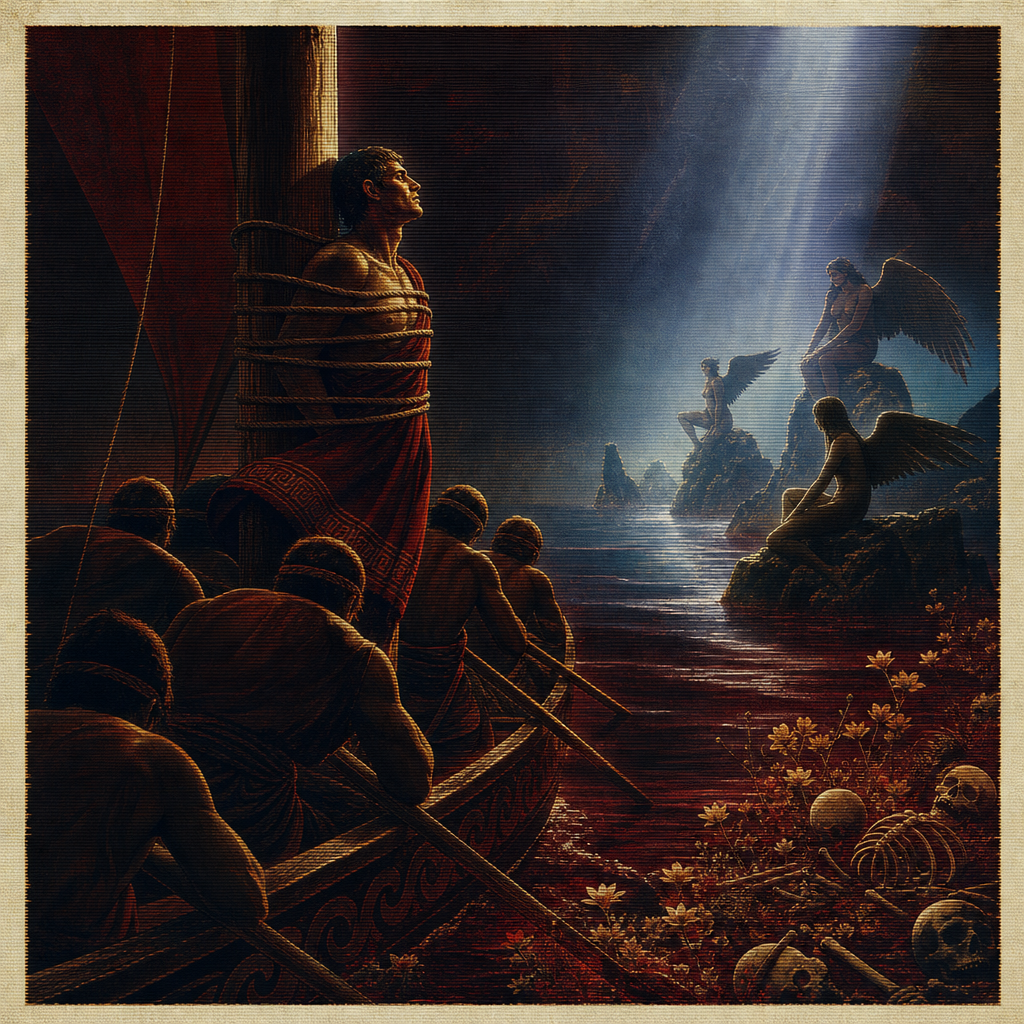
“‘First you will reach the Sirens, who enchant every man who comes to them. Whoever approaches unwittingly and hears the Sirens’ voice has no wife and little children standing beside him, rejoicing at his return home. The Sirens enchant him with their clear song as they sit in a meadow. All around them lies a great heap of rotting men’s bones, with skin shriveling on them. Row past. Knead honey-sweet wax and smear it over your companions’ ears so that none of the others can hear. You may listen yourself, if you wish, but let them bind you hand and foot in the swift ship, upright at the mast step, with the ropes fastened to the mast itself. Then you can enjoy the two Sirens’ voices. If you beg your companions and order them to release you, let them tie you with still more bonds.
Read Ancient Greek Source (Odyssey.12.39–Odyssey.12.54)
“‘Once your companions have rowed past them, I will not tell you in full which of two paths you should take. You must decide for yourself. I will describe both. On one side are overhanging rocks against which the great waves of dark-eyed Amphitrite roar. The blessed gods call them the Wandering Rocks. Not even winged creatures pass that way, not even the timid doves that carry ambrosia to father Zeus. The smooth rock always takes one of them, and the Father sends another to keep their number full. No ship of men that reaches those rocks has yet escaped: the waves of the sea and storms of deadly fire carry a ship’s planks and men’s bodies together. Only one seagoing ship has passed them, Argo, known to all, on her voyage from Aeetes. The waves would soon have hurled her against those great rocks too, but Hera brought her through because she loved Jason.
Read Ancient Greek Source (Odyssey.12.55–Odyssey.12.72)
“‘On the other route are two crags. One thrusts its pointed summit into broad heaven, wrapped in a dark cloud that never lifts. Its peak is never clear, in summer or in autumn. No mortal could climb up or gain a foothold there, even with twenty hands and twenty feet: the rock is smooth, as if it had been polished all around. Halfway up the crag is a murky cave facing west into Erebus. That is where you must steer your hollow ship, glorious Odysseus. Not even a man in his prime could shoot an arrow from the ship as far as that hollow cave. Scylla lives there, barking terribly. Her voice is only as loud as a newborn puppy’s, but she herself is an evil monster. No one could take pleasure in seeing her, not even a god who met her.
Read Ancient Greek Source (Odyssey.12.73–Odyssey.12.88)
“‘She has twelve dangling feet and six very long necks, each with a dreadful head. In each head are three rows of teeth, close-packed and thick, full of black death. Half her body is sunk inside the hollow cave, but she thrusts her heads out of that terrible gulf. There she fishes, feeling about the rock for dolphins, sea-dogs, or any larger creature she can catch among the countless beasts that loud-groaning Amphitrite feeds. No sailors can boast that they have passed her unharmed in their ship. With each head she snatches a man from the dark-prowed hull. The other crag you will see, Odysseus, is lower. They stand close together, an arrow shot apart. On it grows a great wild fig tree, thick with leaves. Beneath it divine Charybdis sucks down the black water. Three times a day she spews it up, and three times she sucks it down with a dreadful roar. Do not be there when she sucks it in! Not even the Earth-shaker could save you from disaster. Keep your ship close to Scylla’s crag and row quickly past. It is far better to miss six companions from your ship than lose them all.’
Read Ancient Greek Source (Odyssey.12.89–Odyssey.12.110)
“I answered her: ‘Goddess, tell me truly: could I somehow escape deadly Charybdis and fight the other off when she attacks my companions?’ The radiant goddess answered at once: ‘Reckless man! Even now you think of fighting and hard struggles. Will you not yield even to the immortal gods? She is no mortal creature but an immortal evil, dreadful, harsh, savage, impossible to fight. There is no defense. Your strongest course is to flee. If you linger beside the rock to arm yourself, I fear she will rush out again with all those heads and snatch as many more men. Row as hard as you can, and call on Crataeis, Scylla’s mother, who bore her to be a plague to mortals. She will stop her from rushing out a second time.
Read Ancient Greek Source (Odyssey.12.111–Odyssey.12.126)
“‘You will come to the island of Thrinacia. There the Sun’s many cattle and sturdy sheep graze: seven herds of cattle and as many fine flocks of sheep, fifty in each. They never breed and never die. Goddesses tend them, the lovely-braided nymphs Phaethusa and Lampetie, whom radiant Neaera bore to Hyperion the Sun. Their honored mother bore and raised them, then settled them far away on Thrinacia to guard their father’s sheep and curved-horned cattle. If you leave the cattle unharmed and think about your return, you may still reach Ithaca, though you suffer. But if you harm them, I foretell destruction for your ship and companions. Even if you yourself escape, you will come home late and in misery, having lost all your companions.’
Read Ancient Greek Source (Odyssey.12.127–Odyssey.12.141)
“As she finished, Dawn of the golden throne arrived. The radiant goddess went away through the island. I went to the ship and urged my companions to board and loose the stern cables. They boarded quickly and sat at the oarlocks. Sitting in their rows, they struck the gray sea with their oars. Behind our dark-prowed ship Circe of the lovely braids, the fearsome goddess with a human voice, sent a following wind to fill the sails—a good companion. We made all the gear ready aboard, then sat while wind and helmsman steered her.
Read Ancient Greek Source (Odyssey.12.142–Odyssey.12.152)
“Then, grieving at heart, I said to my companions: ‘Friends, it is wrong for only one or two of us to know the prophecies the radiant goddess Circe told me. I will tell you, so that with knowledge we may either die or avoid death and escape our doom. First she told us to avoid the marvelous Sirens’ voice and their flowering meadow. She told me alone to listen to their voice. But bind me in painful bonds so that I stay firmly in place, upright at the mast step, with the ropes fastened to the mast itself. If I beg you and order you to release me, press me tighter with still more bonds.’
Read Ancient Greek Source (Odyssey.12.153–Odyssey.12.164)
“While I explained these things to my companions, our well-built ship quickly reached the two Sirens’ island, driven on by a harmless following wind. Suddenly the wind dropped. There was a dead calm: a divine power stilled the waves. My companions stood and furled the sails, stowed them in the hollow ship, then sat at their oars and whitened the water with polished blades of fir. I cut a great round of wax into little pieces with sharp bronze and kneaded them in my sturdy hands. Soon the wax grew warm under the force of my hands and the rays of lord Sun, Hyperion’s son. I smeared it over all my companions’ ears, one by one. They bound me hand and foot aboard the ship, upright at the mast step, and fastened the ropes to the mast itself. Then they sat and struck the gray sea with their oars.
Read Ancient Greek Source (Odyssey.12.165–Odyssey.12.180)
“When we were a shout’s distance away, moving swiftly, the Sirens noticed our sea-swift ship drawing near and raised their clear song: ‘Come here, much-praised Odysseus, great glory of the Achaeans! Stop your ship and listen to our two voices. No one has ever sailed past this place in a black ship without hearing the honeyed voice from our lips. He goes on his way delighted, knowing more than before. We know all that the Argives and Trojans suffered on Troy’s broad plain by the will of the gods. We know everything that happens on the earth that feeds so many.’
Read Ancient Greek Source (Odyssey.12.181–Odyssey.12.191)
“They sang, sending out their beautiful voices. My heart longed to listen, and I ordered my companions to release me, signaling with my eyebrows. But they bent forward over their rowing. Perimedes and Eurylochus stood at once, bound me with more ropes, and pressed me tighter. When they had rowed past and we could no longer hear the Sirens’ voice or song, my trusty companions quickly removed the wax I had smeared over their ears and freed me from my bonds.
Read Ancient Greek Source (Odyssey.12.192–Odyssey.12.200)
“As soon as we left the island, I saw smoke and a great wave, and heard a crashing roar. In terror the oars flew from their hands and thudded into the current. The ship stopped where she was: their hands no longer drove the tapering oars. I went through the ship, standing beside each man and urging my companions with gentle words: ‘Friends, we are not strangers to suffering. This danger is no greater than when the Cyclops penned us in his hollow cave by brute force. Even then we escaped through my courage, judgment, and wits. I think you will remember this danger too one day. Come now, all of you do as I say. Sit at the oarlocks and strike the deep sea’s surge with your blades. Perhaps Zeus will grant us escape from this destruction.
Read Ancient Greek Source (Odyssey.12.201–Odyssey.12.216)
“‘Helmsman, here are your orders. Take them to heart, since you handle our hollow ship’s steering oars. Keep her clear of that smoke and wave, and steer for the crag. Do not let her dart that way unawares and carry us into disaster.’ They quickly obeyed my words. I said no more of Scylla, that unavoidable misery, for fear my companions would stop rowing in terror and huddle inside the ship. Then I forgot Circe’s painful warning: she had told me not to arm. I put on my splendid armor, took two long spears in my hands, and stepped onto the foredeck. I expected rocky Scylla, who was bringing ruin to my companions, to appear there first. But I could not catch sight of her anywhere. My eyes grew weary as I searched every part of the misty rock.
Read Ancient Greek Source (Odyssey.12.217–Odyssey.12.233)
“We sailed up the narrow passage in tears. On one side was Scylla; on the other divine Charybdis dreadfully sucked down the salt sea. Whenever she spewed it out, the water churned and seethed all over like a cauldron on a great fire. Spray shot high over the tops of both crags. But whenever she sucked in the salt sea, her whole churning interior showed. The rock roared terribly all around, and beneath it the earth appeared, dark with sand. Pale fear seized the men.
Read Ancient Greek Source (Odyssey.12.234–Odyssey.12.243)
“We watched her, afraid of destruction. Meanwhile Scylla snatched six companions from my hollow ship, the strongest men in hand and muscle. When I looked back across the swift ship at my companions, I saw their hands and feet already raised high above. They called me by name in their anguish, for the last time. As a fisherman on a jutting rock uses a long rod to lower bait for little fish, letting an ox’s horn down into the sea, then catches a fish and throws it writhing out of the water, so they were lifted writhing toward the rocks. There in her doorway she ate them as they screamed and stretched their hands toward me in that dreadful slaughter. Of everything I endured while exploring the sea’s passages, that was the most pitiful sight my eyes ever saw.
Read Ancient Greek Source (Odyssey.12.244–Odyssey.12.259)
“When we had escaped the rocks, dread Charybdis, and Scylla, we soon reached the god’s splendid island. There were the beautiful broad-browed cattle and the many sturdy sheep of Hyperion the Sun. While still at sea in my black ship, I heard the lowing of cattle in their pens and the bleating of sheep. The words of the blind seer, Tiresias of Thebes, came into my mind, and those of Circe of Aeaea, who had repeatedly warned me to avoid the island of the Sun who delights mortals. Grieving at heart, I said to my companions: ‘Listen to me, friends, despite your suffering, while I tell you the prophecies of Tiresias and Circe of Aeaea. She repeatedly warned me to avoid the island of the Sun who delights mortals. She said our worst disaster would be there. Row the black ship past the island.’ At that their hearts broke.
Read Ancient Greek Source (Odyssey.12.260–Odyssey.12.277)
“Eurylochus answered me bitterly: ‘You are a hard man, Odysseus. Your strength is beyond ours, and your limbs never tire. You must be made entirely of iron! You will not let your companions, worn out with exhaustion and sleepiness, step ashore where we could prepare a good supper on this sea-ringed island. Instead you order us to leave it and wander through the swift night on the misty sea. Harsh winds rise at night and wreck ships. How could anyone escape sheer destruction if a sudden storm came, a blast of the South Wind or the raging West, which above all tear ships apart despite the will of the lordly gods? Let us give way to black night, stay beside our swift ship, and prepare supper. At dawn we will board and put out on the open sea.’
Read Ancient Greek Source (Odyssey.12.278–Odyssey.12.293)
“The other companions approved Eurylochus’s words. Then I knew a divine power was plotting trouble. I spoke these winged words to him: ‘Eurylochus, you are all forcing me, a man alone. But now all of you swear a solemn oath to me: if we find a herd of cattle or a great flock of sheep, let no one in reckless folly kill a cow or a sheep. Be content to eat the food immortal Circe gave us.’ They immediately swore as I ordered. When they had sworn and completed the oath, we brought our well-built ship to rest in the sheltered harbor near fresh water. My companions went ashore and skillfully prepared supper. When they had satisfied their desire for food and drink, they remembered and wept for the dear companions Scylla had snatched from the hollow ship and eaten. Sweet sleep came upon them as they wept.
Read Ancient Greek Source (Odyssey.12.294–Odyssey.12.311)
“When the night was in its third watch and the stars had moved on, cloud-gathering Zeus raised a fierce wind with an unearthly squall. He covered land and sea together with clouds; night rushed down from heaven. When early-born, rosy-fingered Dawn appeared, we hauled the ship into a hollow cave and moored her. There the nymphs had lovely dancing grounds and seats. I called an assembly and said: ‘Friends, we have food and drink in our swift ship. Let us keep away from the cattle, or we may suffer for it. These cattle and sturdy sheep belong to a fearsome god, the Sun, who sees and hears everything.’ Their proud hearts yielded to my words.
Read Ancient Greek Source (Odyssey.12.312–Odyssey.12.324)
“For a whole month the South Wind blew without stopping. No other wind arose except the East and South. As long as the men had bread and red wine, they kept away from the cattle, eager to stay alive. But when all the ship’s provisions were gone, need drove them to wander in search of prey: fish and birds, whatever came into their hands, caught with curved hooks. Hunger tormented their bellies. Then I went inland to pray to the gods, hoping one would show me a way home. When I had crossed the island and left my companions behind, I washed my hands in a place sheltered from the wind and prayed to all the gods who hold Olympus. But they poured sweet sleep over my eyelids.
Read Ancient Greek Source (Odyssey.12.325–Odyssey.12.338)
“Eurylochus began giving my companions evil counsel: ‘Listen to me, friends, despite your suffering. Every death is hateful to wretched mortals, but to starve and meet one’s fate is the most pitiful death of all. Come, let us drive off the best of the Sun’s cattle and sacrifice them to the immortals who hold broad heaven. If we reach Ithaca, our own country, we will quickly build a rich temple to Hyperion the Sun and fill it with many fine offerings. If he is angered over his straight-horned cattle and wants to destroy our ship, and the other gods join him, I would rather gulp a wave and lose my life at once than slowly waste away on a deserted island.’ The other companions approved his words.
Read Ancient Greek Source (Odyssey.12.339–Odyssey.12.352)
“They immediately drove off the best of the Sun’s cattle from nearby: the beautiful broad-browed, curved-horned cattle grazed not far from the dark-prowed ship. They stood around them and prayed to the gods, plucking tender leaves from a tall-crowned oak, since they had no white barley aboard the well-benched ship. When they had prayed, cut the throats, and skinned the cattle, they cut out the thigh bones, wrapped them in a double layer of fat, and laid raw meat on top. They had no wine to pour over the burning offerings, so they made libations with water as they roasted all the innards. When the thigh bones had burned and they had tasted the innards, they cut the rest into pieces and threaded them on spits.
Read Ancient Greek Source (Odyssey.12.353–Odyssey.12.365)
“Then sweet sleep left my eyelids. I set out for the swift ship and the seashore. As I drew near the curved ship, the sweet smell of fat enveloped me. I groaned and cried aloud to the immortal gods: ‘Father Zeus and all you other blessed gods who live forever, you lulled me into merciless sleep to ruin me! While I was gone, my companions have devised a terrible deed.’ Lampetie in her flowing robe hurried as a messenger to Hyperion the Sun, to tell him we had killed his cattle. At once, enraged at heart, he said to the immortals: ‘Father Zeus and all you other blessed gods who live forever, punish the companions of Odysseus, son of Laertes. They have insolently killed my cattle, which delighted me as I climbed into the starry sky and when I turned from heaven back toward earth. If they do not pay me fitting compensation for the cattle, I will go down to Hades and shine among the dead.’
Read Ancient Greek Source (Odyssey.12.366–Odyssey.12.383)
“Cloud-gathering Zeus answered: ‘Sun, keep shining among the immortals and upon mortal men on the grain-giving earth. I will soon strike their swift ship with a white thunderbolt and shatter it into little pieces in the middle of the wine-dark sea.’ I learned this from lovely-haired Calypso. She said she herself had heard it from Hermes the messenger.
Read Ancient Greek Source (Odyssey.12.384–Odyssey.12.390)
“When I reached the ship and the sea, I stood beside each man in turn and rebuked him. But we could find no remedy: the cattle were dead already. The gods immediately showed them portents. The hides crawled, and the meat bellowed around the spits, cooked and raw alike. The sound was like the lowing of cattle. For six days my trusty companions feasted on the best of the Sun’s cattle they had driven off. When Zeus, son of Cronus, brought the seventh day, the wind stopped raging in its storm. We boarded at once and put out on the open sea, setting the mast and hauling up the white sails.
Read Ancient Greek Source (Odyssey.12.391–Odyssey.12.402)
“When we had left the island and no other land was in sight, only sky and sea, the son of Cronus set a dark cloud above the hollow ship. The sea darkened under it. She ran for only a little while before the West Wind came howling in a great squall. Its blast snapped both forestays of the mast. The mast fell backward, and all the rigging tumbled into the bilge. At the stern it struck the helmsman’s head and crushed all the bones of his skull at once. He fell from the deck like a diver, and his proud life left his bones. At the same moment Zeus thundered and hurled his bolt at the ship. The whole ship reeled under Zeus’s thunderbolt and filled with sulfur. My companions fell overboard and were carried about the black ship on the waves like crows. The god took their homecoming away.
Read Ancient Greek Source (Odyssey.12.403–Odyssey.12.419)
“I moved about the ship until the swell tore the sides from the keel. The wave carried the bare keel and broke the mast off against it. A backstay made of oxhide was thrown over the mast. With it I bound the two together, keel and mast, and sat on them, driven by the deadly winds. Then the West Wind stopped raging in its storm, and the South Wind quickly came, bringing more pain to my heart: I must measure out the path to deadly Charybdis once again. All night I drifted, and at sunrise I reached Scylla’s crag and dread Charybdis.
Read Ancient Greek Source (Odyssey.12.420–Odyssey.12.430)
“She sucked down the salt sea. I sprang high toward the tall wild fig tree and clung to it like a bat. I had nowhere to brace my feet or gain a foothold: the roots were far below, and the great long branches hung out of reach overhead, shading Charybdis. I held on relentlessly until she should spew up the mast and keel again. Long I yearned for them, and late they came. At the hour when a man rises from the assembly to go to supper after judging many disputes between young men, those timbers appeared out of Charybdis. I let go from above, hands and feet together, and splashed into the water beside the long timbers. Sitting on them, I rowed with my hands. The Father of gods and men did not let Scylla see me, or I would never have escaped sheer destruction.
Read Ancient Greek Source (Odyssey.12.431–Odyssey.12.446)
“From there I drifted for nine days. On the tenth night the gods brought me to Ogygia, where Calypso of the lovely braids lives, the fearsome goddess with a human voice. She loved and cared for me. But why tell you that story? Yesterday I told it here in your house to you and your noble wife. I hate telling again what has already been clearly told.”