Book 14: Odysseus in the Hut of Eumaeus
Ὀδύσσεια · Book 14 · Classix Modern English Reading Edition
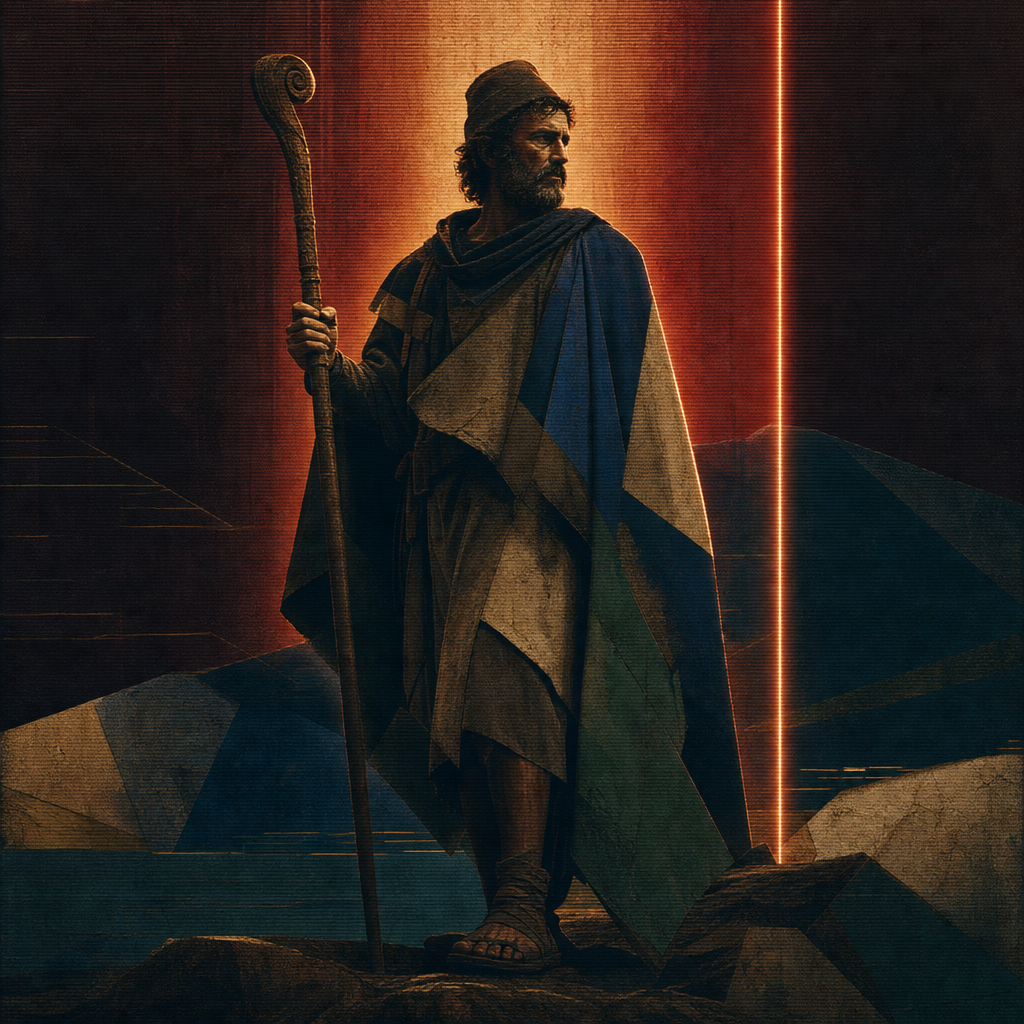
Odysseus left the harbor and climbed a rough path through wooded country over the heights, toward the noble swineherd Athena had described. Of all the household people noble Odysseus had acquired, this man took the greatest care of his livelihood. He found him sitting in the porch of his dwelling. A high-walled yard stood there in an open, commanding place, a great, fine enclosure. The swineherd had built it himself for the pigs while his master was away, without help from his mistress or old Laertes. He used hauled stones and topped the wall with wild pear branches. Outside he drove a close, thick row of stakes all around, split from the black heart of oak. Within the yard he made twelve pens side by side as beds for the pigs.
Read Ancient Greek Source (Odyssey.14.1–Odyssey.14.14)
Fifty breeding sows that slept on the ground were enclosed in each pen. The males slept outside, far fewer in number: the godlike suitors kept eating them away, since the swineherd was always sending the finest of all his well-fed hogs. There were three hundred and sixty of them. Four dogs, like wild beasts, always lay nearby; the swineherd, a leader of men, had raised them. He himself was cutting a fine-colored oxhide and fitting sandals to his feet. Three of the other men had gone in different directions with the herded pigs. The fourth he had been forced to send to town with a hog for the arrogant suitors, so they could sacrifice it and glut themselves on meat.
Read Ancient Greek Source (Odyssey.14.15–Odyssey.14.28)
Suddenly the barking dogs saw Odysseus and rushed at him with loud cries. Cunningly he sat down, and his staff fell from his hand. There beside his own farm he would have suffered a shameful injury, but the swineherd rushed through the doorway on swift feet, the hide falling from his hand. He shouted at the dogs and drove them off in all directions with a shower of stones. Then he said to his master: “Old man, the dogs almost tore you to pieces on the spot! That would have brought disgrace on me. The gods have given me other pains and griefs enough. I sit here mourning and grieving for my godlike master, fattening hogs for other men to eat, while he may be wandering hungry through the land and cities of people who speak strange tongues—if he is still alive and sees the sunlight. But come, old man, let us go into the hut. Once you have satisfied yourself with food and wine, you can tell me where you come from and what sorrows you have endured.”
Read Ancient Greek Source (Odyssey.14.29–Odyssey.14.47)
The noble swineherd led him into the hut and made him sit. He spread thick brushwood beneath him and laid over it a great, shaggy hide of a wild goat, his own bedding. Odysseus was glad to be welcomed so, and said: “Stranger, may Zeus and the other immortal gods give you what you most desire, since you have welcomed me so willingly.”
Read Ancient Greek Source (Odyssey.14.48–Odyssey.14.54)
You answered him, Eumaeus the swineherd: “Stranger, it would be wrong for me to dishonor a guest even poorer than you. All strangers and beggars are under Zeus’s care. Our gift is small but gladly given. That is the lot of enslaved people, always afraid when new masters rule. The gods have barred the return of the man who would have cared for me kindly and given me possessions—a house, a plot of land, a much-courted wife—such things as a kindly master gives a household slave who works hard for him, when a god makes the work prosper. This work I keep at is prospering for me. My master would have done me much good if he had grown old here. But he is dead. If only Helen’s whole line had perished utterly, since she loosened the knees of so many men! He too went to Ilium, rich in horses, for Agamemnon’s honor, to fight the Trojans.”
Read Ancient Greek Source (Odyssey.14.55–Odyssey.14.71)
He quickly belted his tunic and went to the pens where the piglets were shut in. He took two, brought them back, and killed them both. He singed them, cut them up, and threaded them on spits. When he had roasted everything, he set it before Odysseus hot, still on the spits, and sprinkled white barley meal over it. He mixed honey-sweet wine in an ivy-wood cup, sat opposite him, and urged him to eat: “Eat now, stranger, what is available to enslaved people: piglets. The suitors eat the fattened hogs, with no thought of divine retribution or pity in their hearts. The blessed gods do not love brutal deeds. They honor justice and the rightful acts of men. Even hostile raiders who land in someone else’s country, when Zeus grants them plunder and they load their ships and sail home, feel a strong fear of retribution in their hearts. But these men must know something—perhaps they have heard a god’s voice tell of his miserable death—since they will neither court his wife properly nor go back to their own homes. They sit at ease, insolently devouring his possessions without a thought of restraint. Every night and day Zeus sends, they sacrifice not just one victim, nor merely two, and they drain off wine and waste it outrageously.
Read Ancient Greek Source (Odyssey.14.72–Odyssey.14.95)
“His wealth was beyond measure. No warrior on the dark mainland or here in Ithaca had so much. Even twenty men together have no such riches. I will tell you: on the mainland he has twelve herds of cattle, as many flocks of sheep, as many droves of pigs, and as many great herds of goats. Strangers and his own herdsmen tend them. Here on the island, eleven great herds of goats graze on the outlying land, with good men watching them. Each of those men brings the suitors an animal every day, whichever of his well-fed goats looks best. I guard and protect these pigs and pick out the finest hog to send them.” Odysseus ate the meat and drank the wine eagerly, in silence, planting trouble for the suitors.
Read Ancient Greek Source (Odyssey.14.96–Odyssey.14.110)
When he had dined and satisfied his hunger, Odysseus filled the cup he drank from with wine and gave it to the swineherd. The man took it with pleasure. Then Odysseus spoke these winged words: “Friend, who was it that bought you with his wealth, a man so rich and powerful as you say? You say he died for Agamemnon’s honor. Tell me, in case I know such a man. Zeus and the other immortal gods must know whether I could give news of him from having seen him. I have wandered far.”
Read Ancient Greek Source (Odyssey.14.111–Odyssey.14.120)
The swineherd, leader of men, answered: “Old man, no traveler coming with news of him could persuade his wife or his dear son. Wanderers in need of care tell empty lies; they will not tell the truth. Any vagabond who reaches Ithaca goes to my mistress with deceitful stories. She welcomes him, treats him kindly, and asks about every detail. As she grieves, tears fall from her eyes, as is natural for a woman whose husband has died far away. You too, old man, would quickly invent a tale if someone gave you a cloak and tunic to wear. But by now dogs and swift birds must have torn the skin from his bones, and life has left him. Or fish ate him in the sea, and his bones lie on a shore buried deep in sand.
Read Ancient Greek Source (Odyssey.14.121–Odyssey.14.136)
“So he has perished there, leaving sorrows for all who loved him, and most of all for me. Wherever I go, I will never find another master so kind—not even if I went back to my father and mother’s house, where I was born and they raised me. I do not even mourn for them so much now, though I long to see them with my own eyes in my native land. Longing for Odysseus, who is gone, carries me away. Stranger, I respect him too much to speak his name even when he is absent, for he loved me dearly and cared for me in his heart. I call him my dear master, even though he is far away.”
Read Ancient Greek Source (Odyssey.14.137–Odyssey.14.147)
Long-suffering noble Odysseus said: “Friend, you deny it utterly. You say he will not return, and your heart always distrusts the news. But I will not merely speak: I will swear an oath that Odysseus is coming home. Give me a reward for good news as soon as he comes here and reaches his own house: dress me in a fine cloak and tunic. Until then, however much I need them, I will take nothing. The man who yields to poverty and tells deceitful tales is as hateful to me as the gates of Hades. Let Zeus, first of the gods, be my witness, and this table of hospitality and the hearth of excellent Odysseus to which I have come: everything will happen as I say. Within this very year Odysseus will come here. As this month wanes and the next begins, he will return home and punish whoever here dishonors his wife and glorious son.”
Read Ancient Greek Source (Odyssey.14.148–Odyssey.14.164)
You answered him, Eumaeus the swineherd: “Old man, I will not have to pay that reward, and Odysseus will never come home again. Drink at ease. Let us think of other things; do not remind me of him. My heart aches in my breast whenever someone mentions my good master. Let us leave the oath alone. But may Odysseus come, as I and Penelope, old Laertes and godlike Telemachus wish he would! Now it is the son Odysseus fathered, Telemachus, whom I mourn without ceasing. The gods raised him like a young shoot, and I thought he would be no worse a man than his dear father, wonderful in form and looks. But some immortal or mortal has damaged his balanced mind. He has gone to holy Pylos for news of his father. The noble suitors are lying in wait for his return, so that godlike Arceisius’s line may vanish from Ithaca without a name. Let us leave him too: he may be caught, or he may escape, and the son of Cronus may hold a protecting hand above him.
Read Ancient Greek Source (Odyssey.14.165–Odyssey.14.184)
“But you, old man, tell me your own sorrows. Tell me truly, so I can know: who are you, and where do you come from? Where are your town and parents? What ship did you come on? How did its sailors bring you to Ithaca, and who did they claim to be? I do not think you came here on foot.” Resourceful Odysseus answered: “Then I will tell you all of this quite plainly. If the two of us had food and sweet wine to last us here in the hut, to feast undisturbed while others went about the work, I could easily spend a whole year telling my heart’s sorrows and still not finish, all that I have suffered by the will of the gods.
Read Ancient Greek Source (Odyssey.14.185–Odyssey.14.198)
“I claim to come from broad Crete, the son of a wealthy man. Many other sons were born and raised in his halls, legitimate sons of his wife. My mother was a purchased concubine, but Castor, son of Hylax—the man I claim as my father—honored me equally with his trueborn sons. In those days the Cretans honored him like a god for his fortune, his riches, and his glorious sons. But the dooms of death carried him to the house of Hades. His proud sons divided his livelihood and cast lots for it. They gave me very little and allotted me a house. Yet I married a woman from a family with much land because of my own valor. I was no weakling or coward in war. Now all that has left me, but even now I think you can judge the crop from the stubble. Great hardship has overwhelmed me.
Read Ancient Greek Source (Odyssey.14.199–Odyssey.14.215)
“Ares and Athena gave me courage and the power to break men’s ranks. Whenever I chose the best men for an ambush, planting trouble for our enemies, my proud heart never looked ahead to death. I would leap out far in front and spear whoever gave ground before me. That was the man I was in war. Farm work and the household labor that raises splendid children were never dear to me. I always loved oared ships, wars, polished javelins, and arrows—grim things that make other men shudder. But those were the things I loved, which some god must have put into my mind. Different men take pleasure in different work. Before the sons of the Achaeans set foot on Troy, I led men and swift ships against foreign peoples nine times, and much fell into my hands. I chose a pleasing prize for myself and received much more by lot. My house quickly grew rich, and among the Cretans I became feared and respected.
Read Ancient Greek Source (Odyssey.14.216–Odyssey.14.234)
“But when far-seeing Zeus devised that hateful expedition that loosened so many men’s knees, they ordered me and famous Idomeneus to lead the ships to Ilium. There was no refusing: the people’s harsh voice pressed upon us. For nine years we sons of the Achaeans fought there. In the tenth we sacked Priam’s city and set sail for home, and a god scattered the Achaeans. But Zeus the planner devised trouble for wretched me. I stayed only a month, taking pleasure in my children, my wedded wife, and my possessions. Then my heart urged me to fit out ships with godlike companions and sail to Egypt. I readied nine ships, and men quickly gathered. For six days my trusty companions feasted. I provided many victims to sacrifice to the gods and to prepare their own feast. On the seventh day we boarded and sailed from broad Crete with a strong, fair North Wind, easily, as if downstream. None of my ships was damaged. We sat safe and free from sickness while wind and helmsmen steered them.
Read Ancient Greek Source (Odyssey.14.235–Odyssey.14.256)
“On the fifth day we reached the fair-flowing river of Egypt. I moored my curved ships in the river and ordered my trusty companions to stay beside them and guard them. I sent scouts to the lookout points. But yielding to violence and following their own impulses, the men quickly ravaged the Egyptians’ beautiful fields, carried off their wives and little children, and killed the men themselves. The outcry soon reached the city. Hearing the alarm, the people came at dawn. The whole plain filled with foot soldiers, horses, and the flash of bronze. Zeus who delights in thunder threw my companions into a disastrous panic. Not one dared stand and face the enemy: danger surrounded us on every side. They killed many of us with sharp bronze and led the rest away alive to work for them by force. Zeus himself put this thought in my mind—if only I had died and met my fate there in Egypt, for still more trouble awaited me! I immediately took the well-made helmet from my head and the shield from my shoulders and threw my spear from my hand. I went straight toward the king’s horses, clasped and kissed his knees. He protected and pitied me, put me in his chariot as I wept, and took me home. Many men rushed at me with ash spears, eager to kill me in their great anger. But he held them back, fearing the wrath of Zeus, guardian of strangers, who above all resents evil deeds.
Read Ancient Greek Source (Odyssey.14.257–Odyssey.14.284)
“I stayed there seven years and gathered many possessions among the Egyptians: everyone gave to me. But when the eighth year came round, a Phoenician arrived, a man skilled in deceit, a greedy rogue who had done much harm to people. He persuaded me by his cunning and took me to Phoenicia, where he had his house and possessions. I stayed with him a full year. When the months and days of the circling year were done and the seasons came round, he put me aboard a seagoing ship bound for Libya. His deceitful plan was that I should carry cargo with him, but that he would sell me there and gain an immense price. Though I suspected it, I was forced to follow him aboard. She ran with a strong, fair North Wind past the middle of Crete. But Zeus was planning their destruction.
Read Ancient Greek Source (Odyssey.14.285–Odyssey.14.300)
“When we had left Crete and no other land was in sight, only sky and sea, the son of Cronus set a dark cloud above the hollow ship, and the sea darkened under it. At the same time Zeus thundered and hurled his bolt at the ship. The whole ship reeled under Zeus’s thunderbolt and filled with sulfur. Everyone fell overboard and was carried about the black ship on the waves like crows. The god took their homecoming away. But Zeus himself, though my heart was in pain, put the mighty mast of the dark-prowed ship into my hands so that I could still escape disaster. I clung around it and was driven by the deadly winds. For nine days I drifted. On the tenth black night a great rolling wave brought me to the Thesprotians’ land. There the warrior Pheidon, king of the Thesprotians, took me in without payment. His dear son had found me overcome by cold and exhaustion, raised me by the hand, and led me home to his father’s house. He dressed me in a cloak and tunic.
Read Ancient Greek Source (Odyssey.14.301–Odyssey.14.320)
“There I heard of Odysseus. The king said he had welcomed and cared for him on his journey home. He showed me the possessions Odysseus had gathered—bronze, gold, and laboriously worked iron. There was enough to feed a man down to the tenth generation: so much treasure lay in that king’s halls. He said Odysseus had gone to Dodona to hear Zeus’s will from the god’s tall-crowned oak: how he should return to Ithaca’s rich land after his long absence, openly or in secret. He swore to me himself, pouring an offering in his house, that a ship had been launched and a crew was ready to take Odysseus to his native land. But he sent me away first. A Thesprotian ship happened to be leaving for Dulichium, rich in wheat, and he told them to take me with care to king Acastus there. But an evil plan against me pleased their hearts, so that I might reach the very depth of suffering.
Read Ancient Greek Source (Odyssey.14.321–Odyssey.14.338)
“Once the seagoing ship was far from land, they immediately set about arranging a day of slavery for me. They stripped off my cloak and tunic and threw another miserable cloak and tunic around me, the torn clothes you see with your own eyes. At evening they reached the fields of sunlit Ithaca. They bound me firmly aboard the well-benched ship with a tightly twisted rope, then went ashore and hurried to their supper beside the sea. The gods themselves easily undid my bonds. I wrapped the rag around my head, went down the polished boarding plank, and lowered my chest into the sea. Then I swam, rowing with both hands, and was soon well away from them. I climbed ashore where there was a thicket of flowering woods and crouched there in hiding. They went about groaning loudly. But it seemed no use to search further, and they boarded their hollow ship again. The gods themselves easily hid me and led me to the farm of an understanding man. It is still my fate to live.”
Read Ancient Greek Source (Odyssey.14.339–Odyssey.14.359)
You answered him, Eumaeus the swineherd: “Ah, most unfortunate of strangers, you have deeply stirred my heart by telling all you suffered and all your wanderings. But what you say about Odysseus does not seem right to me. You will not persuade me. Why should a man in your condition tell pointless lies? I know well enough myself about my master’s return: all the gods hated him utterly, since they did not let him fall among the Trojans or in his loved ones’ arms after he had wound up the war. Then all the Achaeans would have made him a tomb, and he would have won great fame for his son after him. Now the Harpies have snatched him away without glory.
Read Ancient Greek Source (Odyssey.14.360–Odyssey.14.371)
“I live apart here beside the pigs. I do not go to town unless thoughtful Penelope summons me when news comes from somewhere. They all sit around and ask about every detail, both those grieving for their long-absent master and those delighted to eat his livelihood without paying. But I have no wish to ask or inquire, ever since an Aetolian deceived me with his story. He had killed a man and wandered far before coming to my house, and I welcomed him warmly. He said he had seen Odysseus in Crete with Idomeneus, repairing the ships storms had shattered. He said he would come in summer or autumn, bringing many possessions and godlike companions. As for you, old man of many sorrows, now that a divine power has brought you to me, do not try to please or charm me with lies. That is not why I will respect and care for you. I fear Zeus, guardian of strangers, and pity you yourself.”
Read Ancient Greek Source (Odyssey.14.372–Odyssey.14.389)
Resourceful Odysseus answered: “What a distrustful heart you have in your breast! Even on oath I could not bring you round or persuade you. Come, let us make an agreement, with the gods who hold Olympus to witness it for us both. If your master comes back to this house, give me a cloak and tunic to wear and send me to Dulichium, where my heart wishes to go. But if your master does not come as I say, set your slaves on me and have them throw me from a great cliff, so another beggar will beware of lying.” The noble swineherd answered: “Stranger, what fame and virtue that would bring me among men, now and forever afterward—if I brought you into my hut, gave you hospitality, and then killed you and took your dear life away! What confidence I would have then when I prayed to Zeus, son of Cronus! But now it is time for supper. I wish my companions were here at once, so we could prepare a good meal in the hut.”
Read Ancient Greek Source (Odyssey.14.390–Odyssey.14.408)
While they talked, the pigs and their herdsmen came near. They penned the animals in their usual places for the night, and an immense clamor rose from the pigs as they settled. The noble swineherd called to his companions: “Bring the best hog, so I can sacrifice it for our guest from far away. We will benefit ourselves too, after all the misery we have long suffered for these white-tusked pigs, while others eat the fruits of our labor without paying.” He split wood with the pitiless bronze, and they brought in a very fat five-year-old hog. They stood it beside the hearth. The swineherd did not forget the immortals: he had good sense. He began the offering by cutting hair from the white-tusked hog’s head and casting it into the fire. He prayed to all the gods that resourceful Odysseus might return to his house.
Read Ancient Greek Source (Odyssey.14.409–Odyssey.14.424)
Then he lifted a piece of oak left from his woodcutting and struck the hog. Its life left it. The others cut its throat, singed it, and quickly cut it apart. The swineherd took raw pieces from every limb, laid them in rich fat, sprinkled them with barley meal, and cast them into the fire. They cut up the rest, threaded it on spits, roasted it carefully, drew it all off, and piled it on platters. The swineherd stood to portion it out: he knew in his heart what was fair. He divided it all into seven shares. One he set aside with a prayer for the nymphs and Hermes, Maia’s son; the others he distributed to each man. He honored Odysseus with the whole length of the white-tusked hog’s back and gladdened his master’s heart. Resourceful Odysseus said: “Eumaeus, may father Zeus love you as I do, since you honor me with good things, lowly as I am.”
Read Ancient Greek Source (Odyssey.14.425–Odyssey.14.441)
You answered him, Eumaeus the swineherd: “Eat, extraordinary stranger, and enjoy what we have. A god will give one thing and withhold another, as he chooses in his heart. He has power over everything.” He burned the first offerings for the gods who live forever, poured gleaming wine, and put the cup into the hands of Odysseus, sacker of cities. Then he sat beside his own portion. Mesaulius served them bread. The swineherd had acquired him on his own while his master was away, without help from his mistress or old Laertes. He had bought him from Taphians with his own possessions. They reached for the good food set before them. When they had satisfied their desire for food and drink, Mesaulius cleared away the bread, and they hurried toward bed, full of bread and meat. A foul, moonless night came on. Zeus sent rain all night, and a great West Wind blew, always bringing wet weather.
Read Ancient Greek Source (Odyssey.14.442–Odyssey.14.458)
Odysseus spoke to them, testing the swineherd to see whether his great care would lead him to take off his own cloak and give it to him, or urge one of the others to do so: “Listen, Eumaeus, and all you other companions. I am going to boast a little. Foolish wine is urging me on: it makes even a very sensible man sing and laugh softly, sends him dancing, and lets slip a word better left unsaid. But now that I have burst out, I will not keep it back. If only I were young and my strength stood firm as when we arranged an ambush and led it beneath Troy! Odysseus and Menelaus, son of Atreus, commanded it. I was third in command with them, for they themselves had ordered it. When we reached the city and its high wall, we lay in thick brush around the town, among reeds and marsh, crouching beneath our armor. A bitter night came on with a blast of the North Wind, freezing cold. Snow fell over us, cold as frost, and ice formed around our shields. All the others had cloaks and tunics and slept comfortably, their shoulders covered with their shields. In my foolishness I had left my cloak with my companions when I set out. I did not think I would be cold. I had come with only my shield and gleaming waist armor.
Read Ancient Greek Source (Odyssey.14.459–Odyssey.14.482)
“When the night was in its third watch and the stars had moved on, I nudged Odysseus with my elbow—he was close by—and spoke. He listened at once. ‘Son of Laertes, descended from Zeus, resourceful Odysseus, I will not be among the living much longer. The cold is overcoming me, and I have no cloak. A divine power tricked me into coming with just a tunic. Now there is no escape.’ That was what I said, and he formed this plan in his heart, such a man was he in counsel and battle. He said to me in a low voice: ‘Quiet now. Do not let any other Achaean hear you.’ Then he raised his head on his elbow and said: ‘Listen, friends. A divine dream has come to me in my sleep. We have come much too far from the ships. If only someone would tell Agamemnon, son of Atreus, shepherd of the people, to send more men here from the ships!’ Thoas, son of Andraemon, sprang up at once, laid off his crimson cloak, and ran to the ships. I lay gladly in his clothing, and Dawn of the golden throne appeared.
Read Ancient Greek Source (Odyssey.14.483–Odyssey.14.502)
“If only I were as young now, and my strength stood firm! Someone in the swineherds’ farm would give me a cloak, out of affection and respect for a worthy man. But now they dishonor me because I wear these shabby clothes against my skin.” You answered him, Eumaeus the swineherd: “Old man, that is an excellent tale you have told. Not a word was out of place or without a purpose. Tonight you will lack neither clothing nor anything else due to a much-tried suppliant who comes for help. But in the morning you will shake out your own rags again. We have no store of cloaks or spare tunics to wear here, only one cloak for each man. When Odysseus’s dear son comes, he himself will give you a cloak and tunic and send you wherever your heart and spirit urge.”
Read Ancient Greek Source (Odyssey.14.503–Odyssey.14.517)
He sprang up and made a bed for him near the fire, laying in skins of sheep and goats. Odysseus lay down there, and the swineherd threw over him a great thick cloak, the spare he kept beside him to wear when a terrible storm arose. So Odysseus slept there, and the young men slept beside him. But the swineherd did not like to sleep there away from his pigs. He went outside and armed himself. Odysseus was glad that he took such care of his livelihood while he was away. First the swineherd slung a sharp sword about his sturdy shoulders, then wrapped himself in a thick cloak to keep out the wind. He took the skin of a great well-fed goat and a sharp javelin to ward off dogs and men. Then he went to lie where the white-tusked pigs slept beneath an overhanging rock, sheltered from the North Wind.