Book 11: The Nekyia: Odysseus in the Underworld
Ὀδύσσεια · Book 11 · Classix Modern English Reading Edition
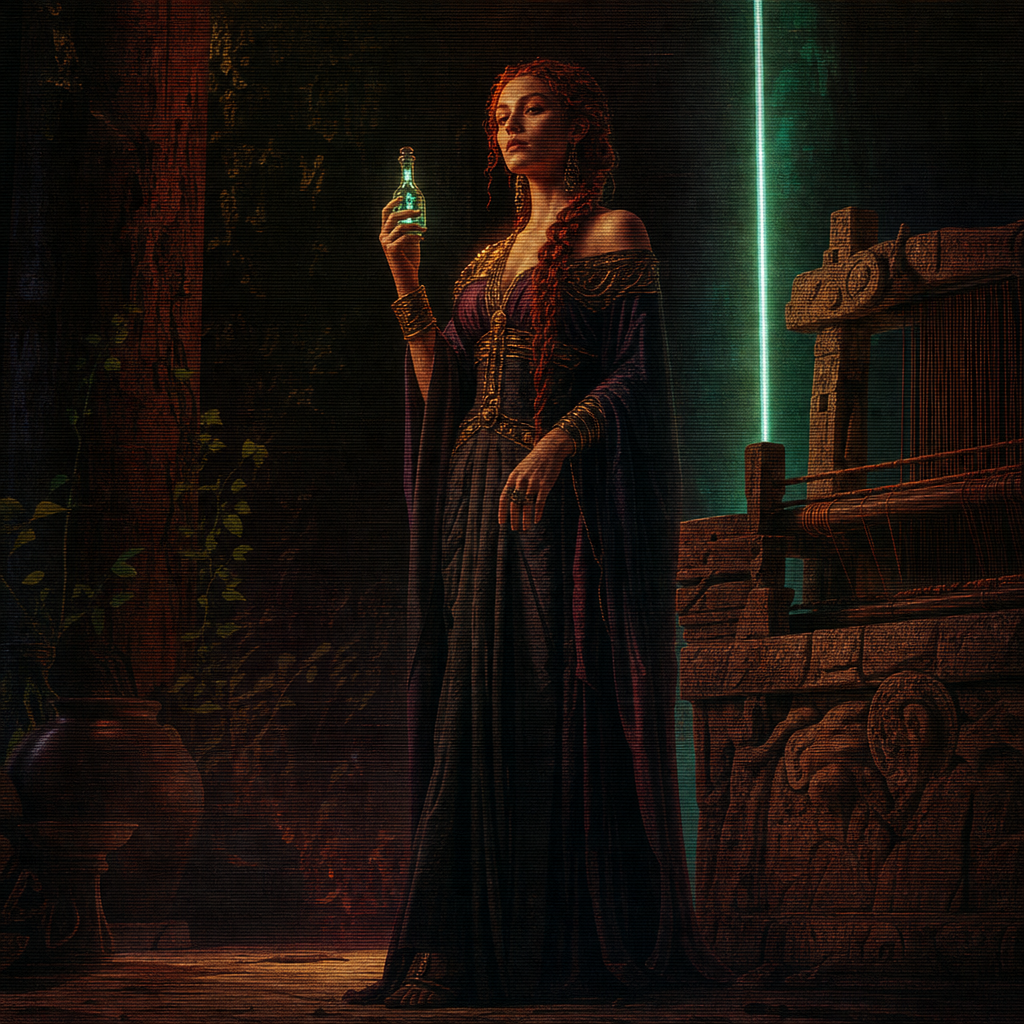
“When we came down to our ship and the sea, we first hauled the ship into the holy water, set mast and sails in the black hull, and took the sheep aboard. We boarded too, grieving, with warm tears streaming down our faces. Behind our dark-prowed ship Circe of the lovely braids, the fearsome goddess with a human voice, sent a following wind to fill the sails—a good companion. We made all the gear ready aboard, then sat while wind and helmsman steered her. All day her sails stood taut as she crossed the sea. The sun went down, and every road grew dark.
Read Ancient Greek Source (Odyssey.11.1–Odyssey.11.12)
“She reached the boundary of deep-flowing Ocean. There the Cimmerian people have their land and city, wrapped in mist and cloud. The shining sun never looks on them with his rays, either when he climbs toward the starry sky or when he turns from heaven back toward earth. Destructive night stretches over those wretched mortals. We beached our ship there and took out the sheep. Then we walked beside the stream of Ocean until we reached the place Circe had described.
Read Ancient Greek Source (Odyssey.11.13–Odyssey.11.22)
“Perimedes and Eurylochus held the victims while I drew my sharp sword from beside my thigh and dug a pit, a cubit each way. Around it I poured a drink offering for all the dead: first milk and honey, then sweet wine, and water third. Over it I scattered white barley meal. I earnestly begged the powerless heads of the dead, promising that once I reached Ithaca I would sacrifice my finest barren cow in my halls and fill a pyre with good things. For Tiresias alone I would separately sacrifice an all-black ram, the finest in our flocks.
Read Ancient Greek Source (Odyssey.11.23–Odyssey.11.33)
“When I had entreated the tribes of the dead with prayers and pleas, I took the sheep and cut their throats over the pit. The dark blood flowed, and up from Erebus gathered the souls of the dead: brides and unmarried young men, old men who had suffered much, tender girls with grief still fresh in their hearts, and many men cut down in war, wounded by bronze-tipped spears, their armor stained with blood. They crowded about the pit from every side with an unearthly clamor, and pale fear seized me. I urged my companions to skin the sheep lying slaughtered by the pitiless bronze, burn them, and pray to the gods—to mighty Hades and dread Persephone. I sat with my sharp sword drawn from beside my thigh and kept the powerless heads of the dead from coming near the blood until I could question Tiresias.
Read Ancient Greek Source (Odyssey.11.34–Odyssey.11.50)
“The first soul to come was my companion Elpenor’s. He had not yet been buried beneath the broad earth. We had left his body in Circe’s house, unmourned and unburied, because another task was pressing us. When I saw him, I wept and pitied him in my heart. I spoke these winged words to him: ‘Elpenor, how did you come beneath this misty darkness? You came here on foot faster than I did in my black ship.’
Read Ancient Greek Source (Odyssey.11.51–Odyssey.11.58)
“He groaned and answered: ‘Son of Laertes, descended from Zeus, resourceful Odysseus, a god’s evil decree and too much wine ruined me. I was lying on Circe’s roof and forgot to go back down by the long ladder. I fell straight off the roof. My neck broke away from its joints, and my soul went down to Hades.
Read Ancient Greek Source (Odyssey.11.59–Odyssey.11.65)
“‘Now I beg you by those we left behind, who are not here—by your wife, by the father who raised you as a little child, and by Telemachus, the only son you left in your halls. I know that when you leave the house of Hades you will bring your well-built ship to the island of Aeaea. When you get there, my lord, remember me. Do not sail away and leave me behind unmourned and unburied, or I may bring the gods’ anger upon you. Burn me with whatever armor I have, and heap a mound for me on the shore of the gray sea, so that people yet to come may hear of an unfortunate man. Do this for me, and plant on my tomb the oar I rowed with when I was alive among my companions.’
Read Ancient Greek Source (Odyssey.11.66–Odyssey.11.78)
“I answered him: ‘Unfortunate man, I will do all these things for you.’ So we sat exchanging sorrowful words, I on one side holding my sword over the blood, my companion’s shade on the other, telling me his story. Then came the soul of my dead mother, Anticleia, daughter of great-hearted Autolycus. I had left her alive when I went away to holy Ilium. I wept at the sight of her and pitied her in my heart. Yet even in my bitter grief I would not let her come near the blood before I had questioned Tiresias.
Read Ancient Greek Source (Odyssey.11.79–Odyssey.11.89)
“Then came the soul of Tiresias of Thebes, holding a golden staff. He recognized me and said: ‘Son of Laertes, descended from Zeus, resourceful Odysseus, why, unhappy man, have you left the sunlight and come here to see the dead and this joyless place? Stand back from the pit and hold your sharp sword away, so I can drink the blood and tell you the truth.’ I drew back and drove my silver-studded sword into its sheath. When he had drunk the dark blood, the excellent seer spoke to me:
Read Ancient Greek Source (Odyssey.11.90–Odyssey.11.99)
“‘You seek a homecoming sweet as honey, glorious Odysseus, but a god will make it hard for you. I do not think you will escape the Earth-shaker’s notice: he has stored anger against you in his heart, enraged because you blinded his dear son. Even so, you might still reach home, though you suffer, if you are willing to restrain yourself and your companions when you first bring your well-built ship to Thrinacia, escaping the violet sea, and find the cattle and sturdy sheep of the Sun, who sees and hears everything. If you leave them unharmed and think about your return, you may still reach Ithaca, though you suffer. But if you harm them, I foretell destruction for your ship and companions. Even if you yourself escape, you will come home late and in misery, having lost all your companions, aboard another man’s ship. You will find trouble in your house: arrogant men eating up your livelihood, courting your godlike wife and offering marriage gifts.
Read Ancient Greek Source (Odyssey.11.100–Odyssey.11.117)
“‘But you will come home and make them pay for their violence. When you have killed the suitors in your halls, by cunning or openly with sharp bronze, set out carrying a well-shaped oar, until you reach men who know nothing of the sea and do not eat food mixed with salt. They know nothing of ships with red-painted bows or the well-shaped oars that are a ship’s wings. I will give you a clear sign you cannot miss. When another traveler meets you and says you are carrying a winnowing shovel on your gleaming shoulder, plant your well-shaped oar in the ground. Make fine sacrifices to lord Poseidon—a ram, a bull, and a boar that mates with sows. Then go home and offer sacred sacrifices of a hundred victims to the immortal gods who hold broad heaven, to every one in order. As for your own death, it will come gently from the sea and take you when you are worn down by prosperous old age. Your people about you will be fortunate. I am telling you the truth.’
Read Ancient Greek Source (Odyssey.11.118–Odyssey.11.137)
“I answered him: ‘Tiresias, the gods themselves must have spun that thread. But tell me this, and tell it plainly. I see the soul of my dead mother here. She sits in silence near the blood and has not ventured to look her own son in the face or speak to him. Tell me, my lord, how can she recognize who I am?’ He answered at once: ‘I will tell you an easy rule to remember. Whichever of the dead you allow to come near the blood will tell you the truth. Whichever you refuse will go back again.’
Read Ancient Greek Source (Odyssey.11.138–Odyssey.11.149)
“With that, the soul of lord Tiresias went back inside the house of Hades, his prophecies delivered. I stayed where I was until my mother came and drank the dark blood. At once she recognized me and spoke these winged words through her grief: ‘My child, how did you come here alive, beneath this misty darkness? It is hard for the living to see these places. Great rivers and dreadful currents lie between us, Ocean first of all, and no one can cross it on foot without a well-built ship. Have you come here now, after wandering a long time from Troy with your ship and companions? Have you still not reached Ithaca or seen your wife in your halls?’
Read Ancient Greek Source (Odyssey.11.150–Odyssey.11.162)
“I answered her: ‘Mother, need brought me down to Hades to consult the soul of Tiresias of Thebes. I have not yet come near Achaean country or set foot on our own land. I have wandered in misery ever since I first followed noble Agamemnon to Ilium, rich in horses, to fight the Trojans. But tell me this, and tell it plainly. What doom of lingering death overcame you? Was it a long illness, or did Artemis the archer come and kill you with her gentle arrows? Tell me about the father and son I left behind. Is my place of honor still theirs, or does another man now hold it, while they say I will never return? Tell me what my wedded wife is thinking and intends to do. Does she stay beside our son and keep everything safe, or has the best of the Achaeans already married her?’
Read Ancient Greek Source (Odyssey.11.163–Odyssey.11.179)
“My honored mother answered at once: ‘She certainly stays in your halls, her heart enduring. Her nights and days are always spent in misery and tears. No one yet holds your fine place of honor. Telemachus manages your estates untroubled and attends the equal feasts that a man who gives judgment ought to take part in: everyone invites him. Your father stays out on the farm and never comes down to town. He has no bedstead for his bed, no cloaks or gleaming coverlets. In winter he sleeps in the house where the enslaved men sleep, in the ashes near the fire, wearing shabby clothes against his skin. When summer and fruitful autumn come, beds of fallen leaves lie on the ground for him all over the slope of his vineyard. There he lies in pain, nursing his great grief, longing for your return, while harsh old age comes upon him.
Read Ancient Greek Source (Odyssey.11.180–Odyssey.11.196)
“‘That is how I too perished and met my fate. The keen-eyed archer goddess did not come into the house and kill me with her gentle arrows. No illness came upon me either, to drain the life from my limbs by a hateful wasting. It was longing for you, glorious Odysseus, for your thoughtfulness and your gentleness, that robbed me of my life, sweet as honey.’
Read Ancient Greek Source (Odyssey.11.197–Odyssey.11.203)
“She spoke, and I pondered how I might clasp the soul of my dead mother. Three times I rushed forward, my heart urging me to hold her; three times she flew out of my hands like a shadow or a dream. The sharp pain in my heart grew greater, and I spoke these winged words to her: ‘Mother, why don’t you wait for me when I long to hold you? Even here in Hades we could put our loving arms around each other and find some comfort in chilling grief. Or is this a phantom that august Persephone has sent to make me groan and grieve still more?’
Read Ancient Greek Source (Odyssey.11.204–Odyssey.11.214)
“My honored mother answered at once: ‘Ah, my child, most unfortunate of all men! Persephone, daughter of Zeus, is not deceiving you. This is the way of mortals when they die. Sinews no longer hold flesh and bones together. The fierce force of blazing fire destroys them once the life has left the white bones, and the soul flutters away and hovers like a dream. But hurry back toward the light. Remember all these things, so that afterward you can tell your wife.’
Read Ancient Greek Source (Odyssey.11.215–Odyssey.11.224)
“While we were exchanging words, the women came, sent by august Persephone: all who had been wives and daughters of the noblest men. They gathered in a crowd around the dark blood. I considered how to question each, and this seemed the best plan: I drew the long-edged sword from beside my sturdy thigh and would not let them all drink the dark blood at once. They came forward one after another, and each told her ancestry. I questioned them all.
Read Ancient Greek Source (Odyssey.11.225–Odyssey.11.234)
“The first I saw was Tyro, daughter of a noble father. She said she was the daughter of excellent Salmoneus and the wife of Cretheus, son of Aeolus. She fell in love with the divine river Enipeus, far the loveliest of all the rivers that flow over the earth, and used to walk beside its beautiful streams. Taking his shape, the god who holds and shakes the earth lay beside her at the mouth of the swirling river. A dark wave rose around them, arching like a mountain, and hid the god and the mortal woman. He loosened her maiden’s girdle and shed sleep upon her.
Read Ancient Greek Source (Odyssey.11.235–Odyssey.11.245)
“When the god had finished the acts of love, he clasped her hand and said: ‘Woman, rejoice in our love. When the year comes round, you will bear splendid children: the beds of immortals are never fruitless. Care for them and raise them. Now go home, and keep silent—do not name me. I am Poseidon, shaker of the earth.’ With that he plunged beneath the surging sea. She conceived and bore Pelias and Neleus, and both became mighty servants of great Zeus. Pelias, rich in sheep, lived in spacious Iolcus; Neleus lived in sandy Pylos. This queen among women bore other sons to Cretheus: Aeson, Pheres, and Amythaon, who fought from chariots.
Read Ancient Greek Source (Odyssey.11.246–Odyssey.11.259)
“Next I saw Antiope, daughter of Asopus. She declared that she too had slept in Zeus’s arms, and she bore two sons, Amphion and Zethus. They first founded the seat of seven-gated Thebes and built its walls. Strong though they were, they could not live in spacious Thebes without walls. Next I saw Alcmene, Amphitryon’s wife, who lay in the arms of great Zeus and bore bold Heracles, lion-hearted. I saw Megara too, daughter of high-spirited Creon, wife of Amphitryon’s son, whose strength never failed.
Read Ancient Greek Source (Odyssey.11.260–Odyssey.11.270)
“I saw Oedipus’s mother, beautiful Epicaste. In ignorance she did a terrible thing: she married her own son. He had killed his father before marrying her, and the gods soon made it known to men. Yet through the gods’ destructive designs he remained in lovely Thebes, ruling the Cadmeans in pain. She went down to mighty Hades, the keeper of the gates, after tying a steep-hanging noose from a high roof beam, overcome by her grief. Behind her she left him countless sufferings, all that a mother’s avenging Furies bring to pass.
Read Ancient Greek Source (Odyssey.11.271–Odyssey.11.280)
“I saw lovely Chloris, whom Neleus once married for her beauty after giving countless marriage gifts. She was the youngest daughter of Amphion, son of Iasus, who once ruled mightily in Minyan Orchomenus. She was queen of Pylos and bore him splendid children: Nestor, Chromius, and proud Periclymenus. Besides them she bore noble Pero, a wonder to mortals. All the neighboring men courted her, but Neleus would give her only to the man who could drive the broad-browed, curved-horned cattle of mighty Iphiclus out of Phylace. They were hard to take. Only an excellent seer promised to drive them off, but a god’s harsh decree held him, together with cruel bonds and the herdsmen of the fields. When the months and days of the circling year were done and the seasons came round, mighty Iphiclus released him, after he had told all the divine oracles. Zeus’s purpose was fulfilled.
Read Ancient Greek Source (Odyssey.11.281–Odyssey.11.297)
“I saw Leda, wife of Tyndareus. To Tyndareus she bore two stout-hearted sons, Castor the horse-tamer and Polydeuces the fine boxer. The life-giving earth holds both of them alive. Even beneath the earth Zeus grants them honor: on alternate days they live and then are dead again. They have received honor equal to the gods’.
Read Ancient Greek Source (Odyssey.11.298–Odyssey.11.304)
“Next I saw Iphimedeia, wife of Aloeus, who said that she had lain with Poseidon. She bore two sons, but their lives were short: godlike Otus and far-famed Ephialtes. They were the tallest men the grain-giving earth ever nurtured and by far the most handsome after famous Orion. At nine years old they were nine cubits across and nine fathoms tall. They threatened to bring the turmoil of furious war against the immortals on Olympus. They meant to set Ossa on Olympus and leafy Pelion on Ossa, so that heaven could be climbed. And they would have done it if they had reached their full youth. But the son of Zeus whom lovely-haired Leto bore killed them both before the down blossomed beneath their temples or covered their chins with a flowering beard.
Read Ancient Greek Source (Odyssey.11.305–Odyssey.11.320)
“I saw Phaedra, Procris, and beautiful Ariadne, daughter of deadly-minded Minos. Theseus once took her from Crete toward the hill of holy Athens, but he had no joy of her: Artemis killed her first on sea-ringed Dia, on the testimony of Dionysus. I saw Maera, Clymene, and hateful Eriphyle, who accepted precious gold in exchange for her own husband. But I could not tell or name all the heroes’ wives and daughters I saw. The immortal night would run out first. It is time to sleep, either here or down by the swift ship among my companions. My passage home is for you and the gods to arrange.”
Read Ancient Greek Source (Odyssey.11.321–Odyssey.11.332)
He finished, and they all fell silent, held spellbound throughout the shadowy hall. White-armed Arete spoke first: “Phaeacians, what do you think of this man’s appearance, his stature, and the balanced mind within him? He is my guest, but each of you shares the honor. Do not hurry to send him away or cut short your gifts to a man in such need. Thanks to the gods, many possessions lie in your halls.”
Read Ancient Greek Source (Odyssey.11.333–Odyssey.11.341)
The old warrior Echeneus, eldest of the Phaeacians, spoke next: “Friends, our thoughtful queen’s words are neither wide of the mark nor short of what we expect. Listen to her. But the word and the deed rest with Alcinous here.” Alcinous answered: “Her words will be fulfilled, as surely as I live to rule the Phaeacians who love their oars. Eager though our guest is to return, let him bear with staying until tomorrow, while I complete all his gifts. Every man will see to his passage home, and I most of all, since authority in this land is mine.”
Read Ancient Greek Source (Odyssey.11.342–Odyssey.11.353)
Resourceful Odysseus answered: “Lord Alcinous, most distinguished of all your people, even if you urged me to stay here a year while you arranged my passage and gave me splendid gifts, I would gladly do so. It would be much better to reach my own country with fuller hands. Every man who saw me home in Ithaca would hold me dearer and treat me with more respect.”
Read Ancient Greek Source (Odyssey.11.354–Odyssey.11.361)
Alcinous answered: “Odysseus, looking at you, we do not think you a deceiver or a cheat, like the many men scattered over the black earth who fashion lies no one could ever trace. Your words have beauty, and your mind is sound. You have told your story with a singer’s skill, the bitter griefs of all the Argives and your own. But tell me this, and tell it plainly. Did you see any of your godlike comrades who went with you to Ilium and met their fate there? This night is very long, immeasurably long. It is not yet time to sleep in the hall. Tell me these wondrous things. I could last until bright dawn if you could bear to tell your sorrows here.”
Read Ancient Greek Source (Odyssey.11.362–Odyssey.11.376)
Resourceful Odysseus answered: “Lord Alcinous, most distinguished of all your people, there is a time for many stories and a time for sleep. But if you still long to listen, I would not begrudge you other, more pitiful tales: the sorrows of my comrades who died afterward, who escaped the Trojans’ grievous battle cries only to perish on their return through an evil woman’s will.
Read Ancient Greek Source (Odyssey.11.377–Odyssey.11.384)
“When holy Persephone had scattered the women’s souls in all directions, the grieving soul of Agamemnon, son of Atreus, came. Around him gathered the others who had died and met their fate with him in Aegisthus’s house. Once he had drunk the dark blood, he recognized me at once. He wept aloud, pouring warm tears, and stretched his hands toward me, eager to reach me. But he no longer had the steadfast strength and vigor his supple limbs had once possessed. I wept at the sight and pitied him in my heart. I spoke these winged words: ‘Most glorious son of Atreus, Agamemnon, lord of men, what doom of lingering death overcame you? Did Poseidon destroy you aboard your ships, stirring the fearful blast of harsh winds? Or did enemies harm you on land as you cut off cattle and fine flocks of sheep, or fought for a town and its women?’
Read Ancient Greek Source (Odyssey.11.385–Odyssey.11.403)
“He answered at once: ‘Son of Laertes, descended from Zeus, resourceful Odysseus, Poseidon did not destroy me aboard my ships by stirring the fearful blast of harsh winds. Nor did enemies harm me on land. Aegisthus prepared my death and doom, invited me to his house, gave me dinner, and killed me with the help of my accursed wife, as someone kills an ox at its manger. That was the pitiful death I died. All around me my companions were slaughtered without mercy, like white-tusked pigs killed in the house of a wealthy, powerful man for a wedding, a shared meal, or a lavish feast. You have already witnessed the slaughter of many men, killed singly or in fierce battle. But this sight would have grieved your heart most of all: how we lay in the hall around the mixing bowl and loaded tables, while the whole floor seethed with blood.
Read Ancient Greek Source (Odyssey.11.404–Odyssey.11.420)
“‘Most pitiful of all was the cry I heard from Priam’s daughter Cassandra. Deceitful Clytemnestra killed her beside me. Dying on the sword, I raised my hands and let them fall to the ground. That shameless woman turned away. She would not even close my eyes with her hands or shut my mouth as I went down to Hades. There is nothing more terrible or shameless than a woman who conceives such deeds in her heart. What a monstrous thing she planned, plotting the murder of her wedded husband! I had thought I would come home a welcome sight to my children and the people enslaved in my house. But with her surpassing knowledge of evil she poured shame on herself and on all women yet to come, even one who does good.’
Read Ancient Greek Source (Odyssey.11.421–Odyssey.11.434)
“I answered him: ‘Ah, how fiercely far-seeing Zeus has hated Atreus’s line from the beginning, through the schemes of women! Many of us died for Helen’s sake, and Clytemnestra plotted your death while you were far away.’
Read Ancient Greek Source (Odyssey.11.435–Odyssey.11.439)
“He answered at once: ‘So never be too gentle even with your own wife. Do not tell her everything you know. Say some of it and keep the rest hidden. Yet murder will not come to you from your wife, Odysseus. Icarius’s daughter, thoughtful Penelope, is very wise and knows how to weigh things well. We left her a young bride when we went away to war, with a baby son at her breast. I suppose he sits now among grown men—fortunate boy! His dear father will see him when he returns, and he will embrace his father, as is right. My wife would not even let me fill my eyes with the sight of my son. She killed me first. I will tell you something else; take it to heart. Bring your ship to your own country secretly, not openly. There is no trusting women anymore.
Read Ancient Greek Source (Odyssey.11.440–Odyssey.11.456)
“‘But tell me this, and tell it plainly. Have you heard whether my son is still alive, perhaps in Orchomenus or sandy Pylos, or with Menelaus in spacious Sparta? Surely noble Orestes is not yet dead upon the earth.’ I answered him: ‘Son of Atreus, why ask me that? I do not know whether he is alive or dead, and it is wrong to speak empty words.’
Read Ancient Greek Source (Odyssey.11.457–Odyssey.11.464)
“So we stood exchanging sorrowful words, grieving, with warm tears streaming down our faces. Then came the souls of Achilles, son of Peleus, and Patroclus, excellent Antilochus, and Ajax, who surpassed the other Danaans in beauty and stature after the excellent son of Peleus. The soul of swift-footed Achilles, Aeacus’s grandson, recognized me and spoke these winged words in sorrow: ‘Son of Laertes, descended from Zeus, resourceful Odysseus, reckless man, what greater deed will you devise next? How did you dare come down to Hades, where the unknowing dead dwell, phantoms of exhausted mortals?’
Read Ancient Greek Source (Odyssey.11.465–Odyssey.11.476)
“I answered him: ‘Achilles, son of Peleus, greatest by far of the Achaeans, I came because I needed Tiresias, hoping he would tell me how to reach rocky Ithaca. I have not yet come near Achaean country or set foot on our own land; trouble is always with me. But no man before you, Achilles, has been more fortunate, nor will be afterward. While you lived, we Argives honored you like the gods; now you have great power among the dead here. So do not grieve at being dead, Achilles.’
Read Ancient Greek Source (Odyssey.11.477–Odyssey.11.486)
“He answered at once: ‘Do not try to soothe me about death, glorious Odysseus. I would rather work the fields for hire under another man, a landless man with little to live on, than rule over all the dead who have perished. But tell me about my noble son. Did he go to war to fight in the front ranks, or not? And tell me anything you have heard of excellent Peleus. Does he still have honor among the many Myrmidons, or do they dishonor him throughout Hellas and Phthia because old age has gripped his hands and feet? I am no longer there beneath the sunlight to defend him, strong as I was when I killed the best fighting men on Troy’s broad plain in defense of the Argives. If I could come to my father’s house like that, even for a little while, I would make my strength and invincible hands a terror to anyone who bullies him and keeps him from his honor.’
Read Ancient Greek Source (Odyssey.11.487–Odyssey.11.503)
“I answered him: ‘I have heard nothing of excellent Peleus. But I will tell you the whole truth about your dear son Neoptolemus, as you ask. I myself brought him from Scyros in my balanced, hollow ship to join the Achaeans in their fine leg armor. Whenever we took counsel around the city of Troy, he was always first to speak, and his words never missed their mark. Only godlike Nestor and I surpassed him. And when we fought the Trojans with bronze on the plain, he never stayed in the crowd or the mass of men. He ran far ahead and yielded to no one in courage. He killed many men in the dreadful fighting. I could not tell or name all the men he killed in defense of the Argives. But what a warrior he brought down with bronze in Eurypylus, son of Telephus! Many of his Ceteian companions were killed around him because of gifts to a woman. He was the handsomest man I ever saw after noble Memnon.
Read Ancient Greek Source (Odyssey.11.504–Odyssey.11.522)
“‘When we Argive chiefs entered the horse Epeius made, I was entrusted with everything—with opening and closing our tightly packed ambush. The other Danaan leaders and rulers wiped away tears, and every man’s limbs trembled beneath him. But I never once saw your son’s handsome skin turn pale or saw him wipe tears from his cheeks. He kept begging me to let him out of the horse. He fingered his sword hilt and his heavy bronze spear, intent on bringing harm to the Trojans. When we had sacked Priam’s high city, he boarded his ship with his share of the spoils and a fine prize of honor, unhurt, neither struck by a sharp bronze missile nor wounded at close quarters, as so often happens in war, where Ares rages indiscriminately.’
Read Ancient Greek Source (Odyssey.11.523–Odyssey.11.537)
“At that, the soul of swift-footed Achilles, Aeacus’s grandson, strode away across the asphodel meadow, rejoicing because I had said his son was outstanding. The other souls of the dead stood grieving, each asking about its sorrows. Only the soul of Ajax, son of Telamon, stood apart, angry over the victory I had won against him in the judgment beside the ships over Achilles’s armor. His honored mother had offered it as a prize; the Trojans’ sons and Pallas Athena judged. If only I had not won a prize like that! For the earth covered so great a man because of those arms: Ajax, who surpassed all the other Danaans in looks and deeds after the excellent son of Peleus.
Read Ancient Greek Source (Odyssey.11.538–Odyssey.11.551)
“I spoke gently to him: ‘Ajax, son of excellent Telamon, were you never going to forget your anger against me, even in death, over those accursed arms? The gods made them a disaster for the Argives. In you we lost such a tower of strength! We Achaeans grieve for you continually, as we do for the death of Achilles, son of Peleus. No one else was to blame but Zeus: he hated the army of Danaan spearmen terribly and laid this fate upon you. Come here, my lord, and listen to what I have to say. Master your anger and your proud spirit.’ He gave me no answer but went away into Erebus among the other souls of the dead. There, angry though he was, he might still have spoken to me, or I to him. But the heart in my breast wanted to see the souls of the other dead.
Read Ancient Greek Source (Odyssey.11.552–Odyssey.11.567)
“There I saw Minos, glorious son of Zeus, sitting with a golden staff and giving judgments among the dead. Around him they sought rulings from their lord, sitting and standing throughout the broad-gated house of Hades. After him I noticed enormous Orion driving together over the asphodel meadow the wild beasts he had killed on the lonely mountains. In his hands he held an all-bronze club, forever unbreakable.
Read Ancient Greek Source (Odyssey.11.568–Odyssey.11.575)
“I saw Tityus, son of glorious Earth, lying on the ground. His body stretched over nine plethra. Two vultures sat on either side and tore his liver, plunging their beaks into his innards, and he did not ward them off with his hands. He had assaulted Leto, Zeus’s glorious consort, as she traveled toward Pytho through Panopeus with its lovely dancing grounds.
Read Ancient Greek Source (Odyssey.11.576–Odyssey.11.581)
“I saw Tantalus too, in terrible torment, standing in a pool that reached his chin. He strained in his thirst but could take no water to drink. Whenever the old man bent down, eager to drink, the water drained away and vanished. Black earth appeared around his feet: a divine power dried it up. Tall trees spilled fruit above his head—pears, pomegranates, apples with shining fruit, sweet figs, and flourishing olives. But whenever the old man reached straight toward them with his hands, a wind tossed them up toward the shadowy clouds.
Read Ancient Greek Source (Odyssey.11.582–Odyssey.11.592)
“I saw Sisyphus too, in terrible torment, holding an enormous stone in both arms. Bracing with hands and feet, he kept pushing it uphill. But whenever he was about to heave it over the crest, its overwhelming weight turned it back, and the shameless stone rolled down again to the plain. Once more he strained and pushed. Sweat ran from his limbs, and dust rose from his head.
Read Ancient Greek Source (Odyssey.11.593–Odyssey.11.600)
“After him I noticed mighty Heracles—his phantom, for he himself delights in feasts among the immortal gods, married to lovely-ankled Hebe, daughter of great Zeus and Hera of the golden sandals. Around him the dead clamored like birds, scattering in terror in every direction. Like black night, he held his bow bare, an arrow on the string, glaring fiercely about him, always looking ready to shoot. A dreadful belt crossed his breast, a golden baldric worked with marvelous scenes: bears, wild boars, glaring lions, clashes, battles, slaughter, and the killing of men. If only the craftsman who put all his skill into that belt had never made it—and may he never make anything else!
Read Ancient Greek Source (Odyssey.11.601–Odyssey.11.614)
“He recognized me as soon as he saw me and spoke these winged words in sorrow: ‘Son of Laertes, descended from Zeus, resourceful Odysseus, unhappy man, are you too dragging out an evil fate like the one I endured beneath the sunlight? I was a son of Zeus, son of Cronus, yet I had misery without end. I was subjected to a man far inferior to me, and he imposed harsh labors on me. Once he sent me here to fetch the dog. He could think of no other labor harder for me than that. I brought the dog up and led him out of Hades; Hermes and bright-eyed Athena guided me.’
Read Ancient Greek Source (Odyssey.11.615–Odyssey.11.626)
“With that he went back inside the house of Hades. I stayed firmly where I was, to see whether any other warrior of the men who died long ago would come. I might have seen still earlier men whom I longed to see, Theseus and Peirithous, glorious children of the gods. But before that, countless tribes of the dead gathered with an unearthly clamor. Pale fear seized me, lest august Persephone send me the Gorgon head of a dreadful monster out of Hades. I went straight to the ship and ordered my companions to board and loose the stern cables. They boarded quickly and sat at the oarlocks. The flowing current carried our ship down the river Ocean, first with our rowing, then with a fair wind.”