Book 10: Aeolus, the Laestrygonians, and Circe
Ὀδύσσεια · Book 10 · Classix Modern English Reading Edition
“We reached the island of Aeolia, where Aeolus, son of Hippotas, lived, dear to the immortal gods. His island floated, surrounded by an unbreakable bronze wall and a sheer cliff rising smooth above it. Twelve children were born to him at home, six daughters and six sons in their prime. He gave his daughters to his sons as wives. They feast continually beside their dear father and honored mother, with countless good things before them. All day the house, fragrant with roasting meat, echoes round the courtyard. At night they sleep beside their respected wives on rugs and carved beds. We came to their city and fine house. For a whole month Aeolus entertained me and asked about everything: Ilium, the Argives’ ships and the Achaeans’ return. I told him everything in due order.
Read Ancient Greek Source (Odyssey.10.1–Odyssey.10.16)
“When I asked him to send me on my way, he did not refuse but prepared my passage. He flayed a nine-year-old ox and gave me its skin as a bag, binding inside it the courses of the howling winds. Cronus’ son had made him keeper of the winds, to calm or rouse whichever he wished. He secured the bag in the hollow ship with a shining silver cord, so not even a breath could escape. For me he set the West Wind blowing, to carry the ships and us. But it was not to bring us home: our own folly ruined us. For nine days we sailed night and day alike. On the tenth our native land came into sight, and we were close enough to see people tending fires. Then sweet sleep fell on me, exhausted. I had handled the ship’s sheet myself throughout, giving it to none of my companions, so we could reach our land sooner.
Read Ancient Greek Source (Odyssey.10.17–Odyssey.10.33)
“My companions talked among themselves. They said I was taking gold and silver home, gifts from great-hearted Aeolus, son of Hippotas. One would look at his neighbor and say: ‘How this man is loved and honored by everyone, whatever city and land he reaches! He brings fine treasures from the plunder of Troy, while we, who have made the same journey, return empty-handed. Now Aeolus has given him these gifts out of friendship. Come, let us quickly see what they are, how much gold and silver is in the bag.’ Their bad counsel prevailed. They untied the bag, and all the winds rushed out. A storm snatched them away from their native land and bore them weeping out to sea. I woke and considered in my heart whether to fall from the ship and die in the sea, or endure in silence and remain among the living. I endured and stayed, covering myself and lying in the ship. The evil storm carried the ships back to Aeolus’ island, while my companions groaned.
Read Ancient Greek Source (Odyssey.10.34–Odyssey.10.55)
“We went ashore, drew water, and my companions quickly took their meal beside the swift ships. After we had eaten and drunk, I took a herald and one companion to Aeolus’ famous house. We found him feasting beside his wife and children. We entered and sat on the threshold beside the doorposts. They were astonished and asked: ‘How have you come back, Odysseus? What evil spirit attacked you? We sent you off with care to reach your native land and home, or wherever you wished.’ I answered with an aching heart: ‘Bad companions and cruel sleep ruined me. Put it right, friends. You have the power.’ So I pleaded gently. They fell silent, but their father answered: ‘Get off my island at once, most disgraced of living men! It is not right for me to care for or escort a man the blessed gods hate. Go! You have come here hated by the gods.’ So he sent me from his house, and I groaned heavily.
Read Ancient Greek Source (Odyssey.10.56–Odyssey.10.76)
“We sailed on with aching hearts. Painful rowing wore the men down through our own folly, since no escort appeared for us now. Six days we sailed night and day alike. On the seventh we reached the steep town of Lamus, Laestrygonian Telepylus. There a shepherd driving his flock in calls to another driving his out, who answers. A man who needed no sleep could earn two wages, one tending cattle, the other pasturing white sheep: the paths of night and day are close together there.
Read Ancient Greek Source (Odyssey.10.77–Odyssey.10.86)
“We came to a fine harbor enclosed on both sides by sheer rock, with jutting headlands facing each other at its narrow entrance. All the others took their curved ships inside and moored close together. No wave ever rose within, large or small; bright calm lay all around. I alone kept my black ship outside, at the edge, tying her cables to a rock. I climbed a rugged lookout and stood there. We could see no work of cattle or men, only smoke rising from the ground. I chose two companions and sent a herald as the third to learn what bread-eating people lived there. They went ashore along a level road where wagons carried wood down from the high mountains to town. Outside the city they met a girl fetching water, the strong daughter of the Laestrygonian Antiphates. She had come down to the lovely-flowing spring Artacia, where the townspeople drew water. They stood beside her and asked who ruled these people as king. At once she pointed out her father’s high-roofed house.
Read Ancient Greek Source (Odyssey.10.87–Odyssey.10.111)
“Inside the famous house they found his wife, huge as a mountain peak, and shuddered at her. She quickly called her husband, renowned Antiphates, from the assembly. He planned a dreadful death for them: at once he seized one companion and made his meal. The other two ran back to the ships. Antiphates raised a cry through the city. Hearing it, mighty Laestrygonians came from all sides in countless numbers, like Giants rather than men. From the cliffs they hurled boulders a man could barely carry. A dreadful din rose among the ships, men dying and vessels breaking together. They speared men like fish and carried them away for a hideous feast. While they destroyed the men inside the deep harbor, I drew my sharp sword from my thigh and cut the cables of the dark-prowed ship. I urged my companions to pull on the oars so we could escape. Fearing death, they churned the sea. My ship gladly escaped the overhanging rocks into open water. All the others were destroyed together there. We sailed on with aching hearts, glad to be alive but bereft of our dear companions.
Read Ancient Greek Source (Odyssey.10.112–Odyssey.10.134)
“We reached Aeaea, home of Circe with the lovely braids, a dread goddess with a human voice, full sister to Aeetes of the deadly mind. Both were born to Helios, who lights mortals, and Perse, daughter of Ocean. Some god guided us quietly into a harbor fit for ships. We went ashore and lay there two days and two nights, eating our hearts out in exhaustion and pain. When Dawn with her lovely braids brought the third day, I took my spear and sharp sword and quickly climbed from the ship to a lookout, hoping to see human work or hear voices. From the rugged height I saw smoke rising through the thick woods and brush from Circe’s house on the broad-pathed earth. Seeing the smoke, I considered going to investigate. But it seemed better first to go back to the swift ship and shore, give my companions a meal and send men to find out.
Read Ancient Greek Source (Odyssey.10.135–Odyssey.10.155)
“As I approached the curved ship, one of the gods took pity on me as I walked alone and sent a great stag with high antlers into my path. It was coming from its woodland pasture down to the river to drink, oppressed by the sun’s heat. As it came out I struck it through the backbone, midway along its back. The bronze spear passed clean through. It fell bleating in the dust, and its spirit flew away. I planted a foot on it, pulled the bronze spear from the wound and left it lying on the ground. Then I gathered shoots and withies, plaited a rope a fathom long, well twisted at both ends, and bound the great beast’s feet. I carried it across my neck toward the black ship, leaning on my spear. I could not carry it on one shoulder while holding it with one hand: it was an enormous animal. I dropped it before the ship and stood beside each companion in turn, rousing him gently:
Read Ancient Greek Source (Odyssey.10.156–Odyssey.10.173)
“‘Friends, however we grieve, we will not go down to Hades’ house before our fated day. While our swift ship has food and drink, let us remember to eat and not waste away with hunger.’ They obeyed at once, threw off their coverings beside the barren sea and marveled at the stag’s great size. When they had looked their fill, they washed their hands and prepared a splendid feast. All day until sunset we sat feasting on abundant meat and sweet wine. When the sun went down and darkness came on, we slept beside the breaking surf.
Read Ancient Greek Source (Odyssey.10.174–Odyssey.10.186)
“When early-born, rosy-fingered Dawn appeared, I called an assembly and spoke to them all: ‘Listen, companions, for all your suffering. Friends, we do not know where darkness or dawn lies, where the sun that lights mortals goes beneath the earth or where it rises. Let us quickly consider whether any plan remains. I do not think there is one. From the rugged lookout I saw that we are on an island, low-lying, ringed by endless sea. In its middle I saw smoke through the thick woods and brush.’ Their hearts broke as they remembered the deeds of Laestrygonian Antiphates and the violence of the great-hearted, man-eating Cyclops. They wept loudly, shedding many tears, but weeping did no good. I counted my companions in fine leg armor into two groups, with a leader for each. I led one, godlike Eurylochus the other. We shook lots in a bronze-fitted helmet, and great-hearted Eurylochus’ lot sprang out. He went with twenty-two companions, weeping, leaving us weeping behind.
Read Ancient Greek Source (Odyssey.10.187–Odyssey.10.209)
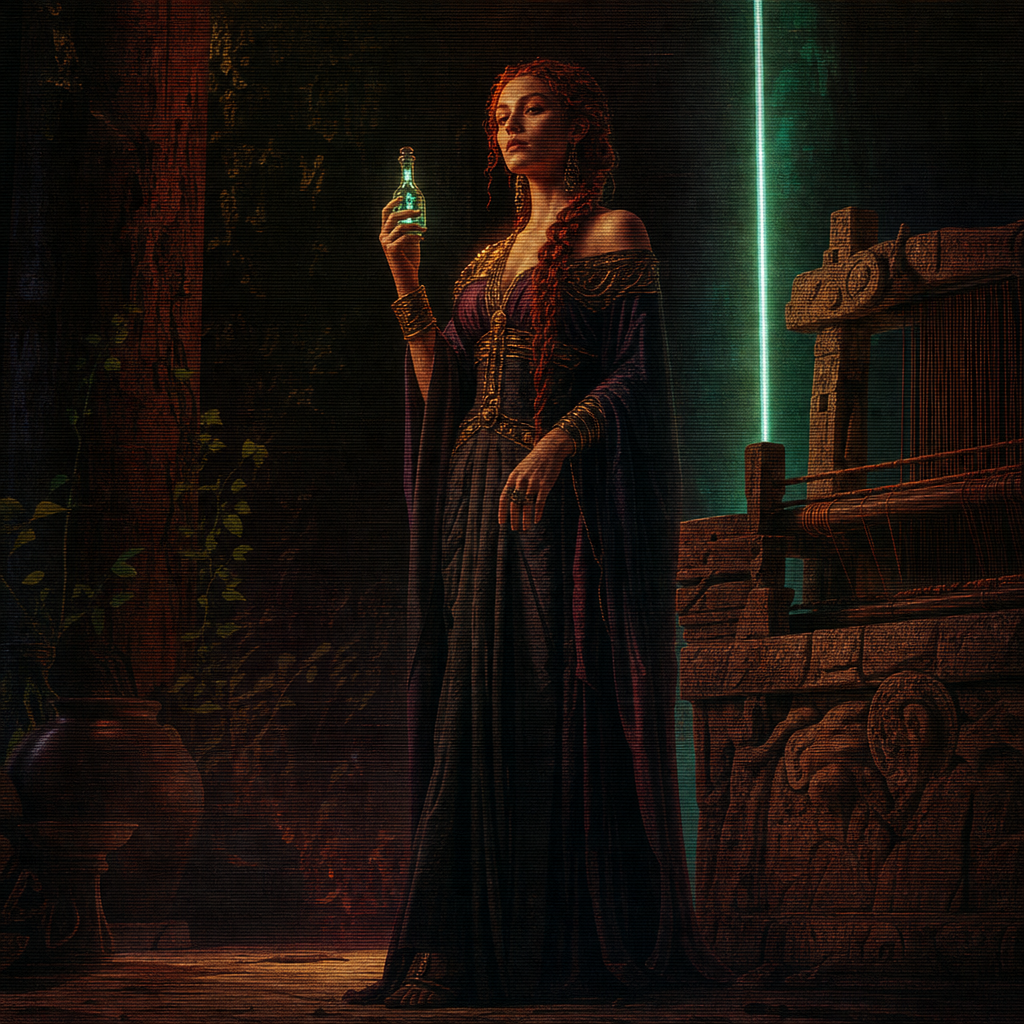
“They found Circe’s house in a clearing among the glens, built of polished stones in a place open to view. Around it were mountain wolves and lions she had bewitched with evil drugs. They did not attack the men but stood up wagging their long tails. As dogs fawn around their master coming from a feast, for he always brings something to please them, so the strong-clawed wolves and lions fawned around them. The men were afraid at the sight of those terrible beasts. They stood at the lovely-haired goddess’ doors and heard Circe singing inside in a beautiful voice as she worked at a great, divine web, such fine, graceful, splendid work as goddesses make.
Read Ancient Greek Source (Odyssey.10.210–Odyssey.10.223)
“Then Polites, a leader of men, began to speak among them—he who was the dearest to me and most trusted of my companions: ‘Friends, someone inside is walking back and forth at a great loom, singing beautifully, and the whole floor echoes around her—some goddess or a woman. Come, let us call out to her at once.’ So he spoke, and they raised their voices and called out. She came out at once, threw open the shining doors, and called them in; and in their ignorance they all followed her together. Only Eurylochus stayed behind, suspecting a trap. She led them inside and seated them on couches and chairs, and mixed cheese, barley meal, and pale honey for them with Pramnian wine; but into the dish she stirred baneful drugs, to make them utterly forget their native land. When she had given it to them and they had drunk it down, at once she struck them with her wand and penned them in the pigsties. They had the heads, voices, bristles, and bodies of pigs, yet their minds remained unchanged, just as before. So they were penned in, weeping, and before them Circe flung acorns, oak mast, and cornel berries to eat—such things as pigs that bed on the ground always eat.
Read Ancient Greek Source (Odyssey.10.224–Odyssey.10.243)
“Eurylochus came back at once to the swift black ship to report the news of our companions and their bitter fate. Yet he could not utter a single word, eager though he was, stricken to the heart with great grief; his eyes filled with tears, and his spirit was set on lamentation. But when we all marveled and questioned him closely, then he recounted the ruin of our other companions: ‘We went through the woods as you ordered, glorious Odysseus, and found a fine house built of polished stones in a clearing among the glens, open to view. Inside, someone was singing clearly at a great loom, a goddess or a woman. The men called out. She came at once, opened the shining doors and invited them in. All followed in their ignorance, but I stayed behind, suspecting a trap. They all vanished together. Not one came out again, though I sat watching a long time.’
Read Ancient Greek Source (Odyssey.10.244–Odyssey.10.260)
“So he spoke, and I slung my silver-studded sword about my shoulders—a great bronze blade—and my bow with it, and I ordered him to lead me back by the same path. But he caught my knees with both hands and begged me, and weeping, he spoke to me in winged words: ‘Do not take me there against my will, prince cherished by Zeus, but leave me here. For I know that you yourself will not return, nor will you bring back any other of your companions. Instead, with these men here let us quickly flee, while we may still escape the evil day.’ So he spoke, and I answered him: ‘Eurylochus, stay right here in this place yourself, eating and drinking beside the hollow black ship. But I will go, for strong necessity compels me.’ With those words, I went up from the ship and the sea.
Read Ancient Greek Source (Odyssey.10.261–Odyssey.10.274)
“But when, as I went through the sacred glens, I was about to reach the great house of Circe of the many drugs, Hermes of the golden wand met me as I approached the hall, in the likeness of a young man with the first down on his lip, when youth has its greatest charm. He clasped my hand and spoke to me directly: ‘Where are you going now, unhappy man, alone through the hills, a stranger to this land? Your companions are shut up there in Circe's house like pigs, kept inside closely barred dens. Have you come here to set them free? I tell you, you will not return yourself, but will stay right there where the others are. Yet come now, I will keep you from harm and save you. Here, take this protective herb and go to Circe’s house. It will keep the evil day from your head. I will tell you all her deadly tricks. She will mix you a potion and put drugs into the food, but she will not be able to bewitch you. The good herb I give you will prevent it. I will tell you everything to do.
Read Ancient Greek Source (Odyssey.10.275–Odyssey.10.292)
“‘When Circe strikes you with her long wand, then draw your sharp sword from beside your thigh and rush at Circe as if eager to kill her. She will cower in fear and invite you to her bed. Do not refuse the goddess's bed then, so that she may free your companions and care for you yourself; but command her to swear the great oath of the blessed gods that she will plot no other evil mischief against you, so that once you are stripped naked, she does not leave you weak and unmanned.’ With these words, the Slayer of Argus gave me the herb, pulling it out of the earth, and he showed me its nature. It was black at the root, with a flower like milk; the gods call it moly. It is hard to dig up for mortal men, though the gods can do all things.
Read Ancient Greek Source (Odyssey.10.293–Odyssey.10.306)
“Then Hermes departed for high Olympus across the wooded island, while I went on to Circe's halls, my heart surging darkly with many thoughts as I walked. I stood at the doors of the lovely-haired goddess; standing there I called out, and the goddess heard my voice. She came out at once, threw open the shining doors, and called me in; and I followed her with a grieving heart. She led me inside and seated me on a silver-studded chair, fine and skillfully crafted, with a footstool beneath for my feet. She mixed a potion for me in a golden cup to drink, and slipped a drug into it, with evil intent in her heart. She gave it to me and I drank, but she did not bewitch me. Then she struck me with her wand and said: ‘Go to the pigsty now, and lie down with the rest of your companions.’
Read Ancient Greek Source (Odyssey.10.307–Odyssey.10.320)
“So she spoke, and drawing my sharp sword from beside my thigh, I rushed at Circe as if eager to kill her. With a loud cry she darted in under my reach, caught my knees, and weeping, she spoke to me in winged words: ‘Who are you, and where do you come from? Where are your city and your parents? Wonder holds me that you drank these drugs and were not enchanted at all. No other man has ever withstood these drugs once he has drunk them and they have passed the barrier of his teeth. You have a mind in your chest that cannot be bewitched. Surely you are Odysseus, the man of many turns, whom the Slayer of Argus, god of the golden wand, always told me would come on his way home from Troy with his swift black ship.
Read Ancient Greek Source (Odyssey.10.321–Odyssey.10.332)
“‘Now put your sword in its sheath and let us go to bed, so that, joined in bed and love, we may trust one another.’ I answered: ‘Circe, how can you ask me to be gentle with you? You have made my companions pigs in your house, and now you keep me here and cunningly ask me to go to your room and your bed, to make me weak and unmanned once I am naked. I will not go to your bed unless you can bring yourself to swear a solemn oath that you will plan no further harm against me.’ She swore at once as I required. When she had sworn and completed the oath, I went to Circe’s beautiful bed.
Read Ancient Greek Source (Odyssey.10.333–Odyssey.10.347)
“Meanwhile four attendants were busy in the hall, the women who served in her house. They are born from springs and groves and sacred rivers flowing to the sea. One spread fine purple coverings on the chairs, with linen underneath. Another set silver tables before the chairs, with golden baskets upon them. The third mixed sweet, heart-cheering wine in a silver bowl and set out golden cups. The fourth brought water and lit a great fire beneath a large three-legged cauldron. The water grew hot. When it boiled in the gleaming bronze, she seated me in a tub and bathed me from the great cauldron, mixing the water to a comfortable warmth and pouring it over my head and shoulders until she took the heart-wearing fatigue from my limbs. When she had washed me, anointed me richly with oil and dressed me in a fine cloak and tunic, she led me in and seated me in a beautiful, elaborate silver-studded chair, with a footstool beneath my feet. An attendant brought handwashing water in a lovely golden jug and poured it over a silver basin for me to wash, then drew a polished table beside me. The respected housekeeper brought bread and many dishes, giving freely from the stores, and urged me to eat. But I had no heart for it. I sat distracted, my heart foreseeing trouble.
Read Ancient Greek Source (Odyssey.10.348–Odyssey.10.374)
“When Circe saw me sitting without reaching for the food, held by deep grief, she stood close and spoke these winged words: ‘Odysseus, why sit there as though dumb, eating your heart out, touching neither food nor drink? Do you suspect another trick? You need not fear: I have sworn you a strong oath.’ I answered: ‘Circe, what decent man could bear to taste food and drink before freeing his companions and seeing them with his own eyes? If you really wish me to eat and drink, release them, so I can see my loyal companions.’
Read Ancient Greek Source (Odyssey.10.375–Odyssey.10.387)
“So I spoke, and Circe walked out through the hall, holding her wand in her hand, and opened the doors of the pigsty and drove the men out. They looked like nine-year-old fattened hogs. Then they stood facing her, and going among them she smeared each one with another drug. From their limbs the bristles fell away, the ones that had grown before from the ruinous drug that Lady Circe had given them. And they became men again, younger than they were before, and far handsomer and taller to look upon. They recognized me, and each man clung to my hands. A yearning weeping welled up in them all, and all around, the house echoed terribly, and even the goddess herself felt pity. Standing near me, the radiant goddess spoke: ‘Son of Laertes, born of Zeus, resourceful Odysseus, go now to your swift ship and the shore of the sea. First of all, haul the ship up onto the land, and stow your goods and all the tackle in the caves; then come back yourself and bring your trusty companions.’
Read Ancient Greek Source (Odyssey.10.388–Odyssey.10.405)
“So she spoke, and my proud heart was persuaded, and I set out for the swift ship and the shore of the sea. Then beside the swift ship I found my trusty companions lamenting pitifully, shedding warm, streaming tears. And just as calves in the yard, around the cows of the herd returning to the barnyard after grazing their fill of pasture, all leap out together to meet them, and the pens can no longer hold them back, as with constant lowing they run around their mothers—so those men, when they saw me with their own eyes, poured around me in tears, and to their hearts it seemed just as if they had reached their fatherland and the very town of rugged Ithaca, where they were born and raised. And weeping, they spoke to me in winged words: ‘At your return, ruler fostered by Zeus, we rejoice as much as if we had come home to Ithaca, our native land; but come, tell us of the ruin of our other companions.’
Read Ancient Greek Source (Odyssey.10.406–Odyssey.10.421)
“So they spoke, and I answered them with gentle words: ‘First of all, let us haul the ship up onto the land, and stow our goods and all the tackle in the caves; and hurry yourselves, all of you, to follow along with me, so that you may see our companions in the sacred halls of Circe, drinking and eating, for they have an unfailing supply.’ So I spoke, and they quickly obeyed my words. Only Eurylochus tried to hold back all my companions, and lifting his voice, he spoke to them in winged words:
Read Ancient Greek Source (Odyssey.10.422–Odyssey.10.430)
“‘Wretched men, where are we going? Why do you long for such misery, going down to Circe’s house? She will turn us all into pigs or wolves or lions, and force us to guard her great house. Remember what the Cyclops did when our companions entered his courtyard and bold Odysseus went with them. Those men too died through this man’s reckless folly!’
Read Ancient Greek Source (Odyssey.10.431–Odyssey.10.437)
“I considered drawing my long-edged sword from my strong thigh and striking his head off onto the ground, though he was a very close kinsman by marriage. But my companions held me back with gentle words from every side: ‘Zeus-born, if you wish, let us leave him here beside the ship to guard her. Lead the rest of us to Circe’s sacred house.’
Read Ancient Greek Source (Odyssey.10.438–Odyssey.10.445)
“They spoke and went up from the ship and sea. Eurylochus did not stay beside the hollow ship; he followed, afraid of my terrible rebuke. Meanwhile Circe had carefully bathed the other companions in her house, anointed them richly with oil and dressed them in thick cloaks and tunics. We found them all feasting well in the hall. When they saw one another face to face and recognized each other, they wept and lamented, and the house rang with groans. The shining goddess stood beside me and said: ‘Stop this flood of tears. I know myself all you have suffered on the sea that teems with fish, and all the harm hostile men have done you on land. Eat food and drink wine until you recover the spirit you had when you first left your native land of rugged Ithaca. Now you are worn down and dispirited, always remembering your painful wanderings. There is no joy in your hearts: you have suffered so much.’ Our hearts were persuaded. For a full year we sat there day after day, feasting on abundant meat and sweet wine.
Read Ancient Greek Source (Odyssey.10.446–Odyssey.10.468)
“When the year was complete, the seasons had turned, the months waned and the long days passed, my loyal companions called me aside: ‘Man, remember your native land now, if it is decreed that you should live to reach your high-roofed house and native soil.’ My heart was persuaded. All that day until sunset we sat feasting on abundant meat and sweet wine. When the sun went down and darkness came on, they slept in the shadowy halls. I went to Circe’s beautiful bed, clasped her knees and begged her. The goddess heard me as I spoke these winged words: ‘Circe, fulfill the promise you made to send me home. My heart is eager now, and my companions are eager too. They wear my heart away with their lamenting around me whenever you are absent.’ She answered at once: ‘Zeus-born son of Laertes, resourceful Odysseus, do not stay unwilling in my house any longer. But first you must make another journey, to the house of Hades and dread Persephone, to consult the soul of blind Theban Tiresias, the seer whose mind remains steadfast. Even after death Persephone has given him understanding. He alone keeps his wits; the others flit about as shadows.’
Read Ancient Greek Source (Odyssey.10.469–Odyssey.10.495)
“My heart broke. I sat on the bed and wept, with no wish to live or see the sun’s light. When I had had my fill of weeping and rolling on the bed, I answered: ‘Circe, who will guide me on this journey? No one has ever reached Hades in a black ship.’ The shining goddess answered at once: ‘Zeus-born son of Laertes, resourceful Odysseus, do not trouble yourself about a guide aboard your ship. Raise the mast, spread the white sails and sit. The North Wind’s breath will carry her.
Read Ancient Greek Source (Odyssey.10.496–Odyssey.10.507)
“‘When your ship has crossed Ocean, you will find a fertile shore and Persephone’s groves, with tall poplars and willows that shed their fruit. Beach your ship there by deep-swirling Ocean, and go yourself to Hades’ dank house. There Pyriphlegethon and Cocytus, a branch of Styx’s waters, flow into Acheron. There is a rock where the two roaring rivers meet. Come close to it, hero, as I tell you, and dig a pit a cubit each way. Around it pour an offering for all the dead: first honey mixed with milk, then sweet wine, and third water. Sprinkle white barley meal over it. Pray earnestly to the powerless heads of the dead, promising that when you reach Ithaca you will sacrifice the best barren cow in your halls and fill a pyre with fine gifts. For Tiresias alone, separately, promise to sacrifice an all-black ram, the finest in your flock.
Read Ancient Greek Source (Odyssey.10.508–Odyssey.10.525)
“‘When you have begged the glorious hosts of the dead in prayer, sacrifice a ram and a black ewe, turning them toward Erebus, while you turn away toward the river streams. Many souls of the dead will come. Then urge your companions to flay and burn the sheep lying there slaughtered with pitiless bronze, and pray to the gods, mighty Hades and dread Persephone. Draw your sharp sword from your thigh and sit, letting none of the powerless dead approach the blood until you have questioned Tiresias. The seer will soon come to you, leader of men, and tell you the route and the distance of your journey, and how to return across the sea that teems with fish.’
Read Ancient Greek Source (Odyssey.10.526–Odyssey.10.540)
“As she spoke, Dawn on her golden throne arrived. Circe dressed me in cloak and tunic. She put on a long silver-shining robe herself, fine and graceful, with a beautiful golden belt around her waist and a veil on her head. I went through the house, standing beside each companion in turn and rousing him gently: ‘Stop sleeping and taking your ease in sweet sleep. Let us go. Lady Circe has told me the way.’ Their hearts were persuaded.
Read Ancient Greek Source (Odyssey.10.541–Odyssey.10.550)
“Yet I did not lead my companions away unharmed even from there. There was one, Elpenor, the youngest, neither very brave in battle nor sound in judgment. Drunk with wine and wanting cool air, he had lain apart from his companions on the roof of Circe’s sacred house. Hearing the noise and bustle of the men stirring, he sprang up suddenly and forgot to go back to the long ladder to climb down. Instead he fell straight from the roof. His neck broke at the joints, and his soul went down to Hades.
Read Ancient Greek Source (Odyssey.10.551–Odyssey.10.560)
“As the men came, I spoke: ‘You think you are going home to your native land. Circe has marked out another journey for us, to the house of Hades and dread Persephone, to consult the soul of Theban Tiresias.’ Their hearts broke. They sat down where they were, weeping and tearing their hair, but weeping did no good. As we went to the swift ship and seashore, grieving and shedding many tears, Circe went ahead and tied a ram and a black ewe beside the black ship, easily passing us unseen. Who could see a god going this way or that against the god’s will?”