Book 8: Games and Song Among the Phaeacians
Ὀδύσσεια · Book 8 · Classix Modern English Reading Edition
When early-born, rosy-fingered Dawn appeared, Alcinous rose in his sacred might, and Zeus-born Odysseus, sacker of cities, rose too. Alcinous led him to the Phaeacians’ assembly place beside the ships. They sat close together on polished stones. Meanwhile Pallas Athena went through the city in the likeness of wise Alcinous’ herald, planning great-hearted Odysseus’ homecoming. She stood beside each man and said: “Come this way, leaders and counselors of the Phaeacians, go to the assembly, so that you may learn about the stranger who has newly come to the house of wise Alcinous after wandering over the sea, in build like the immortals.”
Read Ancient Greek Source (Odyssey.8.1–Odyssey.8.14)
So she spoke, and stirred the spirit and heart of each man. Quickly the assembly grounds and seats were filled with people gathering together; and many marveled as they looked upon the wise son of Laertes. Upon him Athena poured a divine grace over his head and shoulders, and made him taller and broader to behold, so that to all the Phaeacians he might become dear, awesome and worthy of respect, and might carry through the contests—the many trials by which the Phaeacians tested Odysseus. Now when they had gathered and were assembled together, Alcinous addressed them and spoke among the company:
Read Ancient Greek Source (Odyssey.8.15–Odyssey.8.25)
“Listen, Phaeacian leaders and rulers, while I say what my heart urges. This stranger—I do not know who he is—has wandered to my house from the people of the east or the west. He asks for an escort and begs that it be assured. Let us hasten his passage as we have before. No one who comes to my house waits here grieving long for an escort. Launch a black ship on her maiden voyage into the bright sea, and choose fifty-two young men, the best in our land. Lash the oars securely at their places, then come ashore and hasten to prepare a feast at my house. I will provide generously for everyone. Those are my orders for the young men. The other kings who bear the scepter must come to my fine house, so we can entertain the stranger. Let no one refuse. Summon the inspired singer Demodocus. A god has given him the gift of delighting us with song, wherever his heart moves him to sing.”
Read Ancient Greek Source (Odyssey.8.26–Odyssey.8.45)
So he spoke and led the way, and with him followed the scepter-bearers, while a herald went after the divine singer. And fifty-two chosen young men went, as he had commanded, to the shore of the barren sea. When they came down to the ship and the sea, they dragged the black ship down into the deep water, set the mast and sails inside the black ship, fitted the oars into their leather loops, everything in due order, and spread the white sails. High afloat in the anchorage they moored her, and afterward went their way to the great house of wise Alcinous.
Read Ancient Greek Source (Odyssey.8.46–Odyssey.8.56)
The porticoes and courtyards and rooms were filled with men gathering together; there were many of them, young and old. For them Alcinous slaughtered twelve sheep, eight white-tusked hogs, and two shambling oxen; these they flayed and dressed, and prepared a lovely feast. Then the herald came near, leading the well-loved singer whom the Muse loved above all others, though she gave him both good and evil: she robbed him of his eyes, yet gave him sweet song. For him Pontonous set a silver-studded chair in the midst of the feasters, leaning it against a tall pillar. From a peg he hung the clear-toned lyre right above his head, and showed him how to find it with his hands; and beside him the herald set a basket and a fine table, and beside him a cup of wine, to drink whenever his spirit bade him.
Read Ancient Greek Source (Odyssey.8.57–Odyssey.8.70)
They reached out their hands to the good food spread ready before them. When they had put aside their desire for food and drink, the Muse stirred the singer to sing the famous deeds of men, from a lay whose fame then reached wide heaven: the quarrel of Odysseus and Achilles, son of Peleus, how once they strove at a rich feast of the gods with fierce words, and Agamemnon, lord of men, rejoiced in his mind that the best of the Achaeans were quarreling. For so Phoebus Apollo had spoken to him in prophecy in sacred Pytho, when he stepped across the stone threshold to consult the oracle; for then the beginning of ruin was rolling down upon Trojans and Danaans alike, through the designs of great Zeus.
Read Ancient Greek Source (Odyssey.8.71–Odyssey.8.82)
The famous singer sang this, and Odysseus took his great purple cloak in his strong hands and pulled it down over his head to hide his handsome face. He was ashamed to shed tears before the Phaeacians. Whenever the inspired singer paused, he wiped his tears away, uncovered his head and took a two-handled cup to pour an offering to the gods. When the Phaeacian nobles urged the singer to begin again, delighting in his words, Odysseus covered his head again and wept. None of the others noticed his tears. Alcinous alone saw and understood, sitting close to him and hearing his deep groans. At once he spoke among the oar-loving Phaeacians:
Read Ancient Greek Source (Odyssey.8.83–Odyssey.8.96)
“Hear me, leaders and counselors of the Phaeacians. By now we have satisfied our hearts with the shared feast and with the lyre, which is the companion of a rich banquet. Now let us go outside and make trial of contests of every kind, so that the stranger may tell his friends, when he returns home, how far we surpass other men in boxing and wrestling, in jumping and in running.”
Read Ancient Greek Source (Odyssey.8.97–Odyssey.8.103)
Alcinous led the way, and the others followed. The herald hung the clear-toned lyre from its peg, took Demodocus by the hand and led him out of the hall. He guided him along the route the Phaeacian nobles had taken to watch the contests. They went to the assembly place, followed by a vast crowd, thousands upon thousands. Many fine young men rose to compete.
Read Ancient Greek Source (Odyssey.8.104–Odyssey.8.110)
Up rose Acroneos, Ocyalus, and Elatreus, Nauteus, Prymneus, Anchialus, and Eretmeus, Ponteus and Proreus, Thoon and Anabesineos, and Amphialus, son of Polyneus, the son of Tecton. Up rose Euryalus too, the equal of man-slaying Ares—Naubolus's son, who was finest in face and build of all the Phaeacians after noble Laodamas. And up stood the three sons of noble Alcinous: Laodamas, Halius, and godlike Clytoneus.
Read Ancient Greek Source (Odyssey.8.111–Odyssey.8.119)
First of all, they tested their speed on foot. Their course was stretched out from the starting post, and all together they flew swiftly forward, raising dust across the plain. In running, noble Clytoneus was far the best of them: by the length of a furrow that a pair of mules plows in fallow ground, so far ahead he shot before reaching the crowd, while the others were left behind. Next they tested each other in painful wrestling, and in this Euryalus defeated all the best men. In the jump, Amphialus outdid them all; with the discus, Elatreus was far the strongest of all; and in boxing, it was Laodamas, the brave son of Alcinous.
Read Ancient Greek Source (Odyssey.8.120–Odyssey.8.130)
Then, when all of them had delighted their hearts with the contests, Laodamas, the son of Alcinous, spoke among them: “Come, friends, let us ask the stranger if he knows and has trained in any sport. His build is good: his thighs, calves, arms, strong neck and great strength. He is not past his prime, but many hardships have battered him. Nothing crushes a man like the sea, however strong he is.”
Read Ancient Greek Source (Odyssey.8.131–Odyssey.8.139)
Euryalus answered him and said: “Laodamas, what you have said is very fitting. Go now yourself, challenge him, and speak the word to him.” When the brave son of Alcinous heard this, he stepped into the middle and spoke to Odysseus:
Read Ancient Greek Source (Odyssey.8.140–Odyssey.8.144)
“Come, honored stranger, try the contests yourself, if you have learned any. You look as though you know the games. No man wins greater glory in his lifetime than by what he does with his own hands and feet. Come, take part and scatter the grief from your heart. Your journey will not be long delayed: the ship is launched and the crew ready.”
Read Ancient Greek Source (Odyssey.8.145–Odyssey.8.151)
Resourceful Odysseus answered him: “Laodamas, why do you all taunt me with this challenge? Sorrows are much closer to my mind than games—I who before now have suffered so much and endured so much toil, and now sit here in your assembly longing for my return home, pleading with your king and all your people.”
Read Ancient Greek Source (Odyssey.8.152–Odyssey.8.157)
Then Euryalus answered him and insulted him to his face: “No indeed, stranger, I do not take you for a man skilled in contests, the many kinds that exist among men, but for one who plies back and forth in a many-benched ship, a captain of sailors who are merchant traders, keeping track of the cargo and watching closely over the freight and his greedy profits. You do not look like an athlete.”
Read Ancient Greek Source (Odyssey.8.158–Odyssey.8.164)
Looking at him darkly, resourceful Odysseus said: “Stranger, you have spoken badly. You sound like an insolent man. The gods do not give every man all their gracious gifts: physique, intelligence and eloquence. One man may look unimpressive, but a god crowns his words with beauty. People look on him with delight as he speaks confidently and with winning modesty. He stands out in the assembly, and as he walks through town people look upon him like a god. Another may look like an immortal, yet no grace surrounds his words. So it is with you: your appearance is splendid, and even a god would change nothing about it, but your mind is empty. Your rude words have stirred my heart. I am no stranger to contests, as you claim. I think I ranked among the first when I could trust my youth and my hands. Now pain and misery hold me; I have endured much, passing through men’s wars and grievous waves. Even so, after all my hardships I will compete. Your words bit my heart and provoked me.”
Read Ancient Greek Source (Odyssey.8.165–Odyssey.8.185)
He spoke, and springing up with his cloak still on, he seized a discus larger and thicker, heavier by no small measure than the one the Phaeacians had been hurling among themselves. Whirling it around, he flung it from his sturdy hand. The stone hummed through the air, and down toward the ground crouched the Phaeacians of the long oars, men famed for their ships, beneath the hurtling of the stone. It flew past all the marks, speeding lightly from his hand. And Athena set down the marker, having taken the form of a man, and she spoke aloud and called out: “Even a blind man, stranger, could pick out your mark by feeling with his hands, since it is not mingled with the crowd of others, but lies far in front. Take heart in this contest at least: none of the Phaeacians will reach this cast, much less throw beyond it.”
Read Ancient Greek Source (Odyssey.8.186–Odyssey.8.198)
So she spoke, and much-enduring, godlike Odysseus was glad, rejoicing because he saw a kindly friend in the assembly. Then in a lighter spirit he spoke out to the Phaeacians:
Read Ancient Greek Source (Odyssey.8.199–Odyssey.8.201)
“Reach that mark, young men! I think I can soon throw another just as far or farther. For any other contest, let whoever has the heart come and try me. You have provoked me enough. Boxing, wrestling or running—I refuse none of it against any Phaeacian except Laodamas himself. He is my host. Who would compete against a man who welcomes him? A man who challenges his host at games in a foreign land is senseless and worthless, ruining all his own prospects. I refuse and slight none of the others. I am ready to meet him and find out his measure. I am no weakling in any contest men practice. I know how to handle a polished bow. I would hit a man first in a throng of enemies, even with many companions close beside me shooting at them.
Read Ancient Greek Source (Odyssey.8.202–Odyssey.8.218)
“Only Philoctetes excelled me with the bow in the land of the Trojans, whenever we Achaeans shot our bows. Yet of all the rest, I declare that I am far the best of all mortals now on earth who eat bread. With the men of earlier days I will not seek to contend—not with Heracles, nor with Eurytus of Oechalia, who used to contend even with the deathless gods in archery. That is why great Eurytus died so soon, and never reached old age in his halls; for Apollo grew angry and killed him, because he challenged the god to shoot the bow.
Read Ancient Greek Source (Odyssey.8.219–Odyssey.8.228)
“With a spear I can cast farther than any other man can shoot an arrow. Only in the footrace am I afraid that someone may outrun me among the Phaeacians, for I was beaten down most cruelly amid the many waves, since I had no steady care aboard a ship; and so the strength of my limbs is undone.”
Read Ancient Greek Source (Odyssey.8.229–Odyssey.8.233)
So he spoke, and they all fell utterly silent. Alcinous alone answered and spoke to him: “Stranger, your words are not ungracious. You want to show the prowess you possess, angered because this man stood beside you at the games and insulted you. No one who knew how to speak sensibly would disparage your prowess. Listen now, so that when you feast in your halls beside your wife and children you can tell other heroes of our skill, remembering the pursuits Zeus has given us from our fathers’ days. We are not perfect boxers or wrestlers, but we run swiftly and excel at sea. We love feasting, the lyre and dancing, fresh clothes, warm baths and beds. Come, our finest Phaeacian dancers, perform! Let the stranger tell his friends when he returns home how greatly we excel in seamanship, running, dancing and song. Someone fetch Demodocus’ clear-toned lyre at once. It is in our house.”
Read Ancient Greek Source (Odyssey.8.234–Odyssey.8.255)
So spoke godlike Alcinous, and a herald rose to bring the hollow lyre from the king's palace. Then stewards, nine in all, chosen men, stood up—public officials who arranged everything well at the games—and they leveled the dancing floor and cleared a wide, fair ring. The herald came near, bearing the clear-toned lyre for Demodocus, who then moved into the center; and around him youths in their first bloom took their places, skilled in the dance, and struck the sacred floor with their feet. And Odysseus gazed at the flashing of their feet, and marveled in his heart.
Read Ancient Greek Source (Odyssey.8.256–Odyssey.8.265)
Then the bard struck the chords and began to sing beautifully of the love of Ares and finely crowned Aphrodite: how they first lay together in the house of Hephaestus in secret; and Ares gave her many gifts, and shamed the marriage bed of Lord Hephaestus. Straightway a messenger came to him—Helios, who had noticed them mingling in love. When Hephaestus heard that heart-wrenching tale, he went to his smithy, brooding on evil in the depths of his mind, set the great anvil on its block, and hammered out bonds unbreakable and impossible to loosen, so that they would stay fast right there. When he had forged the trap in his fury at Ares, he went to the bedroom where his own bed stood, and poured the chains around the bedposts in a circle on every side; and many more were slung down from the roofbeam overhead, fine as spiderwebs, so that no one could even see them, not even one of the blessed gods, so cunningly were they made.
Read Ancient Greek Source (Odyssey.8.266–Odyssey.8.281)
When he had spread his trap around the bed, he pretended to set off for the well-built town of Lemnos, the land dearest to him of all. Ares of the golden reins was no blind watcher. Seeing the famed craftsman Hephaestus leave, he went to his house, eager for the love of finely crowned Cytherea. Aphrodite had just returned from her father, mighty Cronus’ son, and sat down. Ares went inside, took her hand and said: “Come, my love, let us go to bed and take our pleasure lying together; for Hephaestus is no longer here in the land, but by now, I think, is gone to Lemnos, among the rough-voiced Sintians.” So he spoke, and to her it seemed welcome to lie with him.
Read Ancient Greek Source (Odyssey.8.282–Odyssey.8.295)
They went to bed and lay together. Ingenious Hephaestus’ cunning bonds closed around them, so they could not move or lift a limb. Then they knew there was no escape. The famous lame god came back before he had reached Lemnos: Helios had been watching for him and told him the news. Hephaestus went home with grief in his heart, stood in the doorway, seized by savage anger, and shouted terribly to all the gods:
Read Ancient Greek Source (Odyssey.8.296–Odyssey.8.305)
“Father Zeus, and all you other blessed, everlasting gods, come here, to see a laughable and intolerable sight—how Zeus's daughter Aphrodite, because I am lame, dishonors me always, and loves ruinous Ares, because he is handsome and sound of foot, whereas I was born weak. Yet no one else is to blame for this but my two parents—I wish they had never begotten me!
Read Ancient Greek Source (Odyssey.8.306–Odyssey.8.312)
“Look at them lying in love in my own bed, while I watch in anguish. Fond as they are of each other, I do not think they will want to lie like this even a moment longer. Soon neither will want to sleep here, but my trap and bonds will hold them until her father gives back every bride-gift I placed in his hands for his dog-eyed daughter. His daughter is beautiful, but cannot master herself.”
Read Ancient Greek Source (Odyssey.8.313–Odyssey.8.320)
So he spoke, and the gods gathered at his bronze-floored house. Earth-encircling Poseidon came; the luck-bringing Hermes came; and Lord Apollo came, who strikes from afar. Out of modesty, the goddesses stayed at home, each in her own house. The gods, givers of good things, stood in the doorway, and unquenchable laughter broke out among the blessed gods as they looked upon the craft of ingenious Hephaestus. And looking at his neighbor, one would say to another: “Wrongdoing does not prosper. The slow catches the swift: Hephaestus, slow and lame, has caught Ares, swiftest of the gods on Olympus, by his craft. Now Ares owes the adulterer’s fine.”
Read Ancient Greek Source (Odyssey.8.321–Odyssey.8.332)
So they spoke such things to one another. And Lord Apollo, the son of Zeus, spoke to Hermes: “Hermes, son of Zeus, guide and giver of good things, would you be willing, pinned fast in strong chains, to sleep in bed beside golden Aphrodite?” Then the guide, the slayer of Argus, answered him: “I wish this could happen, Lord Apollo, archer from afar! Let three times as many endless chains bind me all around, and let all you gods and all the goddesses look on, and still I would sleep beside golden Aphrodite.”
Read Ancient Greek Source (Odyssey.8.333–Odyssey.8.342)
So he spoke, and laughter rose among the immortal gods. Yet laughter did not take hold of Poseidon; instead he kept begging Hephaestus, the famed craftsman, to set Ares free. And raising his voice, he spoke winged words to him: “Release him. I myself promise you that, just as you demand, he will pay all that is due among the immortal gods.” Then the renowned lame god spoke to him in turn: “Poseidon, holder of the earth, do not ask this of me. Worthless to accept are pledges made for the worthless. How could I bind you among the immortal gods if Ares were to slip away, escaping both his debt and his chains?” Then Poseidon, shaker of the earth, spoke to him again: “Hephaestus, even if Ares should slip out of his debt and run off in flight, I myself will pay you this fine.” Then the renowned lame god answered him: “It is not possible, nor is it right, to refuse your word.”
Read Ancient Greek Source (Odyssey.8.343–Odyssey.8.358)
Hephaestus in his might loosened the bonds. Freed from the strong net, the two sprang up. Ares went to Thrace; laughter-loving Aphrodite went to Paphos in Cyprus, where she has her sacred precinct and fragrant altar. There the Graces bathed her, anointed her with the immortal oil that gleams on the everlasting gods, and dressed her in lovely clothes, a wonder to see. This was the song the renowned bard sang; and Odysseus delighted in his heart as he listened, and so did the others, the Phaeacians of the long oars, men famed for their ships.
Read Ancient Greek Source (Odyssey.8.359–Odyssey.8.369)
Then Alcinous ordered Halius and Laodamas to dance alone, since no one could rival them. When they had taken in their hands a handsome ball, dyed dark purple, which skillful Polybus had made for them, one of them would hurl it toward the shadowy clouds, bending far backward, while the other leaped high off the ground and caught it with ease before his feet touched the earth again. Then, after they had tested their skill throwing the ball straight up, they danced upon the fruitful earth, trading places in rapid turns, while the other young men beat time standing around the ring, and a great stamping din rose up. Then noble Odysseus spoke to Alcinous: “Lord Alcinous, most distinguished among all people, you boasted that your dancers were the finest, and now your word is proved true; wonder holds me as I watch.”
Read Ancient Greek Source (Odyssey.8.370–Odyssey.8.384)
So he spoke, and the sacred might of Alcinous rejoiced, and at once he addressed the oar-loving Phaeacians: “Hear me, leaders and counselors of the Phaeacians. This stranger seems to me a man of great good sense. Come then, let us give him a guest-gift, as is fitting. For twelve distinguished kings throughout our land rule as chiefs, and I myself am the thirteenth: let each of you bring him a freshly washed cloak and a tunic, and a talent of precious gold. Let us gather all these gifts and bring them at once, so that with them in hand our guest may go to supper glad at heart. And as for Euryalus, let him make amends to the man himself with words and with a gift, since what he spoke was not at all right.”
Read Ancient Greek Source (Odyssey.8.385–Odyssey.8.397)
So he spoke, and they all praised his words and urged that it be done, and each of them sent forth a herald to fetch the gifts. Then Euryalus answered him in turn and said: “Lord Alcinous, most distinguished among all people, I will indeed make amends to our guest, just as you command. I will give him this sword all of bronze, with a hilt of silver, and a scabbard of freshly sawn ivory fitted around it; it will be worth a great deal to him.” So speaking, he placed the silver-studded sword in his hands, and raising his voice, he spoke winged words to him:
Read Ancient Greek Source (Odyssey.8.398–Odyssey.8.407)
“Farewell, honored stranger. If I have said anything harsh, may the storm winds snatch it up and carry it away. May the gods let you see your wife and reach your native land. You have suffered far from your loved ones so long.” Resourceful Odysseus answered: “Farewell to you too, friend, and may the gods give you prosperity. May you never regret the sword you have given me, making amends with your words.”
Read Ancient Greek Source (Odyssey.8.408–Odyssey.8.415)
He spoke, and slung the silver-studded sword about his shoulders. The sun set, and the splendid gifts were there for him. Noble heralds carried them to the house of Alcinous, and the sons of peerless Alcinous received them and set the exquisite gifts down beside their revered mother. The sacred might of Alcinous led the way for them, and when they came in, they sat down on high thrones. Then the might of Alcinous spoke to Arete:
Read Ancient Greek Source (Odyssey.8.416–Odyssey.8.423)
“Come, wife, bring a fine chest, the best one we have, and place in it yourself a freshly washed cloak and a tunic. And for him, heat a bronze cauldron over the fire and warm the water, so that after he has bathed and seen all the gifts neatly packed—the gifts that the peerless Phaeacians have brought him here—he may take pleasure in the feast and in listening to the strain of the song. And I will give him this exquisite two-handled cup of mine, made of gold, so that he may remember me all his days as he pours libations in his hall to Zeus and the other gods.”
Read Ancient Greek Source (Odyssey.8.424–Odyssey.8.432)
Arete told the enslaved women to set a large three-legged cauldron over the fire at once. They set the bath cauldron in the blaze, poured water in and kindled wood below it. Fire licked its belly, and the water grew warm. Meanwhile Arete brought a beautiful chest from the storeroom and packed the gifts the Phaeacians had given him, clothes and gold. She added a fine cloak and tunic herself, then spoke these winged words: “Look to the lid yourself, and tie it fast at once, so no one robs you on the way when you sleep sweetly in the black ship.”
Read Ancient Greek Source (Odyssey.8.433–Odyssey.8.445)
Much-enduring, noble Odysseus fitted the lid at once and tied an elaborate knot that lady Circe had once taught him. The housekeeper told him to step into the tub and bathe. He welcomed the warm bath: he had had little care since leaving lovely-haired Calypso’s house. There he had been tended constantly, like a god. When the enslaved women had washed him, anointed him with oil and dressed him in a fine cloak and tunic, he stepped from the tub and went to join the men drinking wine.
Read Ancient Greek Source (Odyssey.8.446–Odyssey.8.456)
As he went, Nausicaa, who held beauty from the gods, stood by a pillar of the strongly built roof, and marveled at Odysseus as she looked upon him with her eyes, and she spoke and addressed him with winged words: “Farewell, stranger; see that someday, when you are in your fatherland, you remember me, since to me first you owe the debt of your life.” Resourceful Odysseus answered her: “Nausicaa, daughter of great-hearted Alcinous, may Zeus, the loud-thundering husband of Hera, grant that I reach my home and see the day of my return. Then even there I would pray to you as to a god always, for all my days; for you saved my life, maiden.”
Read Ancient Greek Source (Odyssey.8.457–Odyssey.8.468)
So he spoke, and sat down on a chair beside King Alcinous. Already they were serving out the portions and mixing the wine. Then the herald came near, leading the beloved singer, Demodocus, honored by the people, and seated him in the middle of the feasters, leaning him against a tall pillar. Resourceful Odysseus cut a piece from the back of a white-tusked boar, with rich fat around it, leaving the greater part. He said to the herald, “Take this meat to Demodocus to eat. Grieving though I am, I want to greet him kindly. Among all people on earth singers receive honor and respect. The Muse has taught them the paths of song and loves their calling.” So he spoke, and the herald carried it over and placed it in the hands of the hero Demodocus; he took it, and his heart rejoiced. Then they reached out their hands to the good food spread ready before them. And when they had satisfied their desire for drink and food, resourceful Odysseus spoke to Demodocus:
Read Ancient Greek Source (Odyssey.8.469–Odyssey.8.486)
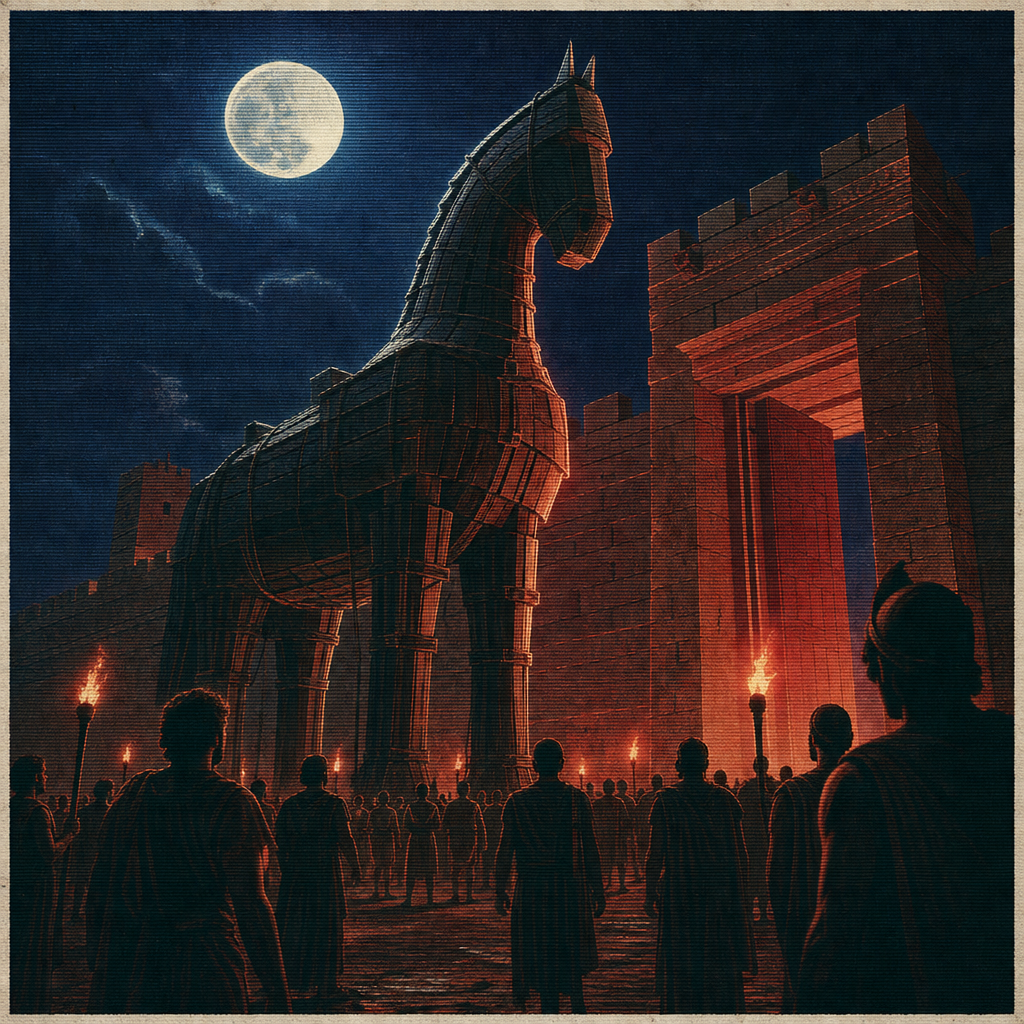
“Demodocus, I praise you above all mortals. Either the Muse, Zeus’s child, taught you, or Apollo. You sing so truly of the Achaeans’ fate, all they did and suffered and struggled through, as though you were there yourself or heard it from someone who was. Change your theme and sing of the making of the wooden horse, which Epeius built with Athena. Noble Odysseus brought it as a trap into the citadel, filled with the men who sacked Ilium. If you recount this as it should be told, I will tell everyone at once that a god has gladly given you divine song.”
Read Ancient Greek Source (Odyssey.8.487–Odyssey.8.498)
So he spoke, and stirred by the god, the singer began and let his song unfold, taking up the tale from where the men boarded their well-benched ships and sailed away, after hurling fire into their camp huts—those Argives—while the others, gathered around famous Odysseus, already sat in the Trojans' assembly place, hidden inside the horse; for the Trojans themselves had dragged it up into their citadel. So the horse stood there, and the Trojans debated endlessly without decision as they sat around it, divided three ways in counsel: whether to split open the hollow timber with pitiless bronze, or drag it to the summit and hurl it down over the rocks, or let it stand as a great offering to appease the gods—and that last way was how it was bound to end; for it was fated that the city should perish once it enclosed within itself the great wooden horse, where they sat—all the best of the Argives, bringing slaughter and doom to the Trojans.
Read Ancient Greek Source (Odyssey.8.499–Odyssey.8.513)
He sang how the sons of the Achaeans ravaged the city, pouring out from the horse and leaving their hollow ambush behind. He sang how one man here, another there laid waste the steep town, while Odysseus, heading for the house of Deiphobus, strode on like Ares alongside godlike Menelaus. There, he sang, Odysseus dared the most terrible battle and in the end won victory, through great-hearted Athena.
Read Ancient Greek Source (Odyssey.8.514–Odyssey.8.520)
So the famous singer sang. Odysseus melted into tears that wet his cheeks beneath his eyelids. As a woman weeps, flinging her arms around her dear husband who has fallen before his city and his people, defending his town and children from the pitiless day—she sees him dying, gasping, clasps him and wails aloud, while men behind her beat her back and shoulders with their spears and lead her away to slavery, to toil and misery, and her cheeks waste with the most pitiful grief—so Odysseus shed pitiful tears beneath his brows.
Read Ancient Greek Source (Odyssey.8.521–Odyssey.8.531)
His tears escaped everyone else. Alcinous alone noticed and understood, sitting beside him and hearing his deep groans. At once he addressed the oar-loving Phaeacians: “Listen, Phaeacian leaders and rulers. Let Demodocus stop his clear-toned lyre. This song does not give everyone pleasure. Since we began supper and the inspired singer rose, our guest has never stopped his sorrowful weeping. Grief must have closed around his heart. Let the singer stop so we can all enjoy ourselves together, guest and hosts. That is far better. All this has been prepared for our honored guest: the escort and the gifts we gladly give. To any man with even a little sense, a stranger and suppliant is as a brother.
Read Ancient Greek Source (Odyssey.8.532–Odyssey.8.547)
“And you, do not use your cleverness to hide what I ask you. It is better to speak. Tell us the name your mother and father called you, and the other people of your town and its surroundings. No one, good or bad, is altogether nameless once he is born. Parents give everyone a name when they bring them into the world.
Read Ancient Greek Source (Odyssey.8.548–Odyssey.8.554)
“Tell me your land, your people and your city, so our ships can steer their thoughts toward taking you there. The Phaeacians have no helmsmen; their ships have no steering oars such as other ships have. They know men’s thoughts and minds themselves, and know everyone’s cities and rich fields. They cross the great sea swiftly, covered in mist and cloud, with no fear of harm or loss.
Read Ancient Greek Source (Odyssey.8.555–Odyssey.8.563)
“Yet I once heard my father Nausithous say that Poseidon would begrudge us giving everyone a safe escort. He said that one day the god would wreck a well-built Phaeacian ship on the misty sea as she returned from an escort, and cover our city with a great mountain. That was what the old man said. The god may fulfill it or leave it unfulfilled, as his heart pleases.
Read Ancient Greek Source (Odyssey.8.564–Odyssey.8.571)
“But tell me truly where you have wandered, which lands and people you have reached, and their well-settled cities. Which people were harsh and savage, without justice, and which welcomed strangers and were mindful of the gods? Tell me why you weep and grieve in your heart when you hear the fate of the Argive Danaans and Ilium. The gods made that fate and spun destruction for men, so there would be song for people yet to come.
Read Ancient Greek Source (Odyssey.8.572–Odyssey.8.580)
“Did some noble relative of yours by marriage die before Ilium—a son-in-law or father-in-law, who are closest to us after our own blood and family? Or was it some good companion who knew what pleased you? A thoughtful companion is worth no less than a brother.”