Book 20: The Gods Enter the Battle
Ἰλιάς · Book 20 · Classix Modern English Reading Edition
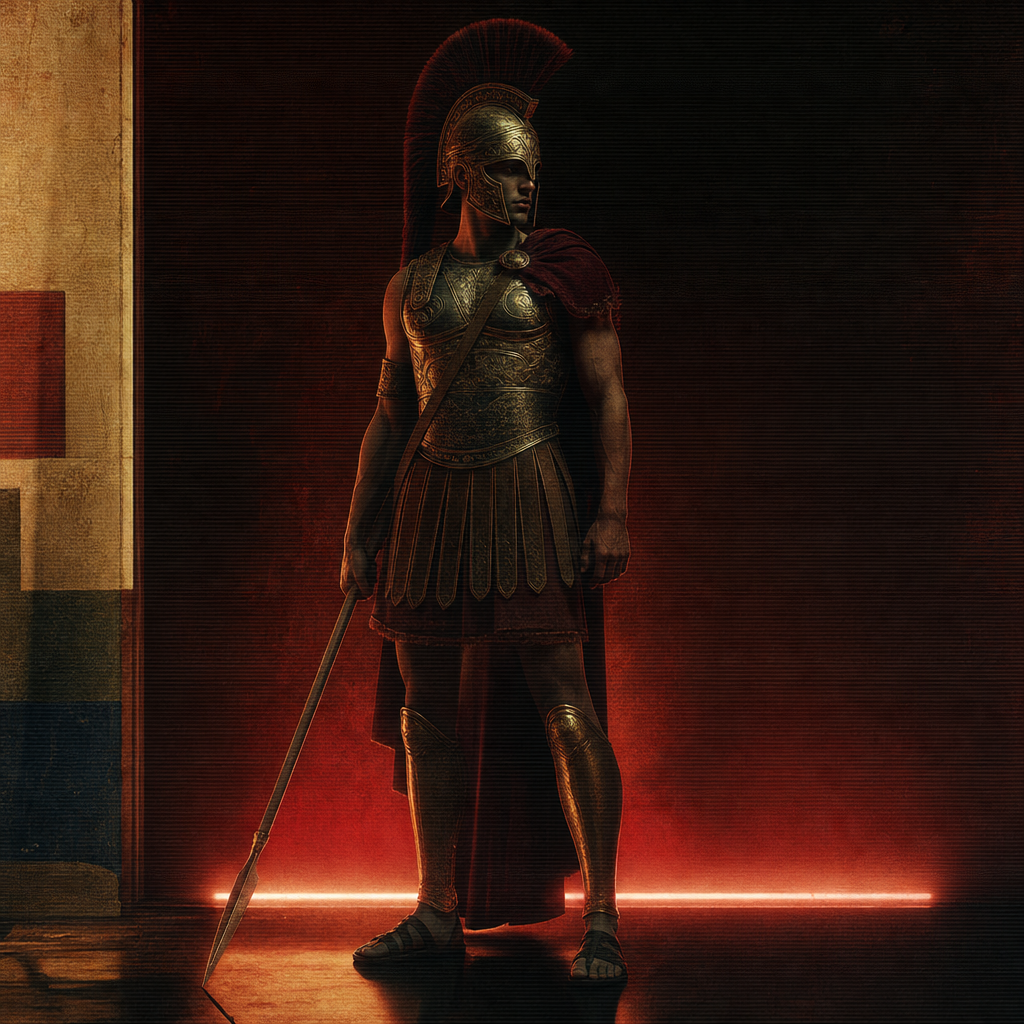
So by the curved ships the Achaeans armed themselves around you, son of Peleus, insatiable in battle, while across from them the Trojans armed on the rising ground of the plain. Meanwhile Zeus ordered Themis to summon the gods to assembly from the peak of many-ridged Olympus. She went everywhere and told them to come to the house of Zeus. Not one of the rivers stayed away, except Oceanus, nor any of the nymphs who haunt the lovely groves, the springs of rivers, and the grassy meadows. Coming to the house of cloud-gathering Zeus, they sat down in the polished colonnades that Hephaestus had built for Father Zeus with his cunning skill.
Read Ancient Greek Source (Iliad.20.1–Iliad.20.12)
So they gathered inside the house of Zeus. Nor did the Earthshaker fail to heed the goddess's call, but came up from the sea to join them. He sat down in their midst and asked Zeus his purpose: "Why now, lord of the bright lightning, have you called the gods to assembly again? Are you pondering some matter concerning the Trojans and Achaeans? For right now war and battle are blazing up close between them."
Read Ancient Greek Source (Iliad.20.13–Iliad.20.18)
Cloud-gathering Zeus answered him: "Earthshaker, you know the plan within my chest, and why I gathered you here. Even as they perish, I care for them. Yet I myself will stay seated in a fold of Olympus, watching from here to delight my heart. As for the rest of you, go down until you reach the Trojans and Achaeans, and help either side as the mind of each of you inclines. For if Achilles fights against the Trojans alone, they will not hold back the swift-footed son of Peleus even for a moment. Even before now they used to tremble just looking at him; and now, when his heart is terribly enraged for his companion, I fear he may storm their wall even beyond what is fated."
Read Ancient Greek Source (Iliad.20.19–Iliad.20.30)
So spoke the son of Cronus, and he stirred up relentless war. The gods set out for battle with divided hearts: Hera went to the massed ships, along with Pallas Athena, earth-embracing Poseidon, and the helper Hermes, who excels in sharp-minded craft; and Hephaestus went with them, exulting in his strength, limping as his slender legs moved busily beneath him. To the Trojans went Ares of the flashing helmet, and with him Phoebus of the unshorn hair, Artemis who delights in arrows, Leto, Xanthus, and laughter-loving Aphrodite.
Read Ancient Greek Source (Iliad.20.31–Iliad.20.40)
As long as the gods stood apart from mortal men, the Achaeans exulted greatly, because Achilles had appeared on the field after staying so long away from painful battle. But a terrible trembling crept into the limbs of every Trojan, struck with fear as they saw the swift-footed son of Peleus blazing in his armor, equal to man-slaying Ares. Yet once the Olympians plunged into the press of men, mighty Strife, rouser of armies, rose up, and Athena shouted—standing now beside the dug trench outside the wall, and at other times crying out loud along the echoing shore. On the other side Ares shouted, dark as a storm wind, calling piercingly to the Trojans from the city's highest crest, and at times racing beside the Simois over the hill of Callicolone.
Read Ancient Greek Source (Iliad.20.41–Iliad.20.53)
So the blessed gods urged both armies on and drove them together, breaking open heavy strife among themselves. Terribly then the father of men and gods thundered from on high, while from beneath Poseidon shook the boundless earth and the steep mountain peaks. All the foothills of many-springed Ida trembled, along with its summits, the city of the Trojans, and the ships of the Achaeans. Down below, Aidoneus—Hades, lord of the dead—was seized with fear; terrified, he leaped from his throne and shouted aloud, afraid that above him Poseidon the Earthshaker might split the ground wide open and lay bare to mortals and immortals alike his halls—grim, dank, and moldering, which even the gods loathe. Such was the din that rose as the gods clashed in strife. For against Lord Poseidon stood Phoebus Apollo with his winged arrows; against Ares Enyalius stood the bright-eyed goddess Athena; against Hera stood she of the golden spindle and the hunting cry, Artemis who delights in arrows, sister of the Far-Shooter; against Leto stood strong, helpful Hermes; and against Hephaestus stood the great deep-eddying river, whom the gods call Xanthus, and men call Scamander.
Read Ancient Greek Source (Iliad.20.54–Iliad.20.74)
So gods went out to face gods. Meanwhile Achilles longed above all to plunge into the throng and face Hector, son of Priam; for his spirit urged him above all to glut Ares, the tough-shielded warrior, with Hector's blood. But Apollo, rouser of armies, sent Aeneas straight against the son of Peleus, and breathed brave strength into him. Taking the voice and likeness of Priam's son Lycaon, Apollo, son of Zeus, spoke to him: "Aeneas, counselor of the Trojans, where are the boasts you pledged to the Trojan kings over your wine, that you would fight Achilles, son of Peleus, man to man?"
Read Ancient Greek Source (Iliad.20.75–Iliad.20.85)
Aeneas answered him in turn: "Son of Priam, why do you urge me against my will to fight the proud-hearted son of Peleus? This would not be the first time I stood against swift-footed Achilles. Once before he drove me in flight with his spear down from Ida, when he raided our cattle and sacked Lyrnessus and Pedasus. That day Zeus saved me by rousing my strength and making my knees quick. Otherwise I would have been cut down at the hands of Achilles and of Athena, who went before him setting light in his path, and urged him to slaughter Leleges and Trojans with his bronze spear. So no mortal man can fight Achilles face to face: one of the gods is always beside him to ward off ruin. Even without that, his spear flies straight and never stops until it tears through human flesh. Yet if a god held the balance of battle even, Achilles would not easily win, not even if he boasts that he is made of solid bronze."
Read Ancient Greek Source (Iliad.20.86–Iliad.20.102)
Lord Apollo, son of Zeus, said to him in reply: "Hero, come then—pray to the everlasting gods yourself! Men say that you too were born of Zeus's daughter Aphrodite, whereas he springs from a lesser goddess: your mother is the daughter of Zeus, his the daughter of the Old Man of the Sea. Drive straight at him with unyielding bronze, and do not let him turn you back at all with grim words and threats." So speaking, he breathed great courage into the shepherd of the people, and Aeneas strode through the front ranks, armored in gleaming bronze.
Read Ancient Greek Source (Iliad.20.103–Iliad.20.111)
Nor did the son of Anchises escape white-armed Hera's notice as he pushed through the press of men to face the son of Peleus. Calling the gods together, she spoke among them: "Consider now, you two, Poseidon and Athena, in your own minds how this matter will turn out. Here goes Aeneas, armed in gleaming bronze, against the son of Peleus, and Phoebus Apollo has urged him on. Come then, let us at least turn him back again from right here; or else let one of us too stand beside Achilles and give him great power, keeping his courage from failing at all, so he may know that the greatest of the immortals love him, while those who until now have been warding war and slaughter from the Trojans are empty wind. All of us came down from Olympus to take part in this battle, so that he would suffer no harm among the Trojans today; afterward he will suffer whatever Fate spun for him with her thread at birth, when his mother bore him. But if Achilles does not learn this from a god's voice, he will be afraid when some god comes against him in war; for the gods are hard to bear when they appear in full sight."
Read Ancient Greek Source (Iliad.20.112–Iliad.20.131)
Then Poseidon the Earthshaker answered her: "Hera, do not rage beyond good sense; you have no need to. I, for one, would not want us to clash with the other gods, since we are far the stronger. Rather, let us go and sit down off the beaten track on a lookout point, and war will be the work of men. But if Ares begins the fighting, or Phoebus Apollo, or if they hold Achilles back and will not let him fight, then right there and then the quarrel of open battle will rise for us too; and very soon, I think, they will break off the fight and go back to Olympus to the company of the other gods, beaten down by force beneath our hands."
Read Ancient Greek Source (Iliad.20.132–Iliad.20.143)
So spoke the dark-haired god, and led the way to the heaped-up earthen wall of godlike Heracles, the high rampart that the Trojans and Pallas Athena had built for him, so he could escape and shelter from the sea-monster whenever it charged at him from the beach onto the plain. There Poseidon sat down with the other gods, and they wrapped an unbreakable cloud around their shoulders; while the opposing gods sat on the other side upon the brows of Callicolone, around you, archer Phoebus, and Ares the sacker of cities. So the gods sat on either side, working out their plans; yet both sides hesitated to begin the harsh pain of war, though Zeus from his high seat urged them on.
Read Ancient Greek Source (Iliad.20.144–Iliad.20.155)
Meanwhile the whole plain filled with men and horses and blazed with bronze, and the earth rang beneath their feet as the armies surged together. Then two men, the finest by far, strode into the space between both hosts, eager to fight: Aeneas, son of Anchises, and brilliant Achilles. Aeneas advanced first with a threat, the heavy helmet nodding on his head; he held his fierce shield before his chest and brandished his bronze spear. From the other side the son of Peleus sprang to meet him like a ravenous lion that a whole community of men has gathered to hunt down and kill: at first he goes his way in scorn of them, but when one of the swift young fighters hits him with a spear, he crouches with jaws gaping, foam forms around his teeth, and inside his chest his brave heart groans; with his tail he lashes his ribs and flanks on both sides, whipping himself on to fight, and with eyes glaring bright he charges straight ahead in his fury, to kill some man or be killed himself in the front of the throng. Just so, fury and his proud spirit drove Achilles on to go out and face great-hearted Aeneas.
Read Ancient Greek Source (Iliad.20.156–Iliad.20.175)
When they had come close, advancing on one another, swift-footed brilliant Achilles spoke first to him: "Aeneas, why have you stepped so far out in front of the ranks to stand your ground? Does your heart urge you to fight me because you hope to rule the horse-taming Trojans with the royal honor now held by Priam? Yet even if you kill and strip me, Priam will not on that account place his royal prize in your hand; for he has sons of his own, and his mind is sound, not flighty. Or have the Trojans marked out for you an estate finer than all others, rich in orchard and plowland, for you to enjoy if you kill me? I think you will find that hard to do. Already once before, I say, I put you to flight with my spear. Do you not remember when you were all alone, and I drove you from your cattle and chased you headlong down the hills of Ida on my swift feet? That day you never once looked back as you ran. From there you escaped into Lyrnessus; but I attacked that town and sacked it, with the help of Athena and Father Zeus, and I took the women captive, stripping away their day of freedom, and led them off—though Zeus and the other gods rescued you. Yet I do not think they will save you now, as you imagine in your heart. No, I tell you to draw back and go into the crowd; do not stand and face me, before you suffer some harm. Once the thing is done, even a fool sees it."
Read Ancient Greek Source (Iliad.20.176–Iliad.20.198)
Then Aeneas answered him and said: "Son of Peleus, do not think you will frighten me with words like a little child, since I too know well enough how to speak both taunts and harsh insults. We know each other's lineage, and we know each other's parents, from hearing the old stories told among mortal men, though by sight you have never seen mine, nor have I seen yours. Men say you are the offspring of noble Peleus, and born of your mother Thetis of the lovely tresses, daughter of the sea; while I proudly claim to be born the son of great-hearted Anchises, and my mother is Aphrodite. Of these parents, one pair or the other will mourn a beloved son today; for I say it is not with childish words that the two of us will part like this and walk away from battle.
Read Ancient Greek Source (Iliad.20.199–Iliad.20.212)
"But if you wish to learn this too, so that you may know well our family line—and many men know it: cloud-gathering Zeus first fathered Dardanus, who founded Dardania, since sacred Ilium had not yet been built on the plain as a city of mortal men, and people still lived on the lower slopes of many-springed Ida. Dardanus in turn fathered a son, King Erichthonius, who became the wealthiest of mortal men: three thousand horses of his grazed across the marshland, all mares, delighting in their tender foals. Even Boreas fell in love with them as they grazed, and taking the form of a dark-maned stallion, he mated with them; they conceived and bore twelve foals. Whenever they bounded across the grain-giving plowland, they skimmed the topmost ears of grain without snapping a stalk; and when they bounded over the broad back of the sea, they ran along the crests of the gray breakers. Erichthonius fathered Tros to be lord over the Trojans, and from Tros in turn three noble sons were born: Ilus, Assaracus, and godlike Ganymede, who was the handsomest of mortal men; the gods snatched him up to pour wine for Zeus because of his beauty, so that he might live among the immortals. Ilus in turn fathered a noble son, Laomedon, and Laomedon fathered Tithonus and Priam, Lampus, Clytius, and Hicetaon, scion of Ares. Assaracus fathered Capys, and Capys fathered a son, Anchises; Anchises fathered me, while Priam fathered brilliant Hector. This is the lineage and the blood I claim as my own.
Read Ancient Greek Source (Iliad.20.213–Iliad.20.241)
"But Zeus increases and diminishes men's valor however he wishes, for he is the strongest of all. Come then, let us stop talking of these things like children, standing here in the middle of the murderous fight. Both of us have insults enough to hurl at each other—so many that a hundred-benched ship could not carry the load. A mortal's tongue is supple, with many words in it of every kind, and wide is the range of speech this way and that. Whatever sort of word you speak, the same you will hear in return. But why must the two of us trade quarrels and insults face to face like women who grow furious over a heart-gnawing quarrel and go out into the middle of the street to rail at one another with much that is true and much that is not, as their anger drives them to say? I am eager to fight, and your words will not turn me from my courage before we fight face to face with bronze. Come then, quickly—let us taste each other with our bronze-tipped spears."
Read Ancient Greek Source (Iliad.20.242–Iliad.20.258)
He spoke, and drove his heavy spear into the dread, terrifying shield, and the great shield rang out around the spearpoint. The son of Peleus held the shield away from his body with his strong hand in alarm, for he thought the long-shadowed spear of great-hearted Aeneas would easily punch right through—foolish man, not realizing in his mind and heart that the glorious gifts of the gods are not easily overcome by mortal men or made to yield. Nor did the heavy spear of battle-wise Aeneas break through the shield then, for the gold, the gift of the god, stopped it. It drove through two layers, but three still remained, since the club-footed god had forged five layers: two of bronze, two inside of tin, and one of gold, in which the ash spear was held fast.
Read Ancient Greek Source (Iliad.20.259–Iliad.20.272)
Next Achilles hurled his long-shadowed spear and struck the balanced shield of Aeneas just inside the outer rim, where the bronze ran thinnest and the oxhide backing was thinnest. Right through it the Pelian ash spear tore, and the shield cracked beneath the blow. Aeneas crouched low and thrust the shield up away from himself in terror; the spear flew over his back and plunged into the earth and stood there, having torn through both circles of the man-covering shield. Having dodged the long shaft, Aeneas stood still, and a blinding dismay poured over his eyes, terrified that the weapon had planted itself so close to him. Then Achilles lunged forward in fury, drawing his sharp sword with a terrifying shout. In his hand Aeneas seized a boulder—a massive weight that two men, such as mortals are today, could not lift, yet he hefted it easily on his own. Then Aeneas would have struck the charging Achilles with the stone, hitting his helmet or shield, which would have saved Achilles from grim death, and the son of Peleus would have taken Aeneas's life at close quarters with his sword, had not Poseidon the Earthshaker been quick to see.
Read Ancient Greek Source (Iliad.20.273–Iliad.20.291)
At once he spoke among the immortal gods: "Ah, I grieve for great-hearted Aeneas, who will soon go down to the house of Hades, cut down by the son of Peleus because he trusted the words of far-shooting Apollo—poor fool! Apollo will do nothing to save him from grim destruction. Why should this innocent man suffer now for nothing, on account of others' troubles, when he always gives pleasing offerings to the gods who hold wide heaven? Come, let us rescue him from death ourselves, or the son of Cronus too will be angry if Achilles kills this man. It is fated for him to escape, so that the lineage may not perish without seed and vanish without trace—the line of Dardanus, whom the son of Cronus loved above all the children born to him by mortal women. For the son of Cronus has come to hate the house of Priam, and now strong Aeneas will rule over the Trojans, and his children's children born in times to come."
Read Ancient Greek Source (Iliad.20.292–Iliad.20.308)
Then ox-eyed Queen Hera answered him: "Earthshaker, decide in your own mind about Aeneas, whether to rescue him or leave him to be cut down, brave as he is, by Achilles son of Peleus. For the two of us have sworn many oaths before all the immortals—Pallas Athena and I—never to ward off the day of ruin from the Trojans, not even when all Troy burns in ravenous fire as the warlike sons of the Achaeans set it ablaze."
Read Ancient Greek Source (Iliad.20.309–Iliad.20.317)
When Poseidon the Earthshaker heard this, he strode through the battle and the clash of spears, and came to the place where Aeneas and glorious Achilles stood. At once he poured a mist over the eyes of Achilles, son of Peleus; then he drew the fine bronze-tipped ash spear out of the shield of great-hearted Aeneas and laid it down before Achilles' feet, while he lifted Aeneas high off the ground and hurled him away. Over many ranks of warriors and many ranks of horses Aeneas soared, launched from the god's hand, and came down at the far edge of the surging battle, where the Caucones were arming for war. Poseidon the Earthshaker came right up to him and spoke to him with winged words: "Aeneas, which of the gods drives you in such blind folly to fight face to face against the proud son of Peleus, who is both stronger than you and dearer to the immortals? Draw back instead whenever you meet him in battle, so that you do not go down to the house of Hades even against fate. Once Achilles meets his death and his own appointed doom, then take courage and fight among the front ranks, for no other Achaean will kill you and strip your armor." So he spoke and left him there, once he had told him everything plainly.
Read Ancient Greek Source (Iliad.20.318–Iliad.20.340)
Then at once he scattered from Achilles' eyes the mist that the god had shed; and Achilles stared wide-eyed and saw clearly again. Deeply troubled, he spoke to his own great heart: "Gods! What a great wonder I see here with my own eyes! My spear lies here on the ground, yet I cannot see the man at whom I hurled it, eager to kill him. Truly Aeneas too was dear to the immortal gods after all, though I thought his boasts were empty talk. Let him go! He will have no stomach to test me again, when even now he was glad to escape from death. Come then, I will call on the battle-loving Danaans and go face the rest of the Trojans to put them to the test."
Read Ancient Greek Source (Iliad.20.341–Iliad.20.352)
He spoke, and sprang along the ranks, calling out to each man: "Stand back from the Trojans no longer now, brilliant Achaeans! Come, let man go against man and set his heart on fighting. It is hard for me, strong as I am, to chase down so many men and fight them all. Not even Ares, who is an immortal god, not even Athena could charge into the jaws of such a battle and toil through it all. Yet as far as I have power in my hands and feet and strength, I tell you I will not slacken even a little; I will drive straight through their line, and I think no Trojan will rejoice when he comes within reach of my spear."
Read Ancient Greek Source (Iliad.20.353–Iliad.20.363)
So he spoke to spur them on; meanwhile glorious Hector shouted commands to the Trojans, declaring that he would go face Achilles: "High-hearted Trojans, do not fear the son of Peleus! With words even I could fight the immortal gods, though with a spear it is hard, since they are far stronger than we are. Nor will Achilles make good on every word he speaks; one thing he will fulfill, and another he will cut short halfway. I will go out to meet him, even if his hands are like fire—if his hands are like fire, and his fury like gleaming iron!" So he spoke to spur them on, and the Trojans raised their spears to face the enemy; their fury clashed together, and the battle cry rose up. Then Phoebus Apollo stood beside Hector and spoke to him: "Hector, do not go out in front of the lines to fight Achilles at all, but wait for him within the crowd, amid the roar of battle, or else he may hit you with a cast of his spear or strike you up close with his sword." So he spoke, and Hector plunged back into the press of men, seized with fear when he heard the voice of the god speaking.
Read Ancient Greek Source (Iliad.20.364–Iliad.20.380)
But Achilles clothed his heart in fierce strength and leaped among the Trojans with a terrifying war cry. First he killed Iphition, the brave son of Otrynteus and leader of many men, whom a water nymph bore to Otrynteus, sacker of cities, beneath snowy Mount Tmolus in the rich land of Hyde. As Iphition charged straight ahead, brilliant Achilles struck him with his spear square in the middle of the head, and his whole skull split in two. He fell with a thud, and brilliant Achilles boasted over him: "There you lie, son of Otrynteus, most terrifying of all men! Here is your death, though your birth was by the waters of Lake Gygaea, where your father's estate lies beside the fish-filled Hyllus and the eddying Hermus." So he spoke in triumph, and darkness covered Iphition's eyes. The horse-drawn chariots of the Achaeans tore his body apart with their wheel-rims in the front of the battle. Next, right after him, Achilles stabbed Demoleon, Antenor's son, a brave defender in the fight, in the temple through his bronze-cheeked helmet. The bronze helmet did not stop the blow: driving straight through it, the spearhead smashed the bone, and the whole brain was scattered inside; so Achilles cut down the charging Demoleon. Next, as Hippodamas leaped down from his chariot and fled before him, Achilles drove his spear into his back. He gasped out his life and bellowed, just as a bull bellows when it is dragged before the Heliconian lord by young men hauling it in, and the Earthshaker delights in them; so, as he bellowed, his proud spirit left his bones.
Read Ancient Greek Source (Iliad.20.381–Iliad.20.406)
Then Achilles went with his spear after godlike Polydorus, son of Priam. His father would not let him fight at all, because he was the youngest born of all his sons and the dearest to him, and on foot he outran everyone. Now, in his boyish folly, showing off the speed of his feet, he was dashing through the front ranks until he lost his life. Swift-footed, brilliant Achilles struck him square in the back with a cast of his spear as he flashed past, right where the golden clasps of his war-belt fastened and the double layers of his corselet met. Straight through beside the navel came the point of the spear; he dropped to his knees with a groan, a dark cloud wrapped around him, and as he sank down he clutched his entrails to his body with both hands.
Read Ancient Greek Source (Iliad.20.407–Iliad.20.418)
When Hector saw his brother Polydorus clutching his entrails in his hands and slumping to the ground, a mist poured over his eyes, and he could no longer bear to range far off in the battle, but came straight at Achilles like a flame, brandishing his sharp spear. And Achilles, the instant he saw him, sprang forward and boasted aloud: "Here is the man who cut deepest into my heart, who killed my cherished companion! Not for much longer shall we shrink from each other across the lanes of battle." So he spoke, and glaring darkly he called to brilliant Hector: "Come closer, so you may all the sooner reach the bounds of your doom." Unshaken, Hector of the flashing helmet answered him: "Son of Peleus, do not think you will frighten me with words like a little child, since I too know well enough how to speak both taunts and harsh insults. I know that you are strong, and that I am far weaker than you. Yet these things lie on the knees of the gods—whether, though I am the weaker man, I may take your life with a cast of my spear, for my weapon too has a sharp point."
Read Ancient Greek Source (Iliad.20.419–Iliad.20.437)
He spoke, drew back his spear, and hurled it; but Athena turned it back from glorious Achilles with a breath, blowing ever so lightly, and it came back to brilliant Hector and fell right there before his feet. Then Achilles charged furiously at him, raging to kill him, with a terrible cry; but Apollo snatched Hector away with ease, as a god can, and wrapped him in thick mist. Three times then swift-footed, brilliant Achilles lunged with his bronze spear, and three times he struck deep mist. But when he rushed in a fourth time like a god, he shouted a terrible threat and spoke winged words: "Once more you have escaped death, dog! Yet very close your ruin came; once again Phoebus Apollo has saved you, to whom you surely pray whenever you go into the crash of spears. I will finish you yet when I meet you next time, if any of the gods is a helper to me as well. For now I will go after the others, whomever I can catch."
Read Ancient Greek Source (Iliad.20.438–Iliad.20.454)
So speaking, he struck Dryops with his spear full in the neck, and he crashed down before his feet. Achilles left him there and struck brave, tall Demuchus, the son of Philetor, on the knee with his spear and stopped him short; then, stabbing him with his great sword, he took his life. Then against Laogonus and Dardanus, the two sons of Bias, he charged, and hurled both from their chariot to the ground, striking one with a cast of his spear, the other up close with his sword. And Tros, Alastor's son, came forward to clasp Achilles' knees, hoping Achilles might take him captive, spare him, and let him go alive, and not kill him, out of pity for a man of his own years—fool that he was, not knowing Achilles would never be persuaded, for this was no sweet-tempered or gentle-hearted man, but fiercely relentless. Tros reached with his hands for Achilles' knees, straining to beg for mercy, and Achilles stabbed his liver with his sword. His liver slid out, and dark blood gushing from it filled the hollow of his tunic, and darkness covered his eyes as his life left him. Then Achilles stepped close and stabbed Mulius in the ear with his spear, and straight through the other ear the bronze point passed. Then he struck Agenor's son Echeclus down through the center of his head with his hilted sword, and the whole blade grew warm with blood, while over his eyes dark, surging death and overpowering fate took hold.
Read Ancient Greek Source (Iliad.20.455–Iliad.20.477)
Then Achilles pierced Deucalion's arm with his bronze spear-point, right where the tendons join at the elbow. His arm hanging heavy, Deucalion waited, staring death in the face. Achilles struck his neck with his sword and sent his head flying far off, helmet and all; marrow spurted from his spine, and Deucalion lay stretched out on the ground. Then Achilles went after Rhigmus, the noble son of Peires, who had come from deep-soiled Thrace. He struck Rhigmus square with a javelin; the bronze lodged in his belly, and Rhigmus toppled from his chariot. Next, as Rhigmus's squire Areithous wheeled the horses around, Achilles pierced him in the back with his sharp spear and thrust him from the chariot, and the horses bolted in panic.
Read Ancient Greek Source (Iliad.20.478–Iliad.20.489)
As a fiercely blazing fire rages through the deep gorges of a parched mountain, and the dense forest burns, and the driving wind whirls the flames every way, so Achilles raged in every direction with his spear like a god, hounding the men he slaughtered, and the black earth ran with blood. And as when a man yokes broad-browed bulls to tread white barley on a well-built threshing floor, and quickly the grain is husked under the feet of the bellowing oxen, so, driven by great-hearted Achilles, his solid-hoofed horses trampled corpses and shields alike; the whole axle beneath the chariot was drenched in blood, as were the rails around the chariot, splashed by drops flying up from the horses' hooves and from the wheel-rims. Still the son of Peleus strained to win glory, his invincible hands splattered with gore.