Book 19: Penelope and the Disguised Odysseus; Eurycleia’s Discovery
Ὀδύσσεια · Book 19 · Classix Modern English Reading Edition
Godlike Odysseus stayed behind in the hall, planning the suitors’ murder with Athena. At once he spoke these flying words to Telemachus: “Telemachus, we must put all the weapons away inside. When the suitors miss them and ask you, put them off with gentle words: ‘I put them out of the smoke. They no longer looked as they did when Odysseus left them to sail for Troy. The breath of the fire has disfigured them. And a god put a more serious concern in my mind: you might get drunk, start a quarrel among yourselves and wound one another, disgracing the feast and the courtship. Iron itself draws a man on.’”
Read Ancient Greek Source (Odyssey.19.1–Odyssey.19.13)
Telemachus obeyed his dear father. He called out to his nurse Eurycleia. “Nurse, keep the women in their rooms while I put my father’s fine weapons away in the storeroom. Smoke has been ruining them, neglected here in the house since Father went away. I was still a child. Now I want to put them where the breath of the fire won’t reach them.” His dear nurse Eurycleia replied, “Child, if only you would at last learn to take care of the house and guard all its possessions! But who will go with you to carry a light? You won’t let the enslaved women come out, though they could light your way.” Sensible Telemachus answered, “This stranger will. I won’t have anyone idle who eats my measure of grain, even if he’s come from far away.”
Read Ancient Greek Source (Odyssey.19.14–Odyssey.19.28)
She took his words to heart and shut the doors of the well-appointed rooms. Odysseus and his splendid son sprang up and carried in helmets, bossed shields and sharp spears. Before them Pallas Athena held a golden lamp and made a beautiful light. Telemachus spoke at once to his father. “Father, what a wonder I see with my own eyes! The walls of the hall, the fine crossbeams, the fir rafters and the pillars rising high all shine as though from a blazing fire. Surely one of the gods who hold the wide heaven is here inside.”
Read Ancient Greek Source (Odyssey.19.29–Odyssey.19.40)
Odysseus, master of schemes, answered him. “Be quiet. Keep it in your mind and ask no questions. This is the way of the gods who live on Olympus. Go to bed now. I’ll stay here to test the women and your mother further. In her grief she will question me about everything.” Telemachus went through the hall by the light of blazing torches to sleep in the room where he had always lain when sweet sleep came upon him. There he lay now and waited for divine Dawn. Godlike Odysseus stayed behind in the hall, planning the suitors’ murder with Athena.
Read Ancient Greek Source (Odyssey.19.41–Odyssey.19.52)
Thoughtful Penelope came out of her room, like Artemis or golden Aphrodite. They set a chair beside the fire for her to sit on, its curving work inlaid with ivory and silver. The craftsman Icmalius had made it and had fitted a footstool to it, part of the chair itself; a great fleece lay over it. Thoughtful Penelope sat down. White-armed enslaved women came from the hall and cleared away the heaps of food, the tables and the cups from which the overbearing men had drunk. They emptied the braziers’ fire onto the ground and piled fresh wood on them for light and warmth. Melantho abused Odysseus a second time. “Stranger, are you still going to plague us, wandering through the house all night, spying on the women? Get outside, wretch, and be glad you had a meal. Or you’ll soon be hit with a burning brand and sent outside.”
Read Ancient Greek Source (Odyssey.19.53–Odyssey.19.69)
Odysseus, master of schemes, looked at her darkly. “Woman, why do you bear down on me so angrily? Because I’m dirty, wear wretched clothes and beg through the town? Necessity drives me. That is how beggars and wanderers are. I too once lived prosperously among men in a rich house, and often gave to a wanderer, whoever he might be and whatever he needed when he came. I had countless slaves and all the other things that make a man live well and be called rich. But Zeus, Cronus’ son, laid it waste. That must have been his will. Take care, woman, that you don’t lose all the beauty that now makes you stand out among the enslaved women. Your mistress may grow angry and be harsh with you, or Odysseus may return: there is still room for hope. Even if he has perished and will never come home, by Apollo’s favor he has a son such as Telemachus now is. No woman doing wrong in this house escapes his notice. He is no longer so young.”
Read Ancient Greek Source (Odyssey.19.70–Odyssey.19.88)
Thoughtful Penelope heard him and rebuked the attendant, calling her by name. “You bold, shameless dog! You certainly haven’t hidden this monstrous behavior from me. You’ll pay for it with your own head. You knew perfectly well, because you heard it from me, that I meant to question the stranger in my hall about my husband. My grief is deep.” Then she addressed Eurynome the housekeeper. “Eurynome, bring a stool with a fleece on it, so the stranger can sit and speak and listen to me. I want to question him.” Eurynome quickly brought a polished stool and spread a fleece on it. Steadfast, godlike Odysseus sat down. Thoughtful Penelope began their conversation. “Stranger, first I will ask you this myself: who are you? Where do you come from? Where are your city and your parents?”
Read Ancient Greek Source (Odyssey.19.89–Odyssey.19.105)
Odysseus, master of schemes, answered her. “Lady, no mortal anywhere on the boundless earth could find fault with you. Your fame reaches the wide heaven, like the fame of a blameless king who fears the gods and rules over many strong men, upholding justice. The dark earth bears wheat and barley, the trees are heavy with fruit, the flocks bear steadily, the sea supplies fish, all because of his good leadership, and his people prosper under him. So ask me about anything else here in your house, but don’t question me about my family and native land. Remembering them would fill my heart with still more pain. I am already full of sorrow. It isn’t right to sit weeping and lamenting in another man’s house. Endless grieving does harm. One of your slaves, or you yourself, might resent it and say that I was swimming in tears because wine had dulled my wits.”
Read Ancient Greek Source (Odyssey.19.106–Odyssey.19.122)
Thoughtful Penelope answered him. “Stranger, the immortals destroyed my excellence, my beauty and my figure when the Argives sailed for Ilium and my husband Odysseus went with them. If he returned to watch over my life, my fame would be greater and more splendid. But now I grieve. Some god has sent so many troubles upon me. All the leading men who rule the islands—Dulichium, Same and wooded Zacynthus—and those who live around clear-seen Ithaca itself court me against my will and wear this house away. So I pay no attention to guests, to suppliants, or even to heralds who serve the public. Longing for Odysseus, I melt my own heart away. They press for marriage; I wind my schemes.
Read Ancient Greek Source (Odyssey.19.123–Odyssey.19.137)
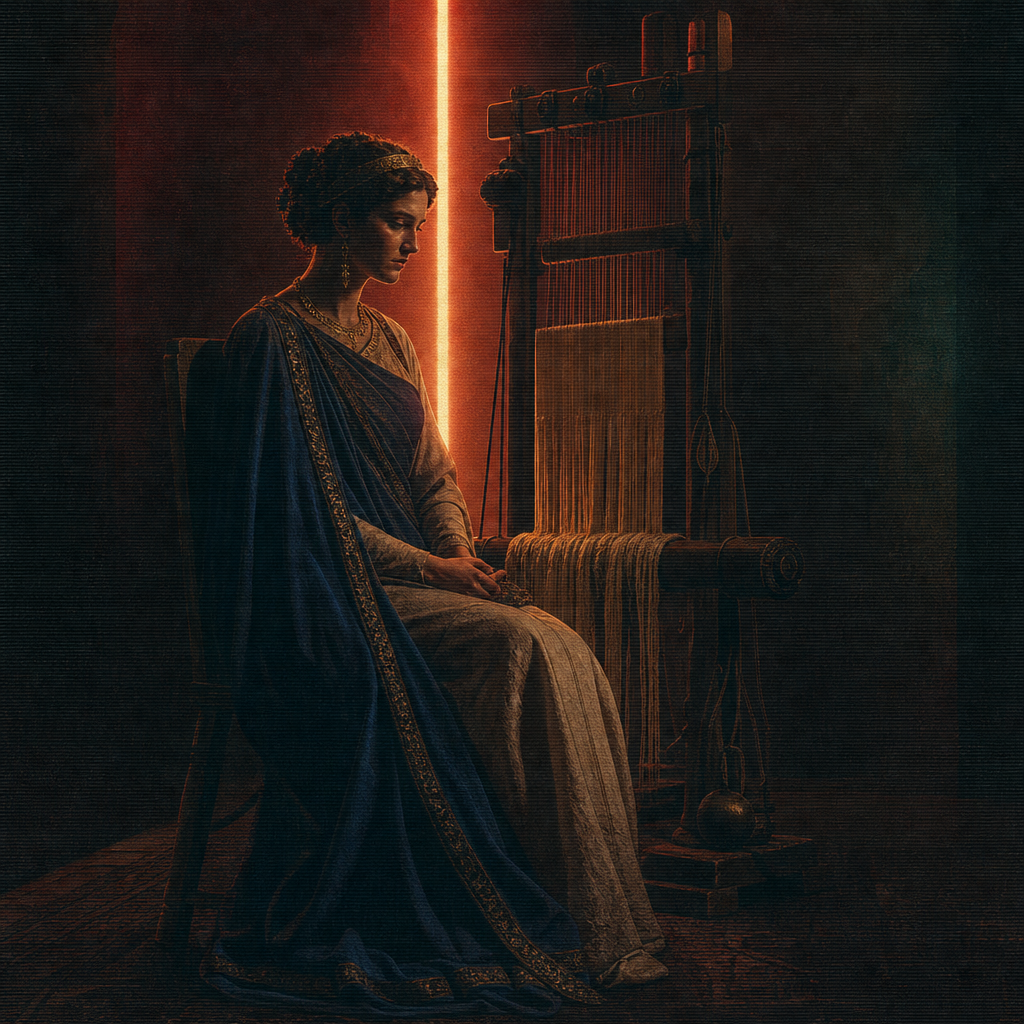
“First a god put it into my mind to set up a great loom in the hall and weave a fine, very wide shroud. I said to them at once, ‘Young men, my suitors, since godlike Odysseus has died, eager as you are for my marriage, wait until I finish this cloth, so my thread will not be wasted: a burial shroud for the hero Laertes, for the time when the destructive fate of grievous death brings him down. I don’t want some Achaean woman in the town to blame me if a man who won so many possessions lies without a winding sheet.’ So I spoke, and their proud hearts agreed. By day I wove at the great loom; by night I set torches beside me and unraveled it. For three years I kept it hidden and persuaded the Achaeans. But when the fourth year came, as the seasons passed, the months waned and many days completed their course, then my enslaved women, those careless dogs, betrayed me. The men came upon me, caught me and shouted at me. So I finished it, unwilling, under compulsion.
Read Ancient Greek Source (Odyssey.19.138–Odyssey.19.156)
“Now I can neither escape marriage nor find another scheme. My parents strongly urge me to marry. My son sees them eating away his livelihood and is distressed. He is already a man, fully able to care for a house, and Zeus grants him honor. But even so, tell me your family and where you come from. You did not spring from the oak of old tales, or from a rock.”
Read Ancient Greek Source (Odyssey.19.157–Odyssey.19.163)
Odysseus, master of schemes, answered her. “Honored wife of Odysseus, Laertes’ son, will you never stop questioning me about my birth? I’ll tell you, though you will give me more grief than I already have. That is what happens when a man has been away from his homeland as long as I have, wandering through many cities and suffering. Even so, I’ll tell you what you ask. There is a land called Crete in the middle of the wine-dark sea, beautiful and fertile, with water all around it. Many people live there, beyond counting, in ninety cities. Their languages mingle: there are Achaeans, great-hearted native Cretans, Cydonians, Dorians in three divisions, and noble Pelasgians. Among those cities is great Cnossus, where Minos ruled for nine years, the intimate companion of mighty Zeus. He was the father of my father, great-hearted Deucalion. Deucalion fathered me and lord Idomeneus. But Idomeneus sailed to Ilium in curved ships with the sons of Atreus. My renowned name is Aethon. I am the younger by birth; he was older and the better man.
Read Ancient Greek Source (Odyssey.19.164–Odyssey.19.184)
“There I saw Odysseus and gave him gifts of hospitality. A powerful wind had brought him to Crete, driving him off course past Malea as he made for Troy. He anchored at Amnisus, where the cave of Eileithyia is, in a difficult harbor; he barely escaped the storm. He went straight up to the city and asked for Idomeneus, saying he was a dear and honored guest-friend. But it was already the tenth or eleventh dawn since Idomeneus had sailed with his curved ships for Ilium. I took Odysseus home and entertained him well, giving him a warm welcome from the plentiful stores in my house. For him and the companions who followed him, I gathered barley meal and gleaming wine from the people, and cattle to sacrifice, so they could satisfy their hearts. The noble Achaeans stayed there twelve days. A great north wind penned them in and would not even let them stand on land; some harsh god had stirred it up. On the thirteenth day the wind fell and they put to sea.”
Read Ancient Greek Source (Odyssey.19.185–Odyssey.19.202)
He made the many lies he told resemble truth. As she listened, her tears flowed and her body melted. As snow melts on the high mountain peaks when the east wind thaws what the west wind has piled up, and the rivers swell with its melting streams, so her lovely cheeks melted as she shed tears, weeping for the husband sitting beside her. In his heart Odysseus pitied his grieving wife, but his eyes stood motionless between their lids, as though made of horn or iron. Cunningly he hid his tears. When she had had her fill of tearful grief, she spoke to him again. “Now, stranger, I think I’ll test you, to see whether you really entertained my husband and his godlike companions there in your hall, as you say. Tell me what clothes he wore, what he looked like himself, and about the companions who followed him.”
Read Ancient Greek Source (Odyssey.19.203–Odyssey.19.219)
Odysseus, master of schemes, answered her. “Lady, after so long apart it is hard to say. This is already the twentieth year since he left that place and sailed from my homeland. Still, I’ll tell you as my heart pictures it. Godlike Odysseus wore a thick purple cloak, doubled over. Its pin was made of gold with twin catches, and on its front was an intricate design: a dog held a dappled fawn in its forepaws, gripping it as it struggled. Everyone marveled that, although they were gold, the dog gripped the fawn and strangled it, while the fawn struggled with its feet, desperate to escape. I noticed the shining tunic against his skin, like the dry skin of an onion, so soft it was, and bright as the sun. Many women gazed at it in wonder.
Read Ancient Greek Source (Odyssey.19.220–Odyssey.19.235)
“I’ll tell you something else; take it to heart. I don’t know whether Odysseus wore these clothes at home, or a companion gave them to him as he boarded the swift ship, or perhaps a guest-friend. Odysseus had many friends; few Achaeans were his equals. I too gave him a bronze sword, a fine double purple cloak and a fringed tunic, and sent him off with honor on his well-benched ship. A herald followed him, a little older than he was. I’ll describe him too. He was rounded in the shoulders, dark-skinned and curly-haired, and his name was Eurybates. Odysseus honored him above his other companions because his thoughts agreed with his own.”
Read Ancient Greek Source (Odyssey.19.236–Odyssey.19.248)
His words stirred in her a still greater longing to weep, as she recognized the sure signs Odysseus described. When she had had her fill of tearful grief, she answered him. “Stranger, I pitied you before; now you will be loved and honored in my house. I myself gave him the clothes you describe, taking them folded from the chamber, and fastened on the shining pin for him to wear as an ornament. But I will never welcome him again, returning to his home and native land. It was an evil fate that took Odysseus away in his hollow ship to see accursed Ilium, whose name I hate to speak.”
Read Ancient Greek Source (Odyssey.19.249–Odyssey.19.260)
Odysseus, master of schemes, answered her. “Honored wife of Odysseus, Laertes’ son, no longer destroy your lovely body or melt your heart with weeping for your husband. I don’t blame you at all. A woman grieves even for a different sort of man when she loses the husband she married, whom she loved and bore children to—how much more for Odysseus, who they say is like the gods. But stop your weeping and hear my words. I’ll tell you truly, hiding nothing, that I have already heard of Odysseus’ return. He is near, alive in the rich land of the Thesprotians, bringing many fine treasures which he has collected by asking through the land. But he lost his faithful companions and his hollow ship on the wine-dark sea, on his way from the island of Thrinacia. Zeus and the Sun grew angry with him because his companions had killed the Sun’s cattle.
Read Ancient Greek Source (Odyssey.19.261–Odyssey.19.276)
“They all perished in the surging sea, but a wave brought him ashore on the ship’s keel, to the land of the Phaeacians, who are close kin to the gods. They honored him in their hearts like a god, gave him many gifts and wished to send him safely home themselves. Odysseus would have been here long ago, but he thought it more profitable to travel over the wide earth collecting wealth. Odysseus understands gain better than any other mortal; no other man could compete with him. This is what Pheidon, king of the Thesprotians, told me. Pouring a libation in his own house, he swore to me himself that a ship had been launched and the crew were ready to take Odysseus to his native land.
Read Ancient Greek Source (Odyssey.19.277–Odyssey.19.290)
“But he sent me away first: a ship of Thesprotian men happened to be leaving for wheat-rich Dulichium. He showed me all the possessions Odysseus had gathered. The treasures lying in the king’s house would feed another man down to the tenth generation. He said Odysseus had gone to Dodona to hear the will of Zeus from the god’s high-leafed oak: how should he return to his native land after so long away, openly or in secret? So he is safe and will come very soon now. He won’t remain long away from his friends and native land. I will give you an oath. Let Zeus, highest and best of gods, be my first witness, and the hearth of blameless Odysseus to which I have come: everything will happen as I say. Within this very year Odysseus will come here, as one month wanes and the next begins.”
Read Ancient Greek Source (Odyssey.19.291–Odyssey.19.307)
Thoughtful Penelope answered him. “Stranger, if only those words would come true! You would soon know my friendship and receive so many gifts that anyone meeting you would call you fortunate. But this is what my heart foresees, and how it will be: Odysseus will never come home, and you will find no escort, since there are no masters in this house such as Odysseus was among men—if ever he existed—to welcome honored guests and send them on their way. But attendants, wash him and lay out a bed, bedding and cloaks and shining coverlets, so he can keep warm until Dawn takes her golden throne. Very early in the morning bathe and anoint him, so he can sit beside Telemachus in the hall and think of his meal. It will go worse for any of those men who torments him and wounds his heart. He will achieve nothing more here, however fiercely angry he is.
Read Ancient Greek Source (Odyssey.19.308–Odyssey.19.324)
“For how, stranger, will you learn whether I surpass other women in sense and thoughtful judgment, if you feast in my hall unwashed and poorly clothed? Human lives are short. When a man is harsh and thinks harsh thoughts, all mortals call down suffering on him while he lives, and all mock him when he is dead. But when a man is blameless and thinks blameless thoughts, his guests carry his fame far and wide among all people, and many call him good.”
Read Ancient Greek Source (Odyssey.19.325–Odyssey.19.334)
Odysseus, master of schemes, answered her. “Honored wife of Odysseus, Laertes’ son, cloaks and shining coverlets became hateful to me when I first left the snowy mountains of Crete aboard a long-oared ship. I’ll lie down as I have passed sleepless nights before. Many a night I’ve rested on a wretched bed and waited for divine Dawn on her fine throne. Nor does washing my feet please my heart. None of the women who serve in your house will touch my foot, unless there is some old woman, well on in years and kindly, who has borne as much in her heart as I have. I would not object to her touching my feet.”
Read Ancient Greek Source (Odyssey.19.335–Odyssey.19.348)
Thoughtful Penelope answered him. “Dear stranger, no man of such good sense has ever come to my house among my welcome guests from far away. Everything you say is wise and well expressed. I have an old woman with a shrewd mind who nursed and cared for that unhappy man, taking him in her hands when his mother first bore him. She will wash your feet, though her strength is failing. Come, get up now, thoughtful Eurycleia, and wash a man of your master’s age. Odysseus’ hands and feet must look like his by now. People grow old quickly in misfortune.”
Read Ancient Greek Source (Odyssey.19.349–Odyssey.19.360)
The old woman covered her face with her hands and shed hot tears. In grief she spoke. “My child, I am helpless for you! Zeus must have hated you more than any man, though your heart feared the gods. No mortal ever burned so many fat thighbones for Zeus who delights in thunder, or such choice offerings of a hundred beasts, as you gave him, praying to reach a prosperous old age and bring up your splendid son. Yet from you alone he has utterly taken away the day of homecoming. Perhaps the women of far-off hosts mocked him too when he reached some splendid house, just as all these dogs mock you. You refuse to let them wash you to avoid their insults and all their shameful treatment. But Icarius’ daughter, thoughtful Penelope, has ordered me to do it, and I am willing. I’ll wash your feet for Penelope’s sake and yours: grief has stirred my heart within me. But listen now to what I say. Many strangers, worn by suffering, have come here, but I tell you I have never seen anyone so like Odysseus as you are in body, voice and feet.”
Read Ancient Greek Source (Odyssey.19.361–Odyssey.19.381)
Odysseus, master of schemes, answered her. “Old woman, everyone who has seen us both with their own eyes says we look very much alike, just as you yourself have thoughtfully observed.” The old woman took a gleaming basin in which to wash his feet. She poured in plenty of cold water, then added hot. Odysseus sat by the hearth and quickly turned toward the dark. In his heart he suddenly feared that, as she handled him, she might recognize the scar and all would be exposed. She came close and began to wash her lord. At once she knew the scar, where a boar had struck him with its white tusk when he went to Parnassus to visit Autolycus and his sons. Autolycus was his mother’s noble father, who surpassed men in thieving and in oaths. The god Hermes himself had given him that skill, for he burned pleasing thighbones of lambs and kids to Hermes, who gladly accompanied him.
Read Ancient Greek Source (Odyssey.19.382–Odyssey.19.398)
Autolycus had come to the rich land of Ithaca and found his daughter’s newborn son. When he had finished supper, Eurycleia placed the baby on his dear knees and spoke. “Autolycus, find a name yourself to give your daughter’s dear son. He has been much prayed for.” Autolycus answered her. “My son-in-law and daughter, give him the name I tell you. I have come here at odds with many men and women over the earth that feeds so many. So let his name be Odysseus, to echo that. When he is grown and comes to his mother’s great family house on Parnassus, where my possessions are, I’ll give him some and send him away rejoicing.”
Read Ancient Greek Source (Odyssey.19.399–Odyssey.19.412)
That was why Odysseus had come, to receive the splendid gifts. Autolycus and his sons welcomed him with handclasps and gentle words. His mother’s mother, Amphithea, threw her arms around Odysseus and kissed his head and both his beautiful eyes. Autolycus told his splendid sons to prepare a meal, and they obeyed his bidding. At once they brought in a five-year-old bull, skinned it, prepared it and cut it all apart. Skillfully they cut the meat into pieces, threaded them on spits, roasted them with care and divided the portions. All that day until sunset they feasted, and no one’s heart lacked an equal share. When the sun set and darkness came, they lay down and took the gift of sleep.
Read Ancient Greek Source (Odyssey.19.413–Odyssey.19.427)
When early-born, rosy-fingered Dawn appeared, they went hunting, Autolycus’ sons and their dogs, with godlike Odysseus among them. They climbed the steep, forest-clothed mountain of Parnassus and soon reached its windy folds. The Sun was just striking the fields, rising from the deep, gently flowing stream of Ocean, when the hunters reached a glen. The dogs went ahead searching for tracks, Autolycus’ sons behind, and godlike Odysseus moved among them, close to the dogs, brandishing his long-shadowed spear. There in a dense thicket lay a great boar. The force of the moist-blowing winds could not penetrate it, nor could the shining Sun strike through with his rays, nor the rain pass right through: so thick it was, with a great heap of leaves inside.
Read Ancient Greek Source (Odyssey.19.428–Odyssey.19.443)
The thud of men’s and dogs’ feet reached the boar as they advanced. He came out of the thicket to face them, his bristles high, fire in his eyes, and stood close before them. Odysseus was the first to rush at him, raising his long spear in his thick hand, eager to strike. But the boar got in first and struck him above the knee. Lunging sideways, it tore a great strip of flesh with its tusk, though it did not reach the man’s bone. Odysseus struck it in the right shoulder; the point of the shining spear went straight through. It fell bleating in the dust, and its life flew away. Autolycus’ dear sons tended the boar, then skillfully bound the wound of blameless, godlike Odysseus and stopped the dark blood with a chant. They quickly returned to their dear father’s house.
Read Ancient Greek Source (Odyssey.19.444–Odyssey.19.458)
Autolycus and his sons healed him well, gave him splendid gifts and soon sent him rejoicing to his native Ithaca. His father and honored mother welcomed his return and asked him everything: how had he suffered the wound that left the scar? He told them fully how a boar had struck him with its white tusk while he hunted with Autolycus’ sons on his visit to Parnassus. Now the old woman took the scar beneath her hands and recognized it by touch. She let his foot drop; his leg fell into the basin and the bronze rang out. It tipped to one side, spilling the water over the ground. Joy and pain seized her heart together, her eyes filled with tears and her strong voice caught in her throat. Touching Odysseus’ chin, she said, “You really are Odysseus, my dear child! I didn’t know you until I had felt my master all over.”
Read Ancient Greek Source (Odyssey.19.459–Odyssey.19.475)
She looked toward Penelope, wanting to tell her that her dear husband was in the house. But Penelope could neither meet her gaze nor notice: Athena had turned her mind aside. Odysseus reached out with his right hand and gripped the nurse’s throat; with the other he drew her close and spoke. “Nurse, why do you want to destroy me? You yourself fed me at your breast. Now, after much toil and suffering, I have come to my native land in the twentieth year. Since you have recognized me and a god has put it into your heart, be silent. Let no one else in the house learn it. I tell you this, and it will be done: if a god brings the proud suitors down beneath my hands, I will not spare even you, though you were my nurse, when I kill the other enslaved women in my hall.”
Read Ancient Greek Source (Odyssey.19.476–Odyssey.19.490)
Thoughtful Eurycleia answered him. “My child, what words have escaped the fence of your teeth? You know how firm my spirit is, how unyielding. I’ll hold like solid stone or iron. I’ll tell you something else; take it to heart. If a god brings the proud suitors down beneath your hands, then I will name the women in the house for you, those who dishonor you and those who are innocent.” Odysseus, master of schemes, replied, “Nurse, why should you name them? There’s no need. I myself will observe and know each one. Keep this story silent and leave the rest to the gods.” The old woman went through the hall to fetch water for his feet; all the first supply had spilled. When she had washed him and rubbed him richly with oil, Odysseus drew his stool back nearer the fire to warm himself, covering the scar with his rags.
Read Ancient Greek Source (Odyssey.19.491–Odyssey.19.507)
Thoughtful Penelope began to speak. “Stranger, I will ask you a little more myself. Soon it will be time for pleasant sleep, for anyone whom sweet sleep takes, even if he has cares. But a god has given me grief beyond measure. By day I find relief in weeping and lamenting while I watch over my work and my attendants’ work in the house. But when night comes and sleep takes everyone, I lie in bed, and sharp anxieties crowd around my throbbing heart and torment me in my grief. As Pandareus’ daughter, the pale nightingale, sings beautifully at the coming of spring, sitting among the thick leaves of trees, pouring out her many-toned voice with its changing notes, mourning her dear son Itylus, lord Zethus’ child, whom she killed with bronze in her folly, so my heart too is stirred this way and that. Should I stay beside my son and keep everything safe—my possessions, my slaves and the great high-roofed house—respecting my husband’s bed and the people’s talk? Or should I go now with the best of the Achaeans who courts me in the hall and offers countless marriage gifts?
Read Ancient Greek Source (Odyssey.19.508–Odyssey.19.529)
“While my son was still a child, thoughtless, he would not let me marry and leave my husband’s house. But now he is grown and has reached the measure of youth, he even begs me to leave the hall and go back, distressed by the property the Achaeans are eating away from him. But listen to my dream and interpret it for me. I have twenty geese at home that come out of the water to eat wheat, and I delight in watching them. A great hook-beaked eagle came from the mountain and broke all their necks and killed them. They lay in a heap in the hall, and the eagle rose into the bright air. I wept and wailed, even though it was a dream, and Achaean women with lovely braids gathered around me as I lamented piteously because the eagle had killed my geese. Then he returned and perched on a projecting roof beam. With a human voice he checked my grief and said, ‘Take courage, daughter of far-famed Icarius. This is no dream but a good reality, which will be fulfilled. The geese are the suitors. Before, I was the eagle bird; now I have come as your husband, and I will bring a shameful fate upon all the suitors.’
Read Ancient Greek Source (Odyssey.19.530–Odyssey.19.550)
“So he spoke, and honey-sweet sleep released me. I looked around and saw the geese in the hall cropping wheat beside the trough, just as before.” Odysseus, master of schemes, answered her. “Lady, there is no way to twist this dream aside and interpret it otherwise, because Odysseus himself has told you how he will bring it to pass. Destruction is plainly coming upon all the suitors. Not one will escape death and doom.”
Read Ancient Greek Source (Odyssey.19.551–Odyssey.19.558)
Thoughtful Penelope answered him. “Stranger, dreams are baffling, their words hard to judge, and not everything comes true for people. There are two gates for powerless dreams: one made of horn, the other of ivory. The dreams that come through sawn ivory deceive us, bringing words that find no fulfillment. But those that come out through polished horn bring true things to pass when any mortal sees them. Yet I don’t think my terrible dream came that way. It would indeed be welcome to my son and me.
Read Ancient Greek Source (Odyssey.19.559–Odyssey.19.569)
“I’ll tell you something else; take it to heart. The ill-named dawn is coming that will part me from Odysseus’ house. Now I will set a contest with the axes. He used to stand them in a row in his hall, all twelve, like the props for a ship’s timbers, and shoot an arrow through them from far away. Now I will set that contest for the suitors. Whichever man most easily strings the bow in his hands and shoots through all twelve axes, I will follow, leaving this house where I came as a bride, so beautiful, so full of wealth. I think I will remember it even in my dreams.”
Read Ancient Greek Source (Odyssey.19.570–Odyssey.19.581)
Odysseus, master of schemes, answered her. “Honored wife of Odysseus, Laertes’ son, do not put off this contest in your house any longer. Odysseus, master of schemes, will come here before these men, handling the polished bow, can string it and shoot through the iron.”
Read Ancient Greek Source (Odyssey.19.582–Odyssey.19.587)
Thoughtful Penelope answered him. “Stranger, if you wished to sit beside me in the hall and give me pleasure with your words, sleep would never fall upon my eyelids. But people cannot stay sleepless forever. The immortals have set a share for each mortal on the earth that gives us grain. I will go to my upper room and lie on the bed that has become a bed of groaning, always stained with my tears since Odysseus went to see accursed Ilium, whose name I hate to speak. I will lie there; you lie here in the house, either spreading a bed on the ground or letting them lay one out for you.” With that she went up to her bright upper rooms, not alone: other attendants went with her. When she had gone up with the women, she wept for Odysseus, her dear husband, until gray-eyed Athena cast sweet sleep over her eyelids.