Book 3: Telemachus at Pylos with Nestor
Ὀδύσσεια · Book 3 · Classix Modern English Reading Edition
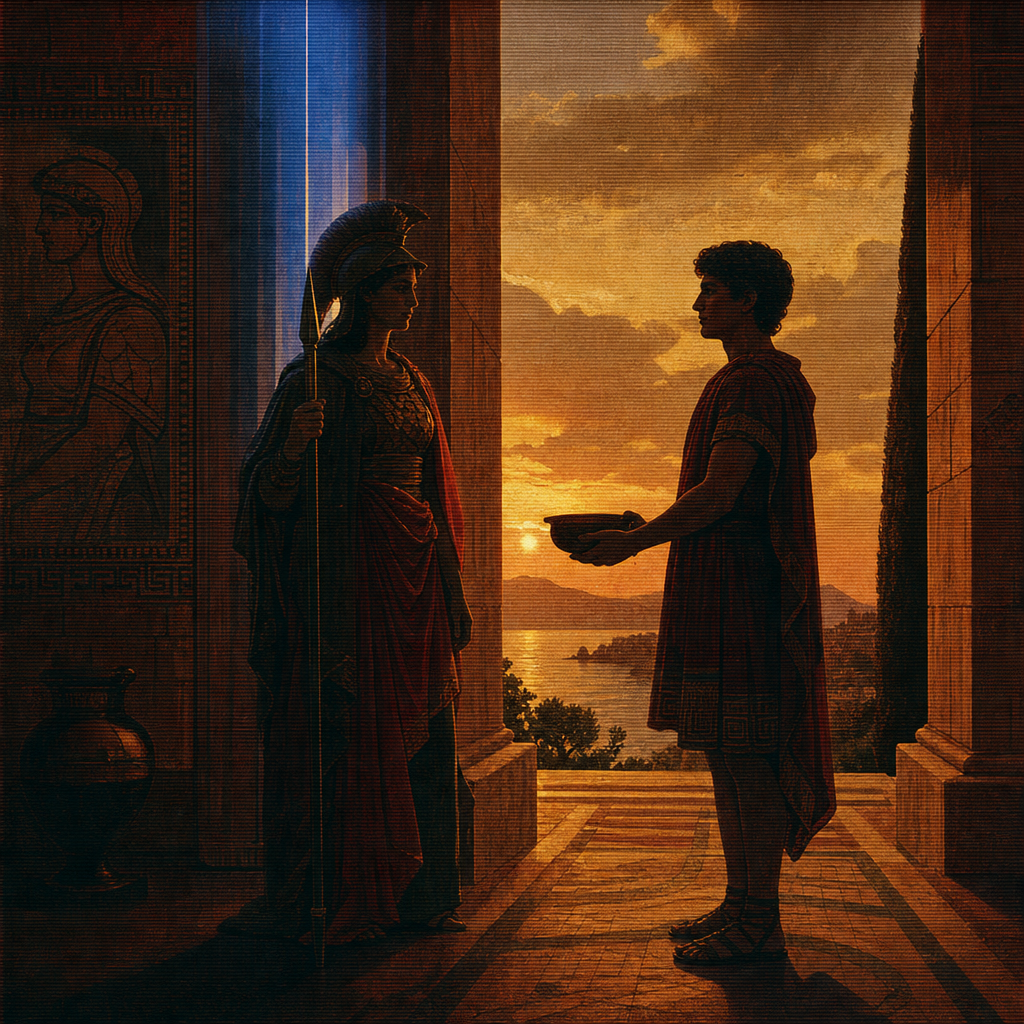
The Sun sprang up, leaving the lovely waters of the sea, into the brazen sky to shine for the immortals and for mortal men across the grain-giving earth. And the travelers came to Pylos, the well-built city of Neleus, where the people on the seashore were offering sacrifices—bulls pitch-black all over—to the dark-haired Earth-Shaker. There were nine seated companies, with five hundred men sitting in each, and each company presented nine bulls. Just as the Pylians were tasting the inner meats and burning the thigh-bones for the god, the travelers steered straight to shore, lifted and furled the sail of their balanced ship, moored her, and stepped out themselves. Telemachus too stepped from the ship, and Athena led the way.
Read Ancient Greek Source (Odyssey.3.1–Odyssey.3.12)
The bright-eyed goddess Athena spoke to him first: "Telemachus, you must not hang back in shyness any longer, not even a little; for this is why you sailed across the sea—to ask for news of your father, where the earth hides him and what fate he met. Come now, go straight to Nestor, tamer of horses; let us learn what counsel he keeps hidden in his breast. Entreat him yourself to tell you the unerring truth; he will not tell a lie, for he is very wise."
Read Ancient Greek Source (Odyssey.3.13–Odyssey.3.20)
Thoughtful Telemachus answered her in turn: "Mentor, how should I go up to him? How should I greet him? I have no experience yet in speaking with good judgment, and a young man feels shy questioning an older man."
Read Ancient Greek Source (Odyssey.3.21–Odyssey.3.24)
Then the bright-eyed goddess Athena said to him: "Telemachus, some things you will think of in your own mind, and a god will put others there too; for I do not believe you were born and raised against the will of the gods."
Read Ancient Greek Source (Odyssey.3.25–Odyssey.3.28)
Speaking so, Pallas Athena led the way with quick strides, and he walked behind in the footsteps of the deity. They came to the gathering and the rows of the men of Pylos, where Nestor sat with his sons, while around them their companions were preparing the feast, roasting some of the meat and skewering the rest. As soon as they saw the strangers, they all crowded forward together, clasped their hands in welcome, and urged them to sit down. First Peisistratus, Nestor's son, came up close, took them both by the hand, and seated them at the feast on soft fleeces over the sea-sand, beside his brother Thrasymedes and his father.
Read Ancient Greek Source (Odyssey.3.29–Odyssey.3.39)
Then he gave them portions of the inner meats, poured wine into a golden cup, and lifting it in welcome, spoke to Pallas Athena, daughter of Zeus who bears the aegis: "Pray now, stranger, to Lord Poseidon, for his is the feast you have chanced upon in coming here. And when you have poured a libation and prayed, as custom requires, hand this man too the cup of honey-sweet wine to pour his offering, since I think he too prays to the immortals; all people have need of the gods. Still, he is younger, a man of my own age, and so I will give the golden goblet to you first."
Read Ancient Greek Source (Odyssey.3.40–Odyssey.3.50)
With these words he placed the cup of sweet wine in her hand; and Athena was pleased with the sensible, upright man, because he had given the golden goblet to her first. At once she prayed earnestly to Lord Poseidon: "Hear me, Poseidon, Earth-Holder, and do not begrudge bringing these endeavors to fulfillment for us who pray to you. First of all, grant glory to Nestor and his sons; and then grant a gracious reward to all the other men of Pylos in return for this splendid hecatomb. And grant besides that Telemachus and I return home having accomplished what we came here for in our swift black ship." So she prayed, and she herself was bringing it all to pass. Then she handed Telemachus the fine two-handled cup, and in the same way Odysseus's dear son offered his prayer.
Read Ancient Greek Source (Odyssey.3.51–Odyssey.3.64)
When the others had roasted the outer cuts of meat and drawn them off the spits, they divided the portions and shared the glorious feast. When they had put aside their desire for food and drink, Nestor, the horseman of Gerenia, began to speak among them: "Now it is more fitting to question and ask our guests who they are, since they have enjoyed their meal. Strangers, who are you? From where do you sail the watery ways? Are you out on some business, or do you rove at random like raiders across the sea, who wander staking their own lives and bringing ruin to men of foreign lands?"
Read Ancient Greek Source (Odyssey.3.65–Odyssey.3.74)
Thoughtful Telemachus answered him in turn, taking heart, for Athena herself had set courage in his mind so that he would ask Nestor about his absent father and win a noble reputation for himself among men: "Nestor, son of Neleus, great glory of the Achaeans, you ask where we are from, and I will tell you. We have come from Ithaca, beneath Mount Neion; and this business I speak of is my own, not a public matter. I am following after any far-reaching report I may hear of my father, godlike, steadfast Odysseus, who they say once fought at your side and sacked the city of the Trojans. For of all the others who warred against the Trojans, we have heard where each man died a grim death; but even that man's death the son of Cronus has left beyond all hearing. No one can say for certain where he perished—whether he was cut down on the mainland by hostile men, or out on the open sea among the waves of Amphitrite.
Read Ancient Greek Source (Odyssey.3.75–Odyssey.3.91)
"That is why I have come now to your knees, in hope that you are willing to tell of his grim death, whether you saw it somewhere with your own eyes, or heard the story from some other wanderer; for his mother bore him more wretched than any other man. Do not soften your words out of respect or pity for me, but tell me plainly what you saw. I beg you—if ever my father, noble Odysseus, promised you any word or deed and made it good in the land of the Trojans, where you Achaeans suffered so much grief, remember it for me now, and tell me the unerring truth."
Read Ancient Greek Source (Odyssey.3.92–Odyssey.3.101)
Then Nestor, the horseman of Gerenia, answered him: "My friend, you have reminded me of the misery we sons of the Achaeans, unchecked in our fury, endured in that land: all we went through with our ships over the misty sea, roaming after plunder wherever Achilles led, and all our battles around the great city of King Priam. There, in the end, all our best men were slain. There warlike Ajax lies, and there Achilles; there lies Patroclus, a counselor equal to the gods, and there my own dear son, both strong and faultless, Antilochus, unmatched in speed of foot and as a fighter. And we suffered many other evils besides those; who among mortal men could ever tell the whole of them? Not even if you stayed beside me five years or six and asked about all the miseries the noble Achaeans suffered there—long before the end, you would grow weary and go home to your fatherland.
Read Ancient Greek Source (Odyssey.3.102–Odyssey.3.117)
"For nine years we worked constantly at weaving ruin for them with every kind of stratagem, and only with difficulty did the son of Cronus bring it to pass. There no man ever wished to match wits face-to-face with noble Odysseus, for he far surpassed them all in every kind of stratagem—your father, if indeed you are truly his son. Wonder holds me as I look at you; for truly your words are like his, nor would anyone think that a younger man could speak so much like him. While we were there, noble Odysseus and I never once spoke at odds in the assembly or in council, but sharing one mind, in judgment and shrewd counsel, we planned for the Argives how things might go best of all.
Read Ancient Greek Source (Odyssey.3.118–Odyssey.3.129)
"But after we had sacked Priam's steep city and boarded our ships, and a god scattered the Achaeans, then indeed Zeus in his heart planned a bitter homecoming for the Argives, since by no means were they all sensible or just; and so many of them met a grim fate from the ruinous wrath of the bright-eyed daughter of the mighty father, who set a quarrel between the two sons of Atreus. The two brothers summoned all the Achaeans to an assembly—recklessly, out of all proper order, at sunset, and the sons of the Achaeans came heavy with wine—and spoke their word, telling why they had gathered the army. There Menelaus urged all the Achaeans to set their minds on homecoming across the broad back of the sea; but that did not please Agamemnon at all, for he wanted to hold the army back and offer sacred hecatombs, so that he might appease Athena's terrible anger—fool that he was, not knowing that she was not about to be persuaded; for the mind of the gods who live forever is not quickly turned. So the two of them stood trading harsh words; and the Achaeans in fine leg armor sprang up with a tremendous roar, divided in their counsel. We spent the night brooding on bitter thoughts against one another, for Zeus was preparing a calamity of evil. At dawn some of us hauled our ships down into the bright sea and loaded our goods aboard, along with the deep-girdled women. Half the army held back and stayed behind right there with Agamemnon, son of Atreus, shepherd of the people, while the other half of us embarked and rowed out; and the ships sailed very swiftly, for a god smoothed the monster-filled deep.
Read Ancient Greek Source (Odyssey.3.130–Odyssey.3.158)
"When we reached Tenedos, we offered sacrifices to the gods, eager for home; but Zeus, relentless as he was, was not yet planning our homecoming, and he stirred up an ugly quarrel a second time. Some turned their curved ships around and went back—those with lord Odysseus, that wise-hearted man of many wiles—doing a favor once more to Agamemnon, son of Atreus. But I, with the massed ships that followed me, fled on, since I recognized that the god was planning evil. The warlike son of Tydeus fled too, and urged on his companions. Fair-haired Menelaus followed the two of us later; he caught up with us at Lesbos as we were debating the long voyage—whether we should sail seaward above craggy Chios, toward the island of Psyria, keeping it on our left, or below Chios, past windy Mimas. We asked the god to show us a sign, and he showed one, and bade us cut straight across the open sea to Euboea, so that we might escape out from under disaster as quickly as possible. A shrill fair wind sprang up to blow, and the ships ran very swiftly across the fish-filled ways and put in at Geraestus in the night; and to Poseidon we laid many thigh-bones of bulls upon the altar, now that we had measured that great expanse of sea. It was the fourth day when, in Argos, the companions of Diomedes, son of Tydeus, tamer of horses, moored their balanced ships; while I held my course for Pylos, and the fair wind never died down from the moment the god first sent it to blow.
Read Ancient Greek Source (Odyssey.3.159–Odyssey.3.183)
"So I came home, dear child, without news, and I know nothing of those others—which of the Achaeans were saved and which were lost. But whatever I have heard while sitting here in our halls, you shall learn, as is right, and I will not hide it from you. They say the spear-fighting Myrmidons came home safely, led by the glorious son of great-hearted Achilles; and safely too came Philoctetes, the splendid son of Poias. Idomeneus brought all his companions back to Crete, all who escaped the war, and the sea robbed him of not a single man. As for Agamemnon, son of Atreus, even you have heard, far off though you live, how he came home, and how Aegisthus devised his bitter destruction. Yet Aegisthus truly paid a miserable price for it. How good a thing it is for a man who perishes to leave a son behind, since that son, Orestes, took vengeance on his father's killer, treacherous Aegisthus, who had slain his famous father. And you too, my friend—for I see you are very handsome and tall—be brave, so that men born even in future days may speak well of you."
Read Ancient Greek Source (Odyssey.3.184–Odyssey.3.200)
Thoughtful Telemachus answered him in turn: "Nestor, son of Neleus, great glory of the Achaeans, yes indeed, that man took full vengeance, and the Achaeans will carry his fame far and wide, even for generations to come to hear. If only the gods would clothe me in such strength, to pay back the suitors for their painful transgression—men who insult me and contrive reckless outrages. But the gods have spun no such fortune for me, for my father and for me; and now I must simply endure it all the same."
Read Ancient Greek Source (Odyssey.3.201–Odyssey.3.209)
Then Nestor, the horseman of Gerenia, answered him: "My friend, since you speak of these things and bring them to my mind, they say that many suitors, courting your mother, contrive evils in your halls against your will. Tell me, do you submit to this willingly, or do the people throughout the land hate you, following the voice of some god? Who knows if your father may yet come home someday and pay them back for their violence, either alone by himself or with all the Achaeans together? If only bright-eyed Athena chose to love you as fiercely as she cared for glorious Odysseus back then in the land of the Trojans, where we Achaeans suffered such grief—for I have never seen the gods show their love so openly as Pallas Athena stood openly by his side—if she chose to love you like that and care for you in her heart, then more than one of those men would soon forget all about marriage."
Read Ancient Greek Source (Odyssey.3.210–Odyssey.3.224)
Thoughtful Telemachus answered him in turn: "Old sir, I do not think this word of yours will ever come true. What you say is far too great; awe holds me. Even if I hoped for it, such things could never happen for me—not even if the gods willed it so."
Read Ancient Greek Source (Odyssey.3.225–Odyssey.3.228)
Then the bright-eyed goddess Athena spoke to him: "Telemachus, what kind of word has slipped past the barrier of your teeth? A god who wishes to can easily save a man, even from far away. As for me, I would rather endure many hard griefs and come home at last to see the day of my return, than come back and be killed at my own hearth, as Agamemnon perished through the treachery of Aegisthus and of his own wife. Yet death, which comes to all alike, is something not even the gods can ward off even from a man they love, once the ruinous fate of death that lays men low overtakes him."
Read Ancient Greek Source (Odyssey.3.229–Odyssey.3.238)
Thoughtful Telemachus answered her in turn: "Mentor, let us not speak of these things any longer, grieved though we are. For him there is no true homecoming anymore; already the immortals have devised death and black fate for him. Now I want to ask about another matter and question Nestor, since he knows justice and wisdom beyond all others. For they say he has been king across three generations of men, so that to my eyes he looks like an immortal to gaze upon. Nestor, son of Neleus, tell me the truth: how did Atreus's son, wide-ruling Agamemnon, die? Where was Menelaus? And what kind of destruction did treacherous Aegisthus plot against Agamemnon, since he killed a man far stronger than himself? Was Menelaus not in Achaean Argos, but wandering somewhere else among foreign peoples, so that Aegisthus took courage and killed Agamemnon?"
Read Ancient Greek Source (Odyssey.3.239–Odyssey.3.252)
Then Nestor, the horseman of Gerenia, answered him: "Then I will tell you the whole truth, my child. Indeed, you yourself can guess how things would have turned out if fair-haired Menelaus, son of Atreus, had found Aegisthus still alive in the halls when he came back from Troy. Then not even in death would they have heaped earth over Aegisthus's body, but dogs and birds of prey would have torn him apart as he lay on the plain far outside the city, and not one of the Achaean women would have wept for him, for he plotted a monstrous deed. For while we were completing many hard struggles over there, he sat at ease in the heart of horse-pasturing Argos, constantly charming Agamemnon's wife with his words. At first, to be sure, noble Clytemnestra refused the shameful deed, for she had a good and sensible mind; and with her too was a singer, a man to whom Agamemnon, son of Atreus, when he set out for Troy, had given strict orders to guard his wife. But when the fate of the gods bound her to be overcome, then Aegisthus took the singer away to a deserted island and left him there to become prey and spoil for the birds, and led her to his own house, a willing woman with a willing man. Many thigh-bones he burned on the sacred altars of the gods, and many offerings he hung up, woven tapestries and gold, now that he had accomplished a great work he had never hoped for in his heart.
Read Ancient Greek Source (Odyssey.3.253–Odyssey.3.275)
"For we were sailing together on our way back from Troy, Menelaus, son of Atreus, and I, in warm friendship with one another. But when we reached sacred Sunium, the headland of Athens, there Phoebus Apollo attacked Menelaus's steersman and killed him with his gentle shafts while he held the steering-oar of the running ship in his hands. This was Phrontis, son of Onetor, and he surpassed all the tribes of men at steering a ship whenever storm winds bore down hard. So Menelaus was delayed there, eager though he was for the journey, to bury his companion and perform his funeral rites. But when he too sailed out across the wine-dark sea in his hollow ships and sped to the steep mountain of Malea, then far-voiced Zeus devised a hateful journey for him, and poured out the blast of shrill winds, and monstrous waves swelled up, as huge as mountains. There Zeus split the fleet and drove part of the ships toward Crete, where the Cydonians lived around the streams of the Iardanus. There is a smooth, sheer cliff rising straight out of the sea at the farthest edge of Gortyn in the misty deep, where the South Wind drives a great wave against the left-hand headland toward Phaestus, and a small rock holds back the great wave. Those ships came in there, and the men barely escaped destruction, though the waves smashed the ships themselves against the reefs. As for the other five dark-prowed ships, the wind and water carried them on and drove them to Egypt.
Read Ancient Greek Source (Odyssey.3.276–Odyssey.3.300)
"So while Menelaus was there gathering much wealth and gold, wandering with his ships among peoples of foreign speech, all that time Aegisthus contrived these grim deeds at home. For seven years he ruled over Mycenae rich in gold after killing Atreus's son, and the people were bowed down under his rule. But in the eighth year, noble Orestes came back from Athens, bringing ruin on Aegisthus, and killed his father's murderer, treacherous Aegisthus, who had slain his famous father. When he had killed him, Orestes gave a funeral feast to the Argives for his hateful mother and the coward Aegisthus; and on that very day Menelaus, good at the war-cry, arrived, bringing home all the treasures his ships could carry as cargo.
Read Ancient Greek Source (Odyssey.3.301–Odyssey.3.312)
"And as for you, my friend, do not wander long far from home, leaving your wealth behind and men inside your halls so arrogant as these, lest they devour all that you have, dividing up your possessions, and your journey turn out to be in vain. Still, I urge and command you to go to Menelaus, for he has only just returned from distant lands, from peoples so far off that no man could hope in his heart to return, once the storm winds have driven him off course into so vast a sea that not even the birds can fly back from it in the same year, since it is huge and terrible. So go now with your ship and your companions; or if you wish to travel by land, a chariot and horses are here for you, and my sons are at your service to be your guides to noble Lacedaemon, where fair-haired Menelaus lives. Entreat him yourself to tell you the unerring truth; he will not tell a lie, for he is very wise."
Read Ancient Greek Source (Odyssey.3.313–Odyssey.3.328)
So he spoke, and the sun went down and darkness came on. Then the bright-eyed goddess Athena spoke among them: "Old sir, you have truly told all this as is fitting. But come, cut out the tongues and mix the wine, so that after we have poured libations to Poseidon and the other immortals, we may turn our thoughts to sleep, for it is the hour for that. Already the light has gone down beneath the gloom, and it is not fitting to sit long at the feast of the gods, but to go our way."
Read Ancient Greek Source (Odyssey.3.329–Odyssey.3.336)
So spoke the daughter of Zeus, and they listened to her voice. Heralds poured water over their hands, and young men brimmed the mixing bowls with drink and served it to all, pouring the first drops into the cups. They cast the tongues onto the fire, and stood up and poured libations over them. Then, when they had poured libations and drunk as much as their hearts desired, Athena and godlike Telemachus both started out to return to their hollow ship. But Nestor held them back, pressing them with his words: "May Zeus forbid this, and the other immortal gods, that you should leave my side to go to your swift ship as though from a man utterly lacking in clothes and poor, who does not have plenty of cloaks and thick blankets in his house for either himself or his guests to sleep in softly. No, in my house there are cloaks and fine blankets. Never indeed shall the dear son of that man Odysseus lie down to sleep on a ship's deck, so long as I am alive, or while my sons are left behind in my halls to welcome guests—whoever may come to my house."
Read Ancient Greek Source (Odyssey.3.337–Odyssey.3.355)
Then the bright-eyed goddess Athena answered him: "You have spoken this well, dear old sir, and it is right for Telemachus to obey you, since it is much better that way. So he will go with you now to sleep in your halls; as for me, I will go to the black ship to hearten the crew and tell them every detail. For I can claim to be the only older man among them; the others are younger men who follow out of friendship, all of them the same age as great-hearted Telemachus. There I will lie down beside the hollow black ship for now, and at dawn I will go to the great-hearted Caucones, where a debt is owed to me—neither a new one nor a small one. And as for this young man, since he has come to your house, send him on his way with a chariot and your son, and give him the horses that are your lightest of foot for running and finest in strength."
Read Ancient Greek Source (Odyssey.3.356–Odyssey.3.370)
Having spoken thus, bright-eyed Athena departed in the likeness of a sea-eagle, and wonder seized all who saw it. The old man marveled when he saw it with his own eyes; he took Telemachus by the hand, spoke to him, and addressed him directly: "My friend, I do not think you will prove a coward or a weakling, if indeed, young as you are, the gods accompany you as guides like this. For this was no other of those who hold the homes of Olympus, but the daughter of Zeus, most glorious Tritogeneia, who also honored your noble father among the Argives. Be gracious, Queen, and grant fine glory to me—to myself, my children, and my revered wife. And in turn I will sacrifice to you a yearling heifer, broad-browed and unbroken, which no man has yet led beneath the yoke; her I will sacrifice to you, after overlaying her horns with gold." So he spoke in prayer, and Pallas Athena heard him.
Read Ancient Greek Source (Odyssey.3.371–Odyssey.3.385)
Then Nestor, the horseman of Gerenia, led the way for them—his sons and his sons-in-law—to his fine halls. When they reached the famous house of that lord, they sat down in order on armchairs and high seats. As they arrived, the old man mixed a bowl for them of sweet-drinking wine, which in its eleventh year the housekeeper had opened, unfastening its sealed cover. Of this the old man mixed a bowl, and earnestly he prayed to Athena as he poured libations, to the daughter of Zeus who bears the aegis. Then, when they had poured libations and drunk as much as their hearts desired, the others went off, each to his own home, to lie down to sleep. But Nestor, the horseman of Gerenia, gave Telemachus, the dear son of godlike Odysseus, a bed right there on a corded bedstead beneath the echoing portico, and beside him Peisistratus of the good ash spear, a leader of men, who among Nestor's sons in the halls was still unmarried. Nestor himself slept in the innermost chamber of the high house, where his lady wife made his bed ready.
Read Ancient Greek Source (Odyssey.3.386–Odyssey.3.403)
When early-born, rosy-fingered Dawn appeared, Nestor, the horseman of Gerenia, rose from his bed, came outside, and sat down on the polished stones that stood before his high doors, white and glistening with oil. Upon them in former days Neleus used to sit, a counselor equal to the gods; but he had already been overcome by fate and gone down to the house of Hades, and now Gerenian Nestor sat there in his turn, guardian of the Achaeans, holding his scepter. Around him his sons gathered together as they came from their bedrooms: Echephron and Stratius, Perseus and Aretus and godlike Thrasymedes. Then the hero Peisistratus came to join them as the sixth, and they led godlike Telemachus in and seated him beside them.
Read Ancient Greek Source (Odyssey.3.404–Odyssey.3.416)
Then Nestor, the horseman of Gerenia, began to speak among them: "Quickly, dear children, fulfill my wish, so that, of all the gods, I may first win the favor of Athena, who came to me in visible form at the rich feast of the god. Come then: let one of you go to the plain for a heifer, so that she may get here as quickly as possible, and let the cattle herdsman drive her in. Let another go to great-hearted Telemachus's black ship and bring all his companions, leaving only two behind; and let one more bid the goldsmith Laerces come here, so that he may overlay the heifer's horns with gold. The rest of you stay together right here, and tell the enslaved women inside the splendid halls to prepare a feast, and to fetch seats, firewood to set around, and bright water."
Read Ancient Greek Source (Odyssey.3.417–Odyssey.3.429)
So he spoke, and they all hurried to obey. The heifer came from the plain, and from the swift, balanced ship came the companions of great-hearted Telemachus; the smith came too, holding in his hands the bronze tools that accomplish his craft—the anvil, the hammer, and the well-made tongs with which he worked the gold. And Athena came to receive the sacrifice. The old horse-driver Nestor gave out the gold, and the smith then overlaid it around the heifer's horns, working it skillfully, so the goddess would rejoice when she saw the offering. Stratius and noble Echephron led the heifer forward by the horns. Aretus brought water for washing hands in a flower-patterned basin, coming out from the storeroom, and in his other hand he held barley grains in a basket; and Thrasymedes, steadfast in war, stood by holding a sharp axe in his hand to strike down the heifer. Perseus held the blood-bowl. The old horse-driver Nestor began the rite with the washing water and the scattered barley, and to Athena he prayed earnestly as he made the first offering, throwing hairs from the heifer's head into the fire. Now when they had prayed and cast the barley grains forward, at once Nestor's high-spirited son Thrasymedes stepped up close and struck; the axe sheared through the tendons of the neck and unstrung the heifer's strength. Then the women raised the ritual cry—the daughters, the daughters-in-law, and the revered wife of Nestor, Eurydice, eldest of the daughters of Clymenus. The men then lifted the heifer up from the wide-wayed earth and held her fast, while Peisistratus, leader of men, slit her throat. When the dark blood had flowed out of her and the life had left her bones, they quickly cut up the carcass and at once carved out the thigh-bones, all in due order, wrapped them in fat folded double, and laid raw strips of meat on top of them. The old man burned them on split firewood and poured sparkling dark wine over them, while the young men stood beside him holding five-pronged forks in their hands. When the thigh-pieces were burned up and they had tasted the inner meats, they sliced the rest of the meat into pieces, pierced them on spits, and roasted them, holding the sharp-pointed spits in their hands.
Read Ancient Greek Source (Odyssey.3.430–Odyssey.3.463)
Meanwhile, beautiful Polycaste, the youngest daughter of Nestor, son of Neleus, bathed Telemachus. When she had bathed him and rubbed him richly with olive oil, and draped a fine cloak and a tunic around him, he stepped out of the bath looking in build like the immortals, and went and sat down beside Nestor, shepherd of the people. When the others had roasted the outer cuts of meat and drawn them off the spits, they sat down and feasted, and worthy men rose to attend them, pouring wine into golden cups. When they had put aside their desire for food and drink, Nestor, the horseman of Gerenia, began to speak among them: "My sons, come now, lead out the fine-maned horses for Telemachus and yoke them under the chariot, so that he may get on with his journey."
Read Ancient Greek Source (Odyssey.3.464–Odyssey.3.476)
So he spoke, and they listened readily to him and obeyed, and quickly yoked the swift horses under the chariot. In it the housekeeper packed bread and wine, and savory meats of the sort that kings cherished by Zeus eat. Telemachus climbed into the splendid chariot, and beside him Peisistratus, Nestor's son, leader of men, mounted the chariot and took the reins in his hands. He cracked the whip to drive them on, and the two horses flew willingly out onto the plain, leaving the steep citadel of Pylos behind. All day long they shook the yoke they bore between them. The sun went down and all the roads grew dark as they reached Pherae and came to the house of Diocles, son of Ortilochus, whom the river Alpheus fathered. There they spent the night, and Diocles set a meal before them as his guests. When early-born, rosy-fingered Dawn appeared, they yoked the horses and climbed into the brightly worked chariot, and drove out through the gateway and the echoing portico. He cracked the whip to drive them on, and the two horses flew willingly. They came to the wheat-bearing plain, and from there they pressed on to finish their journey, so swiftly did the fast horses carry them. The sun went down and all the roads grew dark.