Book 16: The Death of Patroclus
Ἰλιάς · Book 16 · Classix Modern English Reading Edition
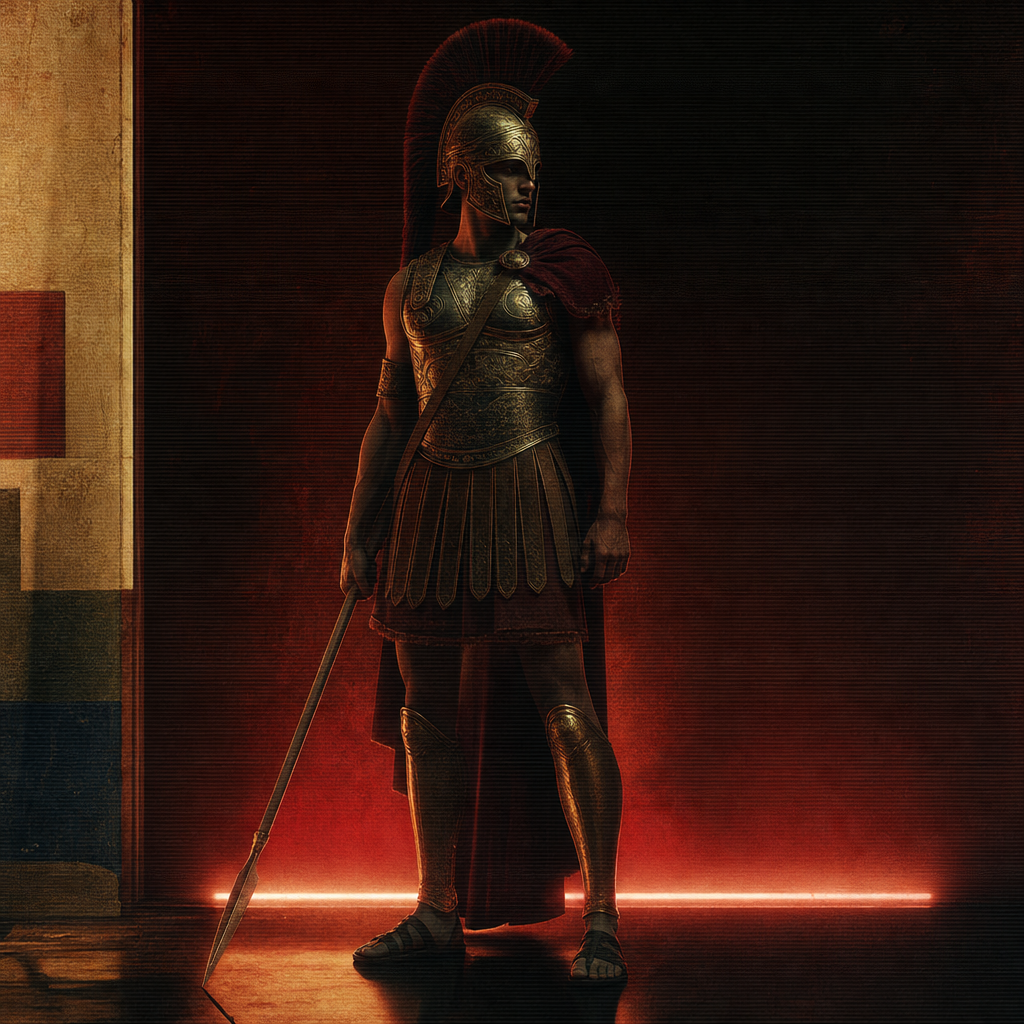
So they fought on around the strong-benched ship. Meanwhile Patroclus came and stood beside Achilles, shepherd of the people, shedding hot tears like a dark-watered spring that pours its shadowy stream down the face of a sheer cliff. When godlike, swift-footed Achilles saw him, he felt pity, and spoke to him in winged words:
Read Ancient Greek Source (Iliad.16.1–Iliad.16.6)
"Why are you in tears, Patroclus, like a little girl who runs beside her mother and begs to be picked up, tugging at her dress to hold her back as she hurries along, looking up at her through tears until she lifts her in her arms? Just like her, Patroclus, you let the soft tears fall. Have you something to tell the Myrmidons, or me myself, or have you alone heard some news from Phthia? Yet they say Menoetius, Actor's son, is still alive, and does not Peleus, son of Aeacus, still live among the Myrmidons? Either of their deaths would grieve us both deeply. Or are you weeping over the Argives, because they are being destroyed beside the hollow ships for their own transgression? Speak out, do not hide it in your mind, so that we both may know."
Read Ancient Greek Source (Iliad.16.7–Iliad.16.19)
With a heavy groan you answered him, Patroclus, master of horses: "Achilles, son of Peleus, by far the greatest of the Achaeans, do not be angry with me; such grief has overwhelmed the Achaeans. For all those who used to be our finest fighters now lie among the ships, struck from afar or stabbed at close quarters. Strong Diomedes, son of Tydeus, has been hit by a shaft; Odysseus, famed for his spear, and Agamemnon have been wounded by spear-thrusts; and Eurypylus too has been shot in the thigh with an arrow. Healers skilled in many remedies are tending them now, dressing their wounds—while you remain impossible to deal with, Achilles.
Read Ancient Greek Source (Iliad.16.20–Iliad.16.29)
"May such anger never take hold of me, this rage you nurse, brave to our ruin! What good will you be to anyone, even in generations to come, if you do not ward off shameful destruction from the Argives now? Pitiless man—the horseman Peleus was never your father, nor was Thetis your mother; the grey sea bore you, and the towering crags, so harsh and unyielding is your mind. But if there is some prophecy you are shunning in your heart, and your revered mother has told you some word from Zeus, at least send me out quickly, and give me the rest of the Myrmidon army to follow me, so that I may become some light of rescue to the Danaans. And give me your armor to strap across my shoulders, in the hope that the Trojans may mistake me for you and hold back from the fighting, and the warlike sons of the Achaeans may catch their breath in their exhaustion—for in war even a brief breathing space is enough. Fresh as we are, we could easily drive men worn out with the battle cry back toward the city, away from the ships and the shelters."
Read Ancient Greek Source (Iliad.16.30–Iliad.16.45)
So he pleaded in his blind folly, for what he was begging for was his own bitter death and doom. Deeply troubled, swift-footed Achilles answered him:
Read Ancient Greek Source (Iliad.16.46–Iliad.16.48)
"Ah, Zeus-born Patroclus, what a thing you have said! I am not heeding any prophecy that I know of, nor has my revered mother told me any word from Zeus. No, this is the terrible grief that comes over my heart and spirit, when a man chooses to rob his equal and take back his prize of honor simply because he surpasses him in power. That is a terrible grief to me, after all the pains I have suffered in my heart. The girl the sons of the Achaeans chose out for me as a prize, whom I won with my own spear after sacking a strong-walled city—Lord Agamemnon, son of Atreus, took her back out of my hands as if I were some dishonored outsider without rights.
Read Ancient Greek Source (Iliad.16.49–Iliad.16.59)
"Still, let what is past be past; a man could not keep rage burning forever in his heart. True, I said I would not end my wrath until the battle cry and the fighting reached my own ships. Carry my glorious armor on your shoulders, then, and lead the war-loving Myrmidons into battle, since a dark cloud of Trojans has closed in overwhelming force around the ships, and the Argives are pinned back against the breakers of the sea, holding only a narrow strip of ground. The whole city of Troy has marched out against them boldly, because they do not see the front of my helmet blazing near at hand. Soon enough they would be fleeing and filling the gullies with their dead, if Lord Agamemnon were kindly disposed toward me—whereas now they are fighting all around our camp. For the spear does not rage in the hands of Diomedes, son of Tydeus, to ward off destruction from the Danaans, nor have I heard the voice of Atreus's son shouting from his hated head; instead it is the voice of man-slaying Hector that rings all around as he urges on the Trojans, and with their war cries they hold the whole plain, defeating the Achaeans in battle. Even so, Patroclus, ward off ruin from the ships and fall upon them in full strength, lest they burn the ships with blazing fire and take away our cherished return home.
Read Ancient Greek Source (Iliad.16.60–Iliad.16.82)
"Obey me now, just as I lay the sum of my word in your heart, so that you may win great honor and glory for me from all the Danaans, and make them send back the lovely girl and give me splendid gifts besides. Once you have driven the enemy from the ships, come back. Even if Hera's loud-thundering husband grants that you win glory, do not be eager to fight the war-loving Trojans apart from me, or you will make me more dishonored still. And do not, exulting in war and slaughter, lead the men on toward Ilion as you cut down Trojans, lest one of the ever-living gods step down from Olympus against you—for far-working Apollo loves them dearly. Turn back instead as soon as you have brought the light of rescue to the ships, and leave the others to fight it out across the plain. Father Zeus, Athena, and Apollo—if only not a single Trojan of all there are might escape death, nor a single one of the Argives, and the two of us might escape destruction, so that we alone could undo the sacred battlements of Troy!"
Read Ancient Greek Source (Iliad.16.83–Iliad.16.100)
So they spoke to one another, while Ajax could hold his ground no longer, overwhelmed by missiles. Both the will of Zeus and the proud Trojans were breaking him with their volleys; around his temples his shining helmet rang terribly under the blows, struck again and again on its well-wrought cheek-pieces. His left shoulder grew weary from holding his glancing shield ever steady, yet they could not budge him where he stood, for all the weapons they drove against him. Painful gasping racked him without cease, sweat poured in streams from every limb, and he had no chance at all to catch his breath; on every side, trouble was piled hard upon trouble.
Read Ancient Greek Source (Iliad.16.101–Iliad.16.111)
Tell me now, Muses who keep your halls on Olympus, how fire first fell upon the ships of the Achaeans. Hector stepped in close and struck Ajax's ash spear with his great sword right behind the socket of the point, shearing it clean through. Telamonian Ajax brandished the lopped shaft in his hand in vain, while far from him the bronze spearhead fell ringing to the ground. Ajax recognized the work of the gods in his noble heart and shuddered, seeing that high-thundering Zeus was cutting short every plan of his fighting and willed victory for the Trojans. He drew back out of range of the missiles, and the Trojans hurled tireless fire onto the swift ship; at once unquenchable flame poured over her.
Read Ancient Greek Source (Iliad.16.112–Iliad.16.123)
So the fire wrapped her stern, while Achilles slapped both his thighs and spoke to Patroclus: "Up, Zeus-born Patroclus, driver of horses! I see the rush of hostile fire beside the ships. They must not take the ships and leave us no way of escape. Put on the armor quickly, while I gather the men."
Read Ancient Greek Source (Iliad.16.124–Iliad.16.129)
So he spoke, and Patroclus armed himself in gleaming bronze. First he placed the fine greaves around his shins, fitted with silver ankle-clasps. Next he put on around his chest the richly worked, starry breastplate of Aeacus's swift-footed grandson. Around his shoulders he slung the bronze, silver-studded sword, and after it the great, sturdy shield. Upon his mighty head he set the well-made helmet with its horsehair crest, and the plume nodded terribly from above. He took two strong spears that fitted his grip. Only the spear of Aeacus's blameless grandson he did not take—heavy, huge, and sturdy; no other Achaean could wield it, but Achilles alone knew how to brandish that Pelian ash spear, which Chiron had given Achilles's dear father from the peak of Pelion to be slaughter for heroes.
Read Ancient Greek Source (Iliad.16.130–Iliad.16.144)
Then he ordered Automedon to yoke the horses quickly—the man he honored most after Achilles, breaker of men, and his most faithful comrade in battle to stand fast against the enemy's roar. For him Automedon led the swift horses under the yoke: Xanthus and Balius, who flew like the blasts of the wind, whom the Harpy Podarge bore to the West Wind Zephyrus as she grazed in a meadow beside the stream of Oceanus. In the side-traces he harnessed faultless Pedasus, whom Achilles had brought back when he took Eetion's city, and though he was mortal, he kept pace with immortal horses.
Read Ancient Greek Source (Iliad.16.145–Iliad.16.154)
Meanwhile Achilles went through the shelters and armed all the Myrmidons in their war-gear. They were like raw-flesh-eating wolves with unspeakable fury in their hearts, wolves that have killed a great antlered stag in the mountains and tear it apart until all their jaws are red with blood; then in a pack they go to lap with their slender tongues the surface of the black water from a dark-watered spring, belching up bloody gore, while the spirit in their chests is fearless and their bellies are crammed tight. Just so the leaders and captains of the Myrmidons surged around the noble attendant of Aeacus's swift-footed grandson, and among them stood warlike Achilles, urging on both horses and shield-bearing men.
Read Ancient Greek Source (Iliad.16.155–Iliad.16.167)
Fifty were the swift ships that Achilles, dear to Zeus, had led to Troy, and in each ship sat fifty men, comrades at the oar-benches. He had appointed five commanders whom he trusted to give orders, while he himself ruled over all in sovereign power. One division was led by Menesthius of the flashing breastplate, son of the rain-fed river Spercheius; Peleus's daughter, lovely Polydora, had borne him to tireless Spercheius, a mortal woman bedded with a god—though by name he was attributed to Borus, son of Perieres, who married her openly after giving countless bride-gifts.
Read Ancient Greek Source (Iliad.16.168–Iliad.16.178)
The second division warlike Eudorus commanded, born to an unwed mother—Polymela, lovely in the dance, the daughter of Phylas. The strong slayer of Argus fell in love with her when his eyes saw her among the singing girls in the choir of Artemis of the golden spindle and the hunting cry. At once gracious Hermes went up to her upper chamber and lay with her in secret, and gave her a splendid son, Eudorus, unmatched in running and as a fighter. After Eileithyia, goddess of birth-pangs, brought him forth into the light and he saw the rays of the sun, mighty Echecles, son of Actor, led her home to his halls after giving countless bride-gifts, while old Phylas raised the boy well and cared for him, doting on him as if he were his own son.
Read Ancient Greek Source (Iliad.16.179–Iliad.16.192)
Warlike Peisander, son of Maemalus, commanded the third division. Among the Myrmidons, his skill with the spear was second only to that of Patroclus, the companion of Peleus's son. The fourth was led by the old horseman Phoenix, and the fifth by Alcimedon, blameless son of Laerces.
Read Ancient Greek Source (Iliad.16.193–Iliad.16.197)
When Achilles had marshaled them all in formation together with their leaders, he laid a stern charge upon them: "Myrmidons, let none of you forget the threats you kept making against the Trojans beside the swift ships through all the time of my wrath, when each of you reproached me: 'Hard-hearted son of Peleus, your mother nursed you on gall—pitiless man, keeping your comrades beside the ships against their will! Let us sail back home again in our sea-crossing ships, since such evil rage has fallen upon your spirit!' So you kept speaking against me as you gathered. Now the great work of battle that you longed for before lies open before you. There let every man with a brave heart fight the Trojans!"
Read Ancient Greek Source (Iliad.16.198–Iliad.16.209)
With these words he roused the strength and spirit of every man, and the ranks closed tighter once they heard their king. Just as a man fits together the wall of a high house with close-set stones to keep out the force of the winds, so their helmets and bossed shields locked together: shield braced against shield, helmet against helmet, man against man, and the horsehair-crested helmets brushed one another with their bright ridges as the men nodded, so tightly they stood packed together. In front of them all, two men armed themselves—Patroclus and Automedon, sharing a single spirit, to fight at the head of the Myrmidons.
Read Ancient Greek Source (Iliad.16.210–Iliad.16.220)
Meanwhile Achilles went into his shelter and opened the lid of a fine, richly worked chest that silver-footed Thetis had placed aboard his ship to carry, after packing it full of tunics, wind-breaking cloaks, and thick woolen rugs. In it he kept a wrought cup; no other man ever drank sparkling dark wine from it, nor did he pour libations from it to any of the gods except Father Zeus. Taking this cup from the chest, he purified it first with sulfur, and then washed it in fair streams of water. He washed his own hands and drew the sparkling dark wine. Then he stood in the middle of the courtyard and prayed, pouring out the wine as he looked up to heaven—and Zeus, who delights in thunder, did not fail to see him:
Read Ancient Greek Source (Iliad.16.221–Iliad.16.232)
"Lord Zeus of Dodona, Pelasgian, dwelling far away, ruling over wintry Dodona, where the Selloi dwell around you as your interpreters, men with unwashed feet who sleep on the ground: just as you heard my words once before when I prayed, and honored me and struck hard at the Achaean army, so even now fulfill this wish for me. For I myself will stay here in the gathering of the ships, while I send my comrade out with the many Myrmidons to fight. Send glory forth with him, far-sounding Zeus, and embolden the heart in his chest, so that Hector too may learn whether my attendant knows how to fight even by himself, or whether his invincible hands rage only when I myself enter the grind of Ares' war. And once he has driven the fighting and the battle cry away from the ships, let him return to me unharmed at the swift ships with all his armor and his close-fighting companions."
Read Ancient Greek Source (Iliad.16.233–Iliad.16.248)
So he spoke in prayer, and Zeus the counselor heard him. The Father granted Achilles one part of his prayer and refused the other: he granted that Patroclus would drive the war and fighting back from the ships, but refused to let him return safely from battle. Once Achilles had poured the libation and prayed to Father Zeus, he went back into his shelter and put the cup away in the chest, then came out and stood in front of the shelter, for in his heart he still wanted to watch the grim clash of Trojans and Achaeans.
Read Ancient Greek Source (Iliad.16.249–Iliad.16.256)
Meanwhile those who had armed alongside great-hearted Patroclus marched out in ranks until in high spirits they charged into the Trojans. At once they poured out like roadside wasps that boys make a habit of provoking, constantly tormenting them in their nests beside the road—foolish children, who create a common trouble for many. Then, if some traveler passing along the road accidentally stirs them up, with fearless hearts every one of them flies straight ahead to defend its young. With their heart and spirit the Myrmidons then poured out from the ships, and an unquenchable roar went up.
Read Ancient Greek Source (Iliad.16.257–Iliad.16.267)
Patroclus shouted aloud, calling on his companions: "Myrmidons, companions of Achilles, son of Peleus, be men, my friends, and remember your furious valor, so that we may honor the son of Peleus, who is by far the best of the Argives beside the ships, as are we, his close-fighting followers—and so that the son of Atreus, wide-ruling Agamemnon, may recognize his blind folly in honoring the best of the Achaeans not at all." With these words he roused the strength and spirit of every man, and in a tight mass they fell upon the Trojans; all around, the ships echoed terribly as the Achaeans raised their war cry.
Read Ancient Greek Source (Iliad.16.268–Iliad.16.277)
When the Trojans saw the brave son of Menoetius, him and his attendant gleaming in their armor, every man's spirit was shaken, and their battle lines wavered, for they thought that by the ships the swift-footed son of Peleus had cast aside his wrath and chosen friendship instead; and each man glanced around to see where he might escape sheer destruction. Patroclus was the first to hurl his shining spear straight into the middle of the press, where the thickest crowd was churning beside the stern of great-hearted Protesilaus's ship, and he struck Pyraechmes, who had led the Paeonian horsemen from Amydon, from the wide-flowing Axius River. He hit him on the right shoulder, and Pyraechmes fell backward in the dust with a groan; around him his Paeonian companions scattered in panic, for Patroclus drove terror into them all by killing their leader, who had been their finest fighter. He drove them from the ships and quenched the blazing fire. The ship was left there half-burned, while the Trojans fled in rout with an unearthly uproar, and the Danaans poured out among the hollow ships, raising a relentless din.
Read Ancient Greek Source (Iliad.16.278–Iliad.16.296)
And just as when, from the high peak of a great mountain, Zeus the lightning-gatherer moves away a dense cloud, and every lookout ridge and jutting headland stands clear along with the mountain glens, while boundless bright air breaks open from heaven, so the Danaans, once they had thrust the hostile fire back from the ships, caught their breath for a moment; yet there was no respite from battle. For the Trojans were not yet fleeing in headlong rout before the war-loving Achaeans away from the black ships, but still stood against them, giving ground from the ships only by necessity.
Read Ancient Greek Source (Iliad.16.297–Iliad.16.305)
Then man killed man among the leaders as the battle line broke apart. First the brave son of Menoetius struck the thigh of Areilycus with his sharp spear at the very moment he turned, driving the bronze clean through; the spear shattered the bone, and he pitched face-down on the ground. Meanwhile warlike Menelaus stabbed Thoas where his chest was left bare beside his shield, and unstrung his limbs. Phyleus's son Meges watched Amphiclus charging at him and lunged first, striking the upper leg where a man's muscle is thickest; the tendons were split apart around the spear-point, and darkness covered his eyes.
Read Ancient Greek Source (Iliad.16.306–Iliad.16.316)
Of Nestor's sons, Antilochus stabbed Atymnius with his sharp spear, driving the bronze shaft through his flank, and he crashed forward. Then Maris, spear in hand at close quarters, leaped at Antilochus in fury for his brother and planted himself in front of the corpse; but godlike Thrasymedes lunged at him before he could stab, and did not miss, hitting him straight on the shoulder; the spear-point tore the upper arm away from the muscles and sheared the bone clean through. He fell with a thud, and darkness covered his eyes. So the two of them, brought down by two brothers, went to Erebus—noble companions of Sarpedon and spear-throwing sons of Amisodarus, who had reared the unconquerable Chimera, a bane to many men.
Read Ancient Greek Source (Iliad.16.317–Iliad.16.329)
Ajax, son of Oileus, sprang at Cleobulus and took him alive as he stumbled in the press; yet right there he unstrung his strength, striking his neck with his hilted sword. The whole blade grew warm with blood, and dark-surging death and overpowering fate closed over his eyes. Peneleos and Lycon charged together; with their spears they had missed each other and both had thrown in vain, so the two clashed again with swords. Lycon struck the ridge of the horsehair-crested helmet, and right at the hilt his sword shattered; then Peneleos struck his neck beneath the ear, and the whole sword plunged in, so that only the skin held fast, and his head hung to one side as his limbs gave way beneath him.
Read Ancient Greek Source (Iliad.16.330–Iliad.16.341)
Meriones overtook Acamas on swift feet and stabbed him in the right shoulder as he was mounting his chariot; he tumbled from the car, and mist poured down over his eyes. Idomeneus stabbed Erymas in the mouth with pitiless bronze; the bronze spear passed straight through underneath the brain and split the white bones apart. His teeth were knocked out, both his eyes filled with blood, and gaping wide he spurted blood up through his mouth and out from his nostrils, as the black cloud of death closed around him. So each of these leaders of the Danaans killed his man.
Read Ancient Greek Source (Iliad.16.342–Iliad.16.351)
As ravenous wolves fall upon lambs or kids, snatching them out from the flocks when they are scattered in the mountains through a shepherd's folly, and once the wolves see them they quickly tear them apart, timid-hearted as they are—so the Danaans fell upon the Trojans; and the Trojans turned their minds to clamorous flight and forgot their furious valor. Great Ajax kept trying to cast his spear at bronze-armored Hector, but Hector in his skill at war kept his broad shoulders covered with his bull's-hide shield and watched the whistle of arrows and the thud of spears. Truly he recognized the shifting tide of victory in battle, yet even so he stood his ground and tried to save his loyal companions.
Read Ancient Greek Source (Iliad.16.352–Iliad.16.363)
Just as a cloud moves from Olympus into the sky out of the bright upper air when Zeus spreads a tempest, so from the ships rose their shouting and panic, and in no good order did they cross back again. Hector's swift-footed horses carried him out in his armor, and he left behind the Trojan army, whom the dug trench held back against their will. In the trench many swift chariot-drawing horses snapped the pole at its tip and left their masters' chariots behind. Patroclus pursued fiercely, shouting commands to the Danaans, his heart set on ruin for the Trojans; with shouting and panic they filled all the ways once they were scattered, a storm of dust spread high beneath the clouds, and the solid-hoofed horses stretched out at full stride back toward the city, away from the ships and the shelters.
Read Ancient Greek Source (Iliad.16.364–Iliad.16.376)
Wherever Patroclus saw the thickest crowd of men in rout, there he drove with a shout; under the axles men were falling headlong from their chariots, and the chariot-cars crashed and overturned. Straight across the trench leaped the swift, immortal horses that the gods had given as glorious gifts to Peleus, straining forward, and Patroclus's heart urged him on against Hector; for he was eager to strike him, but Hector's swift horses carried him away.
Read Ancient Greek Source (Iliad.16.377–Iliad.16.383)
As beneath a tempest the whole dark earth is weighed down on an autumn day, when Zeus pours down the fiercest rain in his anger and rage against men who by force in the assembly hand down crooked judgments and drive out justice, caring nothing for the watch of the gods—then all their rivers flow in full flood, the torrents cut away many a hillside and roar loudly as they rush headlong from the mountains into the dark-surging sea, and the tilled works of men waste away—so the Trojan mares groaned loudly as they ran.
Read Ancient Greek Source (Iliad.16.384–Iliad.16.393)
Now when Patroclus had sheared through their foremost ranks, he hemmed them back again toward the ships and would not let them reach the city, eager though they were; instead, charging after them between the ships, the river, and the high wall, he killed them and exacted vengeance for many. There first he struck Pronoos with his shining spear where his chest was left bare beside his shield, and unstrung his limbs; he fell with a thud. Second, he charged at Thestor, son of Enops, who sat crouched in his polished chariot—for his wits were stunned, and the reins had slipped from his hands. Patroclus stepped up beside him and stabbed him in the right jaw with his spear, driving it through his teeth; then he gripped the spear and dragged him out over the chariot-rim, just as a man sitting on a jutting rock pulls a great fish out of the sea with line and gleaming bronze hook. So Patroclus dragged him gaping from the chariot on his shining spear and shoved him face-down to the ground, and as he fell his life left him.
Read Ancient Greek Source (Iliad.16.394–Iliad.16.410)
Next he struck Erylaus with a stone full on the middle of the head as he rushed in; his whole skull split in two inside his heavy helmet, and he fell face-down on the ground, and life-destroying death poured around him. After that he brought down Erymas, Amphoterus, and Epaltes, Tlepolemus son of Damastor, Echius, and Pyris, Ipheus, Euippus, and Polymelus son of Argeas, laying them all low one after another upon the bounteous earth.
Read Ancient Greek Source (Iliad.16.411–Iliad.16.418)
When Sarpedon saw his companions in unbelted tunics cut down at the hands of Patroclus, son of Menoetius, he called out in rebuke to the godlike Lycians: "Shame, Lycians! Where are you fleeing? Now be swift and fierce! For I myself will face this man, to learn who it is that rampages here and has already done so much harm to the Trojans, unstringing the knees of many brave men." So he spoke, and leaped from his chariot to the ground in his armor. On the other side, when Patroclus saw him, he sprang from his chariot. Like crook-taloned, hook-beaked vultures fighting with loud shrieks upon a high crag, so the two rushed shouting at each other.
Read Ancient Greek Source (Iliad.16.419–Iliad.16.430)
Seeing them, the son of crooked-counseling Cronus felt pity, and spoke to Hera, his sister and wife: "Ah me, that it is fated for Sarpedon, dearest of men to me, to be brought down by Patroclus, son of Menoetius! My heart is divided in two as I ponder in my mind whether to snatch him up while he still lives and set him down far from the tearful battle in the rich land of Lycia, or to let him be vanquished now at the hands of the son of Menoetius."
Read Ancient Greek Source (Iliad.16.431–Iliad.16.438)
Then ox-eyed, revered Hera answered him: "Most dread son of Cronus, what a thing you have said! A man who is mortal, long since doomed by fate—do you wish to release him again from ill-sounding death? Do it; yet not all of us other gods will approve. And I will tell you something else—take it to heart: if you send Sarpedon home alive to his own house, consider whether afterward some other god as well will not want to send his own dear son away from the fierce battle; for many sons of the immortals are fighting around the great city of Priam, and you will put terrible resentment in those gods' hearts. No, if he is dear to you and your heart grieves for him, let him be vanquished in the fierce battle at the hands of Patroclus, son of Menoetius; but once his soul and life have left him, send Death and sweet Sleep to carry him until they reach the land of wide Lycia, where his brothers and kinsmen will bury him with barrow and gravestone—for that is the due of the dead."
Read Ancient Greek Source (Iliad.16.439–Iliad.16.457)
So she spoke, and the father of men and gods did not disobey; he poured bloody raindrops down to the earth in honor of his dear son, whom Patroclus was about to kill in fertile Troy, far from his native land.
Read Ancient Greek Source (Iliad.16.458–Iliad.16.461)
When the two had come close in their advance against each other, Patroclus struck famous Thrasymelus, the brave attendant of Lord Sarpedon, in the lower belly, and unstrung his limbs. Sarpedon lunged second with his shining spear and missed Patroclus himself, but stabbed the horse Pedasus in the right shoulder with his spear. The horse groaned as he breathed out his life, and fell screaming in the dust as his spirit flew away. The other two horses reared apart, the yoke creaked, and their reins fouled now that the trace-horse lay in the dust. For that trouble Automedon, famed for his spear, found a remedy: drawing his long-edged sword from beside his stout thigh, he sprang out without faltering and cut the trace-horse free. The two horses righted themselves and pulled taut in the traces, and the two warriors closed again in soul-devouring combat.
Read Ancient Greek Source (Iliad.16.462–Iliad.16.476)
Once again Sarpedon missed with his shining spear—the point of the shaft passed over Patroclus's left shoulder without hitting him. Then Patroclus lunged second with his bronze; the weapon did not fly in vain from his hand, but struck where the midriff encloses the beating heart. Sarpedon fell as an oak falls, or a white poplar, or a tall pine that shipwrights in the mountains cut down with newly sharpened axes to be a ship's timber; so he lay stretched out in front of the horses and chariot, groaning aloud and clutching at the bloody dust. Just as a lion comes among a herd and kills a tawny, great-hearted bull among the shambling cattle, and it perishes groaning beneath the lion's jaws, so the leader of the shield-bearing Lycians raged even as he was dying at Patroclus's hands, and called his dear companion by name:
Read Ancient Greek Source (Iliad.16.477–Iliad.16.491)
"Dear Glaucus, warrior among men, now more than ever you must be a spearman and a fearless fighter; now let evil war be your desire, if you are swift and brave. First go everywhere among the leaders of the Lycians and urge them to fight around Sarpedon; and then fight over me yourself with the bronze. For I will be a source of shame and disgrace to you for all your days forever after, if the Achaeans strip my armor where I fell in the gathering of the ships. Hold fast with all your strength, and urge on the whole army."
Read Ancient Greek Source (Iliad.16.492–Iliad.16.501)
As he spoke these words, the end of death closed over his eyes and nostrils. Patroclus planted his heel on his chest and pulled the spear out of the flesh, and the midriff came away with it; so he drew out together both Sarpedon's soul and the point of the spear. And right there the Myrmidons held back the snorting horses, eager to bolt now that they had left their masters' chariot.
Read Ancient Greek Source (Iliad.16.502–Iliad.16.507)
Terrible grief came over Glaucus as he heard Sarpedon's voice, and his heart was wrung because he could not come to his aid. He gripped his arm in his hand and squeezed it, for his wound tormented him. Teucer, defending his companions from ruin, had shot Glaucus with an arrow as Glaucus attacked the high wall. In prayer Glaucus spoke to far-shooting Apollo: "Hear me, Lord, whether you are somewhere in the rich land of Lycia or here in Troy; for anywhere you are able to hear a man in distress, as distress now comes upon me. I have this grievous wound, and my arm is pierced through with sharp pains, nor can my blood be stanched, and my shoulder grows heavy under it. I cannot hold my spear steady or go out to fight the enemy. And the best of men has perished, Sarpedon, son of Zeus—who does not even defend his own son. But you, Lord, heal this grievous wound for me, put my pains to sleep, and give me strength, so that I may call on my Lycian comrades and urge them to fight, and do battle myself over the fallen corpse."
Read Ancient Greek Source (Iliad.16.508–Iliad.16.526)
So he spoke in prayer, and Phoebus Apollo heard him. At once he stopped the pains, dried the dark blood from the painful wound, and put strength into his spirit. Glaucus knew it in his heart and rejoiced that the great god had heard his prayer so quickly. First he went everywhere among the leaders of the Lycians and urged them to fight around Sarpedon; then he strode with long steps among the Trojans to Polydamas, son of Panthous, and noble Agenor, and went after Aeneas and bronze-armored Hector, and standing close beside him spoke winged words:
Read Ancient Greek Source (Iliad.16.527–Iliad.16.537)
"Hector, now you have utterly forgotten your allies, who for your sake are losing their lives far from their loved ones and their native land, while you are unwilling to defend them. Sarpedon lies fallen, leader of the shield-bearing Lycians, who protected Lycia by his judgments and his own strength; brazen Ares has vanquished him with the spear at Patroclus's hands. Stand by him, my friends, and feel shame and anger in your hearts, lest the Myrmidons strip his armor and mutilate the corpse in their wrath for all the Danaans who have perished, whom we killed with our spears beside the swift ships."
Read Ancient Greek Source (Iliad.16.538–Iliad.16.547)
So he spoke, and unbearable, unyielding grief seized the Trojans from head to foot, for he had been a bulwark of their city, even though he was a stranger from afar; many troops followed him, and among them he himself was the finest fighter in battle. Eagerly they went straight at the Danaans, and Hector led them, enraged over Sarpedon. Meanwhile the shaggy heart of Patroclus, son of Menoetius, roused the Achaeans. First he spoke to the two Ajaxes, eager though they already were: "Ajaxes, now let it be your delight to stand firm, just as you were among men before, or braver still. The man who first leaped through the wall of the Achaeans lies dead—Sarpedon. Let us try to take him and mutilate his body, strip the armor from his shoulders, and with pitiless bronze cut down any of his comrades who defend him." So he spoke, and they themselves were already fiercely eager to beat the enemy back.
Read Ancient Greek Source (Iliad.16.548–Iliad.16.562)
When they had strengthened their formations on both sides—Trojans and Lycians, Myrmidons and Achaeans—they clashed in battle over the fallen corpse with a terrible shout, and the armor of the warriors rang loudly. Zeus stretched ruinous night over the fierce battle, so that the toil of combat might be grim over his dear son. First the Trojans pushed back the bright-eyed Achaeans, for a man by no means the worst among the Myrmidons was struck—noble Epeigeus, son of great-hearted Agacles. Epeigeus had formerly ruled in well-settled Boudeium; but after killing a noble cousin, he came as a suppliant to Peleus and silver-footed Thetis, and they sent him to follow Achilles, breaker of men, to horse-pasturing Ilion to fight the Trojans. As he was laying hold of the corpse, glorious Hector struck him on the head with a boulder; his whole skull split in two inside his heavy helmet, and he pitched face-down upon the corpse, and life-destroying death poured around him.
Read Ancient Greek Source (Iliad.16.563–Iliad.16.580)
Grief came over Patroclus for his fallen comrade, and he darted through the front fighters like a swift hawk that scatters jackdaws and starlings—just so you rushed straight at the Lycians and Trojans, Patroclus, driver of horses, enraged in your heart for your comrade. He struck Sthenelaus, dear son of Ithaemenes, on the neck with a boulder and snapped the tendons away from it. The front fighters and glorious Hector gave ground—as far as the cast of a long hunting-spear that a man throws to test his strength, either in games or in war under attack from life-destroying enemies, so far the Trojans gave ground and the Achaeans pushed them back.
Read Ancient Greek Source (Iliad.16.581–Iliad.16.592)
Glaucus, leader of the shield-bearing Lycians, was the first to turn back, and he killed great-hearted Bathycles, dear son of Chalcon. Bathycles lived in a home in Hellas and stood out among the Myrmidons for his fortune and wealth. Glaucus spun suddenly as Bathycles was overtaking him in pursuit and stabbed him with his spear in the middle of the chest. He fell with a thud; thick grief seized the Achaeans because a brave man had fallen, while the Trojans rejoiced greatly and came in a mass to stand around him; yet the Achaeans did not forget their valor, and bore their fury straight at them.
Read Ancient Greek Source (Iliad.16.593–Iliad.16.602)
Then Meriones killed a helmeted warrior of the Trojans, bold Laogonus, whose father Onetor was priest of Idaean Zeus and honored like a god by the people. Meriones struck Laogonus beneath the jaw and ear; his spirit quickly left his limbs, and hateful darkness took him. Aeneas hurled his bronze spear at Meriones, hoping to hit him as he advanced under cover of his shield. But Meriones saw it coming straight at him and dodged the bronze spear; he ducked forward, and the long shaft plunged into the ground behind him while the butt-end of the spear quivered, until mighty Ares spent its force. So the spear of Aeneas vibrated into the earth, having sped in vain from his strong hand.
Read Ancient Greek Source (Iliad.16.603–Iliad.16.615)
Aeneas grew angry in his heart and called out: "Meriones, fine dancer though you are, my spear would soon have brought you to a halt for good, if only I had hit you!" Meriones, famed for his spear, answered him in turn: "Aeneas, it would be hard for you, strong though you are, to quench the fighting spirit of every man who comes against you to defend himself. You too are made of mortal flesh. And if I were to hit you square with my sharp bronze, strong though you are and confident in your hands, you would quickly give glory to me, and your soul to Hades of the famed horses."
Read Ancient Greek Source (Iliad.16.616–Iliad.16.625)
So he spoke, and the brave son of Menoetius rebuked him: "Meriones, why do you stand talking like this, brave fighter though you are? My friend, the Trojans will not draw back from the corpse for insulting words; before that happens, the earth will hold someone down. For the outcome of war lies in our hands, while that of words lies in council; so there is no need to multiply speech, but to fight." With these words he led the way, and the godlike warrior followed him.
Read Ancient Greek Source (Iliad.16.626–Iliad.16.632)
Just as the din of woodcutters rises in the glens of a mountain and the sound is heard from afar, so rose the clatter from the wide-wayed earth of bronze and hide and well-made oxhide shields, as they were stabbed with swords and double-pointed spears. No longer could even a sharp-eyed man have recognized noble Sarpedon, for from his head right down to the tips of his feet he was covered over with weapons and blood and dust. And they kept swarming around the corpse, just as flies in a farmstead buzz around the full milk-pails in the season of spring, when the milk wets the pails.
Read Ancient Greek Source (Iliad.16.633–Iliad.16.643)
So they swarmed around the corpse, nor did Zeus ever turn his shining eyes away from the fierce battle, but kept looking down upon them and pondering in his heart, debating much over the slaying of Patroclus: whether glorious Hector should cut him down with the bronze right then in the fierce battle over godlike Sarpedon and strip the armor from his shoulders, or whether Patroclus should first make the steep toil of war heavier for still more men. As he pondered, this seemed to him the better course: that the brave attendant of Achilles, son of Peleus, should drive the Trojans and bronze-armored Hector back toward the city once again and take the lives of many. First of all, he put a timid spirit into Hector; climbing into his chariot, Hector turned to flight and called on the other Trojans to flee, for he recognized the sacred scales of Zeus. Then not even the mighty Lycians stood their ground, but all fled when they saw their king lying struck through the heart in a heap of corpses—for many had fallen on top of him when the son of Cronus stretched taut the fierce strife. Then the Achaeans stripped the gleaming bronze armor from Sarpedon's shoulders, and the brave son of Menoetius gave it to his companions to carry to the hollow ships.
Read Ancient Greek Source (Iliad.16.644–Iliad.16.665)
Then Zeus the cloud-gatherer spoke to Apollo: "Come now, dear Phoebus, go and cleanse the dark-clotted blood from Sarpedon out of range of the weapons, and then carry him far away and bathe him in the streams of the river; anoint him with ambrosia, and clothe him in immortal garments; and send him to be carried by swift escorts, the twins Sleep and Death, who will quickly set him down in the rich land of wide Lycia, where his brothers and kinsmen will bury him with barrow and gravestone—for that is the due of the dead."
Read Ancient Greek Source (Iliad.16.666–Iliad.16.675)
So he spoke, and Apollo did not disobey his father. He went down from the peaks of Ida into the grim battle, and at once lifting noble Sarpedon out of range of the weapons, he carried him far away and bathed him in the streams of the river; he anointed him with ambrosia, clothed him in immortal garments, and sent him to be carried by swift escorts, the twins Sleep and Death, who quickly set him down in the rich land of wide Lycia.
Read Ancient Greek Source (Iliad.16.676–Iliad.16.683)
Meanwhile Patroclus shouted commands to his horses and Automedon and pursued the Trojans and Lycians, and in his blind folly he was fatally deluded; if he had kept the word of Peleus's son, he would have escaped the grim fate of black death. Yet the mind of Zeus is always stronger than the mind of men—he puts even a brave man to flight and easily robs him of victory, while at other times he himself spurs him on to fight; and so then too he urged on the spirit in Patroclus's chest. Then whom first and whom last did you slay, Patroclus, when the gods called you to your death? First Adrestus, Autonous, and Echeclus, Perimus son of Megas, Epistor, and Melanippus, and after them Elasus, Mulius, and Pylartes—these he killed, while the rest each thought only of flight.
Read Ancient Greek Source (Iliad.16.684–Iliad.16.697)
Then the sons of the Achaeans would have taken high-gated Troy at Patroclus's hands, for he raged ahead and all around with his spear, had not Phoebus Apollo taken his stand upon the well-built tower, nursing deadly thoughts against him and aiding the Trojans. Three times Patroclus mounted the jutting angle of the high wall, and three times Apollo battered him back, striking his shining shield with his immortal hands. But when he charged a fourth time like a god, Apollo shouted a terrible warning and spoke winged words: "Draw back, Zeus-born Patroclus! It is not fated that the city of the proud Trojans should be sacked by your spear—nor even by Achilles, who is far stronger than you." So he spoke, and Patroclus drew far back, avoiding the wrath of far-shooting Apollo.
Read Ancient Greek Source (Iliad.16.698–Iliad.16.711)
Hector was holding his solid-hoofed horses at the Scaean Gates, debating whether to drive back into the press and fight or shout to the army to crowd inside the wall. As he pondered this, Phoebus Apollo came and stood beside him in the likeness of a young and vigorous man, Asius, who was maternal uncle to horse-taming Hector—full brother to Hecuba and son of Dymas, who lived in Phrygia by the streams of the Sangarius. Taking his likeness, Apollo, son of Zeus, spoke to him: "Hector, why are you holding back from battle? You have no reason to stop. If only I were as much stronger than you as I am weaker, then you would soon pay dearly for shrinking from the war. Come, drive your strong-hoofed horses straight at Patroclus, in the hope that you may kill him and Apollo may grant you the glory."
Read Ancient Greek Source (Iliad.16.712–Iliad.16.725)
With these words the god went back again through the toil of men, and glorious Hector ordered warlike Cebriones to lash the horses into battle. Meanwhile Apollo plunged into the throng, sent grim panic among the Argives, and granted glory to the Trojans and Hector. Hector left the other Danaans alone and killed none of them, driving his strong-hoofed horses straight at Patroclus. On the other side, Patroclus leaped from his chariot to the ground, holding his spear in his left hand, and with the other he snatched up a jagged, gleaming stone that his hand covered. Bracing himself he hurled it, nor did he shrink back long from his man, nor did his cast go in vain: he struck Hector's charioteer Cebriones, bastard son of famous Priam, right on the forehead with the sharp stone as he held the reins of the horses. The stone crushed both eyebrows together, the bone could not hold, and his eyes fell to the ground in the dust right in front of his feet; like a diver he tumbled from the well-built chariot, and his spirit left his bones.
Read Ancient Greek Source (Iliad.16.726–Iliad.16.743)
Mocking him, you spoke to him, Patroclus, master of horses: "Well now, what an agile man—how lightly he dives! If only he were out on the fish-filled sea, this man could satisfy many a hunger by groping for oysters, leaping overboard even in a rough swell, to judge by how lightly he dives from his chariot onto the plain! Truly, there are tumblers among the Trojans too."
Read Ancient Greek Source (Iliad.16.744–Iliad.16.750)
With these words he strode against the hero Cebriones with the rush of a lion that while ravaging the farmsteads is struck in the chest, and its own valor destroys it—just so you leaped in fury upon Cebriones, Patroclus. Hector for his part leaped from his chariot to the ground on the other side. The two contended over Cebriones like two lions on the peaks of a mountain fighting over a slain hind, both of them ravenous, both high-hearted—just so over Cebriones the two masters of the war cry, Patroclus son of Menoetius and glorious Hector, strove to slash each other's flesh with pitiless bronze. Once Hector seized him by the head, he would not let go, while Patroclus on the other side held him by the foot; and the rest, Trojans and Danaans, joined in fierce battle.
Read Ancient Greek Source (Iliad.16.751–Iliad.16.764)
Just as the East Wind and the South Wind contend with one another in the glens of a mountain to shake a deep forest of oak and ash and smooth-barked cornel, which lash their long-pointed branches against one another with an unearthly roar and the crash of snapping boughs, so Trojans and Achaeans leaped at one another and cut men down, and neither side thought of ruinous flight. Many sharp spears and winged arrows leaping from the bowstring stood fixed around Cebriones, and many great boulders battered the shields of those fighting over him; and there in the whirl of dust he lay stretched out in all his great bulk, his horsemanship forgotten. As long as the sun stood in the middle of the sky, the weapons of both sides struck home and the people kept falling; but when the sun turned toward the time of unyoking oxen, then beyond what was ordained the Achaeans proved stronger. They dragged the hero Cebriones out from the weapons and the tumult of the Trojans, and stripped the armor from his shoulders.
Read Ancient Greek Source (Iliad.16.765–Iliad.16.782)
Then Patroclus charged the Trojans with deadly intent. Three times he charged, the match of swift Ares, shouting terribly, and three times he killed nine men. But when he rushed in a fourth time like a god, then, Patroclus, the end of your life appeared to you; for Phoebus met you in the fierce battle, terrible in power. Patroclus did not see him coming through the rout, for the god met him wrapped in thick mist; Apollo stood behind him and struck his back and broad shoulders with the flat of his hand, and Patroclus's eyes spun in his head. From his head Phoebus Apollo knocked the helmet; and as it rolled, the visored helm clattered beneath the hooves of the horses, and its horsehair plumes were befouled with blood and dust. Before that time it had not been permitted for that horsehair-crested helmet to be befouled in the dust, for it guarded the head and comely brow of a godlike man, Achilles; but then Zeus gave it to Hector to wear upon his head, though his own destruction was near at hand. In Patroclus's hands the long-shadowed spear—heavy, huge, sturdy, and tipped with bronze—was shattered completely; from his shoulders the shield that reached his feet fell to the ground along with its strap; and Lord Apollo, son of Zeus, unfastened his breastplate.
Read Ancient Greek Source (Iliad.16.783–Iliad.16.804)
Blind stupor seized his mind, his shining limbs gave way beneath him, and he stood dazed. Then from behind, at close range, a Dardanian man struck his back between the shoulders with a sharp spear—Euphorbus, son of Panthous, who excelled all his age-mates with the spear, in horsemanship, and on swift feet; for already he had brought down twenty men from their chariots when he first came with his chariot to learn the art of war. He was the first to strike you with a weapon, Patroclus, master of horses, yet he did not vanquish you; instead he snatched his ash spear back out of the flesh and ran back to blend into the crowd, not daring to face Patroclus in the fray even when he stood stripped of armor. And Patroclus, overcome by the god's blow and the spear, drew back into the throng of his companions to escape death.
Read Ancient Greek Source (Iliad.16.805–Iliad.16.817)
When Hector saw great-hearted Patroclus drawing back, wounded by the sharp bronze, he came close to him through the ranks and stabbed him with his spear in the lowest part of the flank, driving the bronze clean through. He fell with a thud, bringing deep grief to the Achaean army. Just as a lion overpowers an untiring wild boar in combat when the two fight high-heartedly on the peaks of a mountain over a scant spring, both wanting to drink, and the lion by its strength subdues the heavily panting boar—so Hector, son of Priam, at close quarters with his spear took the life from the brave son of Menoetius, who had killed so many, and boasting over him spoke winged words:
Read Ancient Greek Source (Iliad.16.818–Iliad.16.829)
"Patroclus, no doubt you thought you would sack our city, strip the Trojan women of their day of freedom, and carry them off in your ships to your dear native land—you fool! In front of them Hector's swift horses stretch out at full stride to fight, and with the spear I myself stand foremost among the war-loving Trojans, warding off from them the day of bondage; while as for you, the vultures will eat you here. Poor wretch, not even Achilles, brave though he is, was any help to you. No doubt Achilles gave you many stern instructions as he stayed behind and you went out: 'Do not come back to me at the hollow ships, Patroclus, driver of horses, until you have torn the bloody tunic across the chest of man-slaying Hector!' So no doubt he spoke to you, and won over your foolish heart."
Read Ancient Greek Source (Iliad.16.830–Iliad.16.842)
Your strength failing, you answered him, Patroclus, master of horses: "Boast loud now, Hector; for Zeus, son of Cronus, and Apollo have given you the victory—they who brought me down with ease, since they themselves stripped the armor from my shoulders. If twenty men such as you had met me face to face, all of them would have perished right here, cut down under my spear. No, it was ruinous fate and Leto's son who killed me, and of mortal men, Euphorbus; you are only the third to have a hand in my killing. And I will tell you something else—take it to heart: you yourself will not live long either, but already death and overpowering fate stand close beside you, to bring you down at the hands of Achilles, blameless grandson of Aeacus."
Read Ancient Greek Source (Iliad.16.843–Iliad.16.854)
As he spoke these words, the end of death closed over him; his soul flew from his limbs and went down to Hades, mourning its fate, leaving behind manhood and youth. Even after he was dead, glorious Hector spoke to him: "Patroclus, why do you prophesy sheer destruction for me? Who knows whether Achilles, son of lovely-haired Thetis, may not be struck by my spear first and lose his life?" So he spoke, and setting his heel on the body he pulled the bronze spear from the wound and pushed him backward off the spear. At once, spear in hand, he went after Automedon, the godlike attendant of Aeacus's swift-footed grandson, eager to strike him; but Automedon was carried away by the swift, immortal horses that the gods had given as glorious gifts to Peleus.