Book 13: Battle at the Ships and Poseidon’s Intervention
Ἰλιάς · Book 13 · Classix Modern English Reading Edition
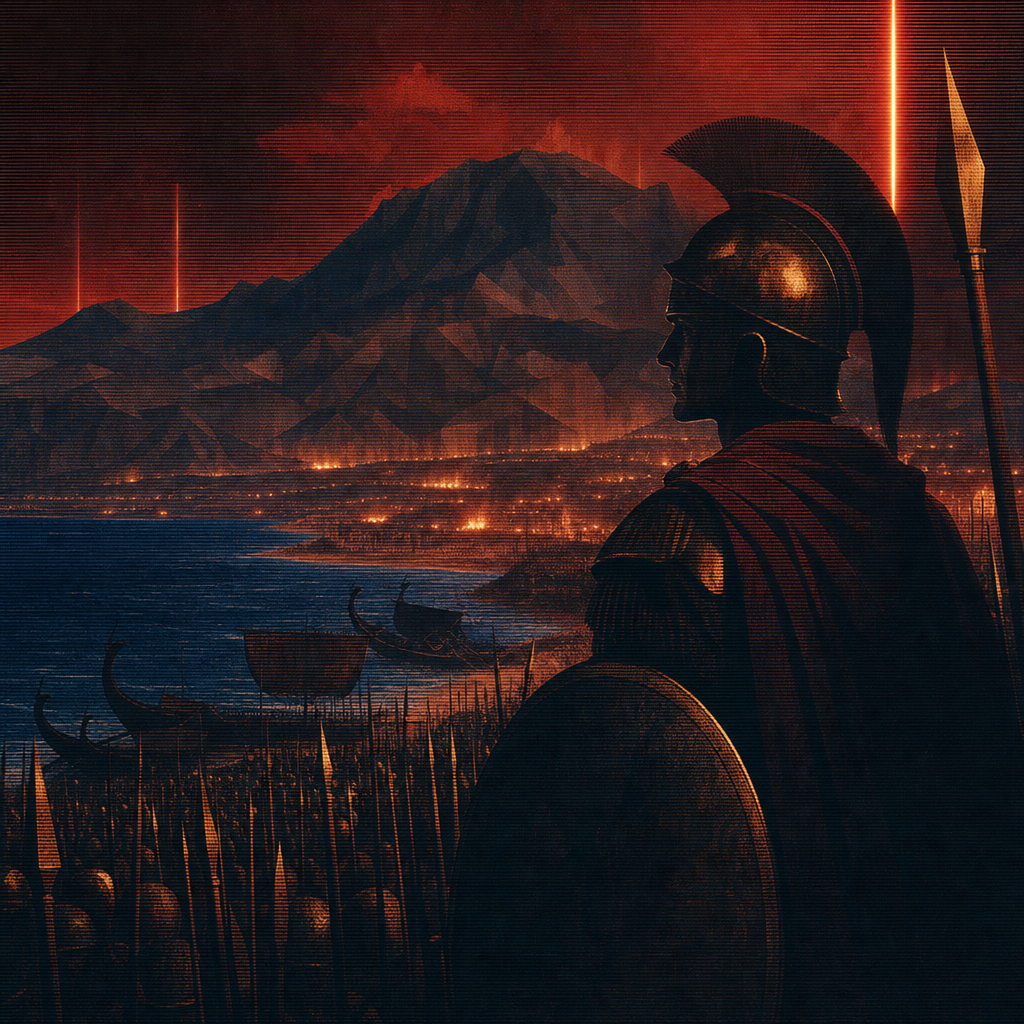
Now once Zeus had brought the Trojans and Hector close to the ships, he left them there to bear hard labor and misery without letup, while he himself turned his shining eyes away, looking far off over the land of the horse-herding Thracians, the Mysians who fight at close quarters, the proud mare-milkers who live on milk, and the Abii, the most just of men. Toward Troy he no longer turned his shining eyes at all, for in his heart he did not expect any of the immortals to go and help either the Trojans or the Danaans.
Read Ancient Greek Source (Iliad.13.1–Iliad.13.9)
Yet the lord who shakes the earth kept no blind watch. He sat marveling at the war and the fighting, high on the topmost peak of wooded Thracian Samos; for from there all of Ida was in plain sight, and Priam's city and the ships of the Achaeans were clear to see. There he had come up from the sea and sat, pitying the Achaeans as they were overpowered by the Trojans, and he was fiercely indignant at Zeus.
Read Ancient Greek Source (Iliad.13.10–Iliad.13.16)
At once he strode down from the rugged mountain, stepping out swiftly, and the tall mountains and forest trembled beneath the immortal feet of Poseidon as he went. Three strides he took on his way, and with the fourth he reached his goal, Aegae, where his famous palace in the depths of the sea stands built of gleaming gold, imperishable forever. Arriving there, he yoked beneath his chariot his two bronze-hoofed horses, swift-flying coursers with flowing manes of gold. He clothed his own body in gold, grasped his well-wrought golden whip, and mounted his chariot; then he drove out across the waves. Beneath him the sea-beasts gamboled from their lairs on every side, recognizing their lord; for joy the sea parted before him, and the horses flew on at full speed, so that the bronze axle underneath was not even wetted as his bounding team carried him toward the ships of the Achaeans.
Read Ancient Greek Source (Iliad.13.17–Iliad.13.31)
There is a wide cavern in the depths of the deep sea, midway between Tenedos and craggy Imbros. There Poseidon the earth-shaker halted his horses, unhitched them from the chariot, and cast immortal fodder beside them to eat; around their hooves he fastened golden hobbles, unbreakable and impossible to untie, so that they would wait fast in that place for their lord's return; and he went off to the camp of the Achaeans.
Read Ancient Greek Source (Iliad.13.32–Iliad.13.38)
Meanwhile the Trojans, massed together like a flame or a storm-wind, followed Hector son of Priam in relentless fury, with a roaring din and loud cries; they hoped to take the ships of the Achaeans and kill all the best men right beside them. But Poseidon, holder and shaker of the earth, came up out of the deep sea and urged on the Argives, taking the build and tireless voice of Calchas. First he spoke to the two Ajaxes, though they were eager already:
Read Ancient Greek Source (Iliad.13.39–Iliad.13.46)
"Ajaxes, you two will save the Achaean army if you remember your fighting strength and give no thought to chilling panic. Elsewhere along the line I do not fear the unstoppable hands of the Trojans who swarmed over the great wall in force, for the Achaeans in fine leg armor will hold them all back. It is here that I am terribly afraid we may suffer disaster, where that rabid man, like a roaring flame, leads the charge—Hector, who boasts that he is the son of almighty Zeus. May some god put it into the hearts of you both to stand your ground firmly yourselves and command the others to do the same. Then, furious though he is, you could drive him back from the fast-sailing ships, even if the Olympian himself is urging him on."
Read Ancient Greek Source (Iliad.13.47–Iliad.13.58)
So he spoke, and with his staff the holder and shaker of the earth struck them both, filled them with fierce strength, and made their limbs light, their feet below and their hands above. Then he himself sprang into flight like a swift-winged hawk that launches itself from a sheer, towering cliff and hurtles over the plain to chase another bird; so Poseidon the earth-shaker darted away from them.
Read Ancient Greek Source (Iliad.13.59–Iliad.13.65)
Of the two, swift Ajax son of Oileus was the first to know him, and at once he spoke to Ajax son of Telamon: "Ajax, one of the gods who hold Olympus has taken the seer's likeness and tells us to fight beside the ships—that was not Calchas, the prophet who reads the birds. I easily recognized the trace of his feet and legs from behind as he went away; the gods are not hard to know. And within my own chest my spirit surges all the more to make war and fight, and my feet below and my hands above are aching for battle."
Read Ancient Greek Source (Iliad.13.66–Iliad.13.75)
Telamonian Ajax answered him: "So it is with me now too: around my spear my unstoppable hands are itching for action, my fighting spirit is roused, and beneath me both feet drive me forward; I am eager even on my own to fight Hector son of Priam in all his relentless fury."
Read Ancient Greek Source (Iliad.13.76–Iliad.13.80)
So they spoke to one another, rejoicing in the battle-lust that the god had cast into their hearts. Meanwhile the earth-holder stirred up the Achaeans in the rear, who were catching their breath beside the swift ships. Their limbs were undone by painful exhaustion, and grief filled their hearts as they watched the Trojans who had swarmed over the great wall in force. Looking at them, they shed tears beneath their brows, for they thought they would never escape ruin. But the earth-shaker moved easily among them and urged on their strong ranks. First he came to Teucer and Leitus, calling on them, and the hero Peneleos, and Thoas and Deipyrus, and Meriones and Antilochus, masters of the war-cry; spurring them on, he spoke winged words to them:
Read Ancient Greek Source (Iliad.13.81–Iliad.13.94)
"Shame on you, Argives, young fighting men! It was on your fighting that I counted to save our ships. If you hang back from the brutal work of war, then our day of defeat at Trojan hands is in sight. Gods above, what a great and dreadful marvel I see with my own eyes, something I never thought would come to pass: the Trojans advancing on our ships! In the past they were like panicky deer that wander helpless and weak through the forest, with no fight in them at all, becoming the prey of jackals, leopards, and wolves. So it was with the Trojans before now: they had no stomach to stand and face the fury and hands of the Achaeans, not even for a moment. Yet now, far from their city, they are fighting right by the hollow ships through the fault of our leader and the slackness of the troops, who in their quarrel with him refuse to defend the fast-sailing ships, and instead are being slaughtered among them.
Read Ancient Greek Source (Iliad.13.95–Iliad.13.110)
"Yet even if the fault in truth lies entirely with the hero, Atreus' son, wide-ruling Agamemnon, because he dishonored swift-footed Achilles, son of Peleus, there is still no way for us to slacken from the war. Come, let us mend this quickly; the hearts of good men can be healed. There is no honor now in your slackening from fierce valor, when you are all the best men in the army. I myself would never quarrel with a man who slackened from the fighting because he was a weakling; but with you I am indignant to the heart. My friends, soon you will bring on some even worse disaster by this slackness of yours! Put into your hearts, every man of you, shame and fear of reproach; for a great struggle has arisen. By the ships now Hector, good at the war-cry, is fighting in his might, and he has smashed the gates and the long crossbar."
Read Ancient Greek Source (Iliad.13.111–Iliad.13.124)
With such urgent calls the earth-holder roused the Achaeans. Around the two Ajaxes stood the battle ranks, strong and firm, which not even Ares could fault if he came among them, nor Athena who rouses armies; for the finest men, picked from the host, stood waiting for the Trojans and brilliant Hector, fencing spear with spear, shield braced on layered shield. Buckler pressed against buckler, helmet on helmet, man on man; the horsehair-crested helmets touched with their gleaming ridges as the men leaned in, so tightly packed they stood beside one another, and spears overlapped as they were brandished from bold hands; they looked straight ahead, eager to fight.
Read Ancient Greek Source (Iliad.13.125–Iliad.13.135)
The Trojans struck forward in a mass, and Hector led them, charging straight ahead like a plunging boulder from a cliff, which a winter-swollen river thrusts down from the brow of a ridge after breaking with endless rain the moorings of the pitiless stone; leaping high it flies through the air, and the forest crashes beneath it, while unchecked it hurtles steadily on until it reaches level ground, and then it rolls no farther, for all its headlong rush—so Hector for a while threatened to tear right down to the sea, easily cutting his way through the shelters and ships of the Achaeans, killing as he went; but when he crashed into the dense ranks, he came to a dead halt, pressed hard against them. Facing him, the sons of the Achaeans stabbed with swords and double-pointed spears and shoved him back from them; he gave ground, staggered by the blow.
Read Ancient Greek Source (Iliad.13.136–Iliad.13.148)
Then he let out a piercing cry, shouting to the Trojans: "Trojans, Lycians, and Dardanians who fight hand to hand, stand fast! The Achaeans will not hold me back for long, even though they have arrayed themselves like a tower wall; no, I think they will give way before my spear, if in truth the greatest of the gods urged me on, the loud-thundering husband of Hera." With these words he stirred the strength and spirit of every man.
Read Ancient Greek Source (Iliad.13.149–Iliad.13.155)
Among them Deiphobus, Priam's son, strode out in high confidence, holding his well-balanced shield before him, stepping lightly and advancing under the cover of his shield. Meriones took aim at him with his shining spear and struck—he did not miss—square on the well-balanced shield of bull's hide; yet he did not drive through it, for long before that the long spear snapped at the socket. Deiphobus held the bull's-hide shield away from his body, fearing in his heart the spear of battle-minded Meriones; and Meriones drew back into the throng of his companions, bitterly angry both for the lost victory and for the spear that had snapped. He set off along the shelters and ships of the Achaeans to fetch a long spear that had been left in his shelter. The others fought on, and an unquenchable din rose up.
Read Ancient Greek Source (Iliad.13.156–Iliad.13.169)
Teucer, son of Telamon, was the first to kill a man, the spearman Imbrius, son of Mentor rich in horses. He used to live in Pedaeum before the sons of the Achaeans came, and had for his wife an illegitimate daughter of Priam, Medesicaste; but when the curved ships of the Danaans arrived, he came back to Ilion and stood out among the Trojans, living in Priam's palace, and Priam honored him equally with his own children. The son of Telamon stabbed him under the ear with his long spear and wrenched the spear back out; and he fell like an ash tree on the crest of a mountain visible from far around, which, cut down by bronze, brings its tender leaves to the ground; so he fell, and around him rang his armor worked with bronze.
Read Ancient Greek Source (Iliad.13.170–Iliad.13.181)
Teucer rushed in, eager to strip his armor; but as he rushed in, Hector hurled his shining spear. Teucer saw it coming straight at him and dodged the bronze spear by an inch; and Hector struck Amphimachus, son of Cteatus, Actor's son, in the chest with the spear as he was advancing into battle. He fell with a thud, and his armor clattered upon him. Hector rushed in to tear the helmet fitted to the temples from the head of great-hearted Amphimachus; but as he rushed in, Ajax lunged with his shining spear at Hector. The spear did not reach Hector’s flesh, for terrible bronze covered him all over; Ajax struck the boss of his shield and shoved him back with his great strength, so that Hector gave ground, stepping away from both corpses, and the Achaeans dragged them out of the fray.
Read Ancient Greek Source (Iliad.13.182–Iliad.13.194)
Stichius and brilliant Menestheus, leaders of the Athenians, carried Amphimachus back to the Achaean host. The two helmeted Ajaxes, eager in their fierce valor, held Imbrius high aloft—just as two lions snatch a goat from under sharp-toothed hounds and carry it off through the thick brush, holding it high above the ground in their jaws—and stripped his armor. Then the son of Oileus, enraged over Amphimachus, hacked the head from Imbrius’s tender neck and swung and hurled it spinning like a ball through the crowd, so that it landed in the dust right in front of Hector's feet.
Read Ancient Greek Source (Iliad.13.195–Iliad.13.205)
Then Poseidon was angered to the heart when his grandson fell in the grim carnage, and he set off along the shelters and ships of the Achaeans to spur on the Danaans, while preparing grief for the Trojans. There spear-famed Idomeneus met him as he came from a companion who had just returned to him out of the fighting, struck behind the knee by sharp bronze. His comrades had carried the man in, and Idomeneus, after giving orders to the healers, was going to his shelter, for he was still eager to face the battle. The lord who shakes the earth spoke to him, taking on the voice of Thoas, son of Andraemon, who throughout all Pleuron and steep Calydon ruled the Aetolians and was honored by the people like a god: "Idomeneus, counselor of the Cretans, where have the threats gone that the sons of the Achaeans used to make against the Trojans?"
Read Ancient Greek Source (Iliad.13.206–Iliad.13.220)
Idomeneus, leader of the Cretans, answered him: "Thoas, no man is to blame right now, so far as I can see, for we all know how to fight. Heart-numbing fear holds no one back, and no one yields to reluctance and shrinks from this grim war. Yet somehow it must please the all-powerful son of Cronus that the Achaeans perish here nameless, far from Argos. But Thoas, since in the past you have always stood firm against the enemy, and you spur on others whenever you see anyone hanging back, do not stop now, and call out to every man."
Read Ancient Greek Source (Iliad.13.221–Iliad.13.230)
Then Poseidon the earth-shaker answered him: "Idomeneus, may that man never return home again from Troy, but stay right here to be a plaything for dogs, whoever willfully hangs back from fighting on this day. Come, take your armor and join me here; we must press on with this together, in case even just the two of us can be of some help. Even very poor fighters find valor when they band together, and the two of us know how to fight even against brave men."
Read Ancient Greek Source (Iliad.13.231–Iliad.13.238)
So speaking, the god went back into the toil of men. And when Idomeneus reached his well-built shelter, he put his fine armor around his body, seized two spears, and set out like a bolt of lightning that the son of Cronus takes in his hand and brandishes from dazzling Olympus, showing a sign to mortals, and its flashes are brilliant; so the bronze blazed around his chest as he ran.
Read Ancient Greek Source (Iliad.13.239–Iliad.13.245)
There Meriones, his brave attendant, met him while still near the shelter, for he was on his way to fetch a bronze spear; and mighty Idomeneus spoke to him: "Meriones, son of Molus, swift of foot, dearest of my comrades, why have you left the war and the fighting to come here? Have you been hit somewhere, and the point of a weapon wears you down, or have you come to find me with some message? I myself have no wish to sit in the shelters, but to fight."
Read Ancient Greek Source (Iliad.13.246–Iliad.13.253)
Thoughtful Meriones answered him: "Idomeneus, counselor of the bronze-clad Cretans, I have come to see if you have any spear left in your shelters that I can take, for we shattered the one I had before when I struck the shield of overbearing Deiphobus."
Read Ancient Greek Source (Iliad.13.254–Iliad.13.258)
Idomeneus, leader of the Cretans, answered him: "As for spears, if you want, you will find one spear or twenty standing in my shelter against the bright entrance walls, Trojan ones that I strip from the men I kill; for I do not think I stand far off from enemy men when I fight. That is why I have spears and bossed shields, and helmets and corselets polished bright."
Read Ancient Greek Source (Iliad.13.259–Iliad.13.265)
Thoughtful Meriones answered him: "I too, at my own shelter and black ship, have plenty of Trojan spoils, but they are not close enough to take. For I say that I too have not forgotten my valor, but stand among the foremost in battle where men win glory whenever the strife of war arises. Some other man among the bronze-clad Achaeans may fail to notice how I fight, but I think you yourself know it well."
Read Ancient Greek Source (Iliad.13.266–Iliad.13.273)
Idomeneus, leader of the Cretans, answered him: "I know your valor and what sort of man you are; why do you need to speak of this? If all the best of us by the ships were being chosen right now for an ambush—where the valor of men is most clearly seen, and where the coward and the brave man both show themselves: the coward's skin changes color one way and another, and the spirit in his chest cannot keep him sitting still, but he shifts from knee to knee and crouches on one foot then the other, while his heart pounds hard inside his chest as he expects death, and his teeth chatter; whereas the brave man's skin does not change color, nor is he overly afraid once he first takes his place in the ambush of men, but he prays to mix as soon as possible in the grim clash—even there no one could fault your strength and your hands. For if you were struck by a thrown weapon or stabbed up close in the struggle, the weapon would not land in your neck from behind or in your back, but would meet your chest or your belly as you pressed forward into the close company of the front-line fighters. But come, let us talk of these things no longer like children, standing here, lest someone blame us beyond measure; go to the shelter and take up a heavy spear."
Read Ancient Greek Source (Iliad.13.274–Iliad.13.294)
So he spoke, and Meriones, the equal of swift Ares, quickly took up a bronze spear from the shelter and went after Idomeneus, his heart set fiercely on war. Just as man-slaughtering Ares goes out into war, and Rout, his dear son, both mighty and fearless, goes with him, who puts to flight even a steadfast warrior—the two of them arming and coming from Thrace to join the Ephyri or the great-hearted Phlegyae, and they do not listen to both sides, but grant glory to one alone—such were Meriones and Idomeneus, leaders of men, as they went into war helmeted in gleaming bronze.
Read Ancient Greek Source (Iliad.13.295–Iliad.13.305)
Meriones was the first to speak to him: "Son of Deucalion, where are you eager to plunge into the throng? On the far right of the whole army, or through the center, or on the left? For nowhere, I think, do the long-haired Achaeans fall so short in the fighting."
Read Ancient Greek Source (Iliad.13.306–Iliad.13.310)
Idomeneus, leader of the Cretans, answered him: "Among the middle ships there are others to defend them—the two Ajaxes and Teucer, who is the best of the Achaeans with the bow, and brave as well in standing combat; they will drive Hector son of Priam to his fill of war, furiously though he charges, even if he is very strong. It will be a steep task for him, eager as he is to fight, to overcome their strength and their unstoppable hands and burn the ships, unless the son of Cronus himself throws a blazing firebrand onto the swift ships. Great Telamonian Ajax would not yield to any man who is mortal and eats the grain of Demeter, and can be torn by bronze and huge boulders. Not even to Achilles, breaker of men, would he give ground in standing fight at least, though Ajax cannot match Achilles in running speed. So hold our course here to the left of the army, so that quickly we may know whether we will give glory to someone, or someone will give it to us."
Read Ancient Greek Source (Iliad.13.311–Iliad.13.327)
So he spoke, and Meriones, the equal of swift Ares, led the way until they reached the part of the army where he had told him. When the Trojans saw Idomeneus, like a flame in his strength, both him and his attendant in their finely worked armor, they shouted through the throng and all charged straight at him; and equal strife rose between them by the sterns of the ships. Just as gusts sweep fast before shrill winds on a day when the dust lies thickest along the roads, and together they raise a great cloud of dust, so their battle clashed together, and in their hearts they burned to slaughter one another through the crowd with sharp bronze. The man-destroying battle bristled with the long, flesh-slicing spears they gripped, and eyes were dazzled by the bronze glare flashing from bright helmets, newly burnished breastplates, and shining shields as the men came on together. Truly hard-hearted would anyone be who could rejoice at seeing that struggle and not feel grief.
Read Ancient Greek Source (Iliad.13.328–Iliad.13.344)
Divided in purpose, the two mighty sons of Cronus were fashioning bitter pain for the warrior heroes. Zeus, for his part, willed victory for the Trojans and Hector, glorifying swift-footed Achilles; yet he did not at all wish the Achaean army to perish completely before Ilion, but was honoring Thetis and her strong-hearted son. Poseidon, meanwhile, went among the Argives and urged them on, slipping up in secret from the gray sea; for it pained him that they were being beaten down by the Trojans, and he was fiercely indignant at Zeus. Truly, both gods shared the same descent and a single parentage, but Zeus had been born first and knew more. Therefore Poseidon avoided defending the Argives openly, and instead kept rousing them in secret through the camp, disguised as a man. Those two took the cord of fierce strife and all-leveling war, looped it across both armies, and pulled it taut—unbreakable and impossible to loosen, a cord that loosened the knees of many.
Read Ancient Greek Source (Iliad.13.345–Iliad.13.360)
Then, though his hair was half-gray, Idomeneus called upon the Danaans, sprang among the Trojans, and drove panic into them. For he killed Othryoneus, who was staying in Troy from Cabesus; he had only recently arrived, seeking renown in the war, and was asking for the hand of the loveliest of Priam's daughters, Cassandra, without bride-gifts, promising instead a great deed: to drive the sons of the Achaeans out of Troy against their will. Old Priam had promised her to him and nodded his assent to give her away; so he fought on, trusting in those promises. Idomeneus aimed at him with his shining spear, cast, and hit him as he strode high; the bronze breastplate he wore did not protect him, but the spear stuck square in his belly. He fell with a thud, and Idomeneus boasted over him and called out:
Read Ancient Greek Source (Iliad.13.361–Iliad.13.373)
"Othryoneus, I praise you above all mortal men, if you will truly fulfill everything that you promised to Priam, descendant of Dardanus, who promised you his own daughter. We too could make you a promise like that and fulfill it: we would give you the loveliest of the daughters of Atreus' son, bringing her from Argos for you to marry, if along with us you sack the well-settled citadel of Ilion. So come along, let us make our bargain by the seafaring ships about the marriage, since we are no stingy givers of a bride."
Read Ancient Greek Source (Iliad.13.374–Iliad.13.382)
So speaking, the hero Idomeneus dragged him by the foot through the fierce battle. But Asius came to defend the fallen man, on foot in front of his horses, which kept breathing on his shoulders as his charioteer attendant held them close. In his heart Asius longed to strike Idomeneus, but Idomeneus was quicker and struck him with his spear in the throat beneath the chin, driving the bronze clean through. He fell as an oak falls, or a white poplar, or a tall pine that carpenters in the mountains cut down with newly whetted axes to be timber for a ship; so he lay stretched out in front of his horses and chariot, groaning and clutching at the bloody dust. His charioteer was stunned out of the wits he had before, and did not dare to turn his horses back to escape the hands of the enemy; steadfast Antilochus struck and pierced him through the middle with a spear. The bronze breastplate he wore did not save him, for the point lodged square in his belly. Gasping for breath, he tumbled from the well-built chariot, and Antilochus, son of great-hearted Nestor, drove the horses out from the Trojan lines to the Achaeans in fine leg armor.
Read Ancient Greek Source (Iliad.13.383–Iliad.13.401)
Then Deiphobus came very close to Idomeneus, grieving for Asius, and hurled his shining spear. But Idomeneus, keeping his eyes on him, dodged the bronze spear; he hid himself behind the well-balanced shield he carried, rounded and made of oxhides and gleaming bronze, fitted with two crossbar rods. Under this he gathered his whole body, and the bronze spear flew over him, though his shield gave a dry ring as the spear grazed it. Yet Deiphobus had not cast it in vain from his heavy hand, for he struck Hypsenor, son of Hippasus, shepherd of the people, in the liver below the midriff, and at once unstrung his knees. Deiphobus boasted terribly over him, shouting aloud: "Surely Asius does not lie unavenged! No, I say that even as he goes down to the house of Hades, the mighty warden of the gates, he will rejoice in his heart, since I have given him an escort!"
Read Ancient Greek Source (Iliad.13.402–Iliad.13.416)
So he spoke, and grief seized the Argives at his boast; above all he stirred the heart of war-minded Antilochus. Yet even in his grief he did not neglect his comrade, but ran up, stood astride him, and covered him with his shield. Then two loyal comrades—Mecisteus, son of Echius, and noble Alastor—stooped beneath the wounded man and carried him, groaning heavily, toward the hollow ships.
Read Ancient Greek Source (Iliad.13.417–Iliad.13.423)
Idomeneus did not slacken his great fury, but kept striving always either to wrap some Trojan in dark night or to crash down in death himself while warding off ruin from the Achaeans. Then there was the dear son of Zeus-cherished Aesyetes, the hero Alcathous—he was son-in-law to Anchises, and had married the eldest of his daughters, Hippodameia, whom her father and honored mother loved with all their heart in their halls, for she excelled all the girls of her own age in beauty, handiwork, and good sense, and for that reason the noblest man in wide Troy had taken her as his wife. This man Poseidon now subdued beneath the hand of Idomeneus, putting a spell on his bright eyes and binding his shining limbs; for he could neither flee backward nor swerve aside, but as he stood motionless like a stone pillar or a high-leafed tree, the hero Idomeneus stabbed him with a spear in the middle of the chest and shattered the bronze corselet around him, which before had warded off destruction from his flesh, but now gave a dry ring as it split around the spear. He fell with a thud, and the spear stood fixed in his heart, which in its convulsing shook even the butt-end of the spear; and there mighty Ares finally spent its force.
Read Ancient Greek Source (Iliad.13.424–Iliad.13.444)
Idomeneus boasted terribly over him, shouting aloud: "Deiphobus, do we reckon it is a fair trade, three killed for one, since you boast the way you do? Come, strange man, stand and face me yourself, so you may see what sort of offspring of Zeus I am who have come here! Zeus first fathered Minos to be guardian over Crete; Minos in turn fathered a faultless son, Deucalion; and Deucalion fathered me to be lord over many men in wide Crete; and now the ships have brought me here as a bane to you, your father, and the rest of the Trojans."
Read Ancient Greek Source (Iliad.13.445–Iliad.13.454)
So he spoke, and Deiphobus debated two ways in his mind: whether to draw back and take some companion from among the great-hearted Trojans, or to try him even alone. As he thought it over, it seemed better to him to go find Aeneas. He found him standing at the very back of the throng, for he was forever resentful toward brilliant Priam, because Priam paid him no honor at all despite his bravery among men. Standing close to him, he spoke winged words: "Aeneas, counselor of the Trojans, now you must by all means defend your brother-in-law, if any grief for kin touches you at all. Come with me, let us defend Alcathous, who as your brother-in-law cared for you in his halls years ago when you were little; spear-famed Idomeneus has killed and stripped him!"
Read Ancient Greek Source (Iliad.13.455–Iliad.13.467)
So he spoke, and stirred the spirit in Aeneas' chest, and he went after Idomeneus with his heart set fiercely on war. Yet panic did not seize Idomeneus like a pampered child; instead he stood his ground like a boar in the mountains, trusting in its strength, that waits in a lonely place for a great noisy pack of men coming against it, bristling up its back; its eyes flash with fire, and it whets its tusks, eager to beat off hounds and men alike. So spear-famed Idomeneus stood his ground and did not retreat before Aeneas coming to the rescue; and he shouted to his comrades, looking toward Ascalaphus, Aphareus, and Deipyrus, and Meriones and Antilochus, masters of the war-cry. Spurring them on, he spoke winged words: "Come here, friends, and defend me, for I am alone! I am terribly afraid of swift-footed Aeneas coming against me, who is bearing down on me now. He is very strong at slaying men in battle, and he has the flower of youth, which is the greatest strength of all. If only we were of the same age to match this spirit of mine, quickly then either he would win great glory or I would."
Read Ancient Greek Source (Iliad.13.468–Iliad.13.486)
So he spoke, and all of them, with a single spirit in their chests, took their stand close beside him, sloping their shields against their shoulders. On the other side Aeneas called out to his comrades, looking toward Deiphobus, Alexander, and brilliant Agenor, who were leaders of the Trojans along with him; and behind them the troops followed, just as sheep follow after the ram from pasture to drink, and the shepherd rejoices in his heart; so the spirit in Aeneas' chest rejoiced when he saw the host of troops following him.
Read Ancient Greek Source (Iliad.13.487–Iliad.13.495)
Around Alcathous they charged into close combat with their long polished shafts, and the bronze rang terribly around their chests as they aimed at one another through the crowd. Two warlike men above all the rest, Aeneas and Idomeneus, the equals of Ares, longed to slice each other's flesh with pitiless bronze. Aeneas first hurled his spear at Idomeneus; but Idomeneus saw it coming straight at him and dodged the bronze spear, and the spear-point of Aeneas went quivering into the earth, since it had sped in vain from his strong hand. Then Idomeneus struck Oenomaus in the middle of the belly, breaking the plate of his corselet, and the bronze spilled his bowels through it; falling in the dust, he clutched the earth in his palm. Idomeneus wrenched his long-shadowed spear out of the corpse, yet could not strip the rest of the fine armor from his shoulders, for he was hard pressed by thrown weapons. The limbs of his feet were no longer steady when he lunged, either to dash in after his own cast or to dodge another's; so in standing fight he warded off the pitiless day, though his feet no longer carried him swiftly to run back out of the battle.
Read Ancient Greek Source (Iliad.13.496–Iliad.13.515)
As Idomeneus was moving away step by step, Deiphobus hurled his shining spear at him, for he held an unceasing grudge against him always. Yet this time too he missed him, and instead struck Ascalaphus, son of Enyalius, with his spear, driving the heavy shaft through his shoulder; falling in the dust, he clutched the earth in his palm. Loud-bellowing, mighty Ares had not yet heard at all that his own son had fallen in the fierce clash, for he sat on the summit of Olympus beneath golden clouds, penned in by the will of Zeus, where the other immortal gods were also held back from the war.
Read Ancient Greek Source (Iliad.13.516–Iliad.13.525)
Then around Ascalaphus they charged into close combat. Deiphobus snatched the shining helmet from Ascalaphus, but Meriones, the equal of swift Ares, sprang in and struck Deiphobus in the arm with a spear, and from his hand the visored helmet dropped to the ground with a clang. Meriones sprang in once more like a vulture, wrenched the heavy spear out of Deiphobus’ upper arm, and drew back into the throng of his companions. Polites, Deiphobus' own brother, threw his arms around the wounded man’s waist and led him out of the harsh-roaring battle until he reached his swift horses, which stood waiting for him behind the fighting and the war with his charioteer and his finely worked chariot. They carried him toward the city, groaning heavily and worn with pain, while blood streamed down from his newly wounded arm. The others fought on, and an unquenchable din rose up.
Read Ancient Greek Source (Iliad.13.526–Iliad.13.540)
Then Aeneas rushed at Aphareus, son of Caletor, as he turned toward him, and struck him in the throat with his sharp spear. His head lolled to one side, his shield and helmet sagged down upon him, and life-destroying death poured around him. Meanwhile Antilochus watched Thoon turn his back, leaped in, and stabbed him, severing the whole vein that runs all the way up the back to reach the neck; he severed it completely, and Thoon fell flat on his back in the dust, stretching out both hands to his dear comrades.
Read Ancient Greek Source (Iliad.13.541–Iliad.13.549)
Antilochus sprang in and began stripping the armor from his shoulders, glancing warily all around; and the Trojans surrounded him from every side and struck his wide, gleaming shield, yet could not scratch the tender flesh of Antilochus inside it with pitiless bronze. For Poseidon the earth-shaker guarded Nestor's son well, even among many flying weapons. Indeed, he was never clear of the enemy, but kept wheeling among them; nor did he hold his spear still, but its point was forever quivering and whirling as he aimed in his mind either to hurl it at someone or to lunge in at close quarters.
Read Ancient Greek Source (Iliad.13.550–Iliad.13.559)
Yet as he took aim through the crowd he did not escape the notice of Adamas, son of Asius, who charged in close and stabbed the center of his shield with sharp bronze. But dark-haired Poseidon made the point powerless, begrudging him Antilochus' life. Half of the shaft stayed right there like a fire-hardened stake in Antilochus' shield, while the other half lay on the ground; and Adamas drew back into the throng of his companions to escape death. But Meriones followed after him as he retreated and struck him with a spear between the genitals and the navel, where Ares is most agonizing of all for wretched mortals. There he planted his spear; and Adamas, collapsing around the shaft, writhed like a bull that herdsmen in the mountains bind by force with twisted ropes and lead away against its will; so he writhed when he was struck, for a little while, not very long, until the hero Meriones came up close and wrenched the spear out of his flesh, and darkness covered his eyes.
Read Ancient Greek Source (Iliad.13.560–Iliad.13.575)
Then Helenus at close quarters struck Deipyrus on the temple with a great Thracian sword and sheared away his helmet. Knocked flying, it fell to the ground, and one of the fighting Achaeans picked it up as it rolled among their feet; and dark night covered Deipyrus' eyes.
Read Ancient Greek Source (Iliad.13.576–Iliad.13.580)
Grief seized Atreus' son, Menelaus, good at the war-cry. He strode out with a shout of threat against the hero Lord Helenus, brandishing his sharp spear, while Helenus drew back the horn of his bow. The two of them let fly together, one eager to cast his sharp spear, the other to shoot an arrow from the string. Priam's son struck him in the chest with his arrow on the plate of his corselet, and the bitter arrow glanced off. Just as dark-skinned beans or chickpeas leap from a broad winnowing-shovel across a great threshing floor under the shrill breeze and the winnower's toss, so from the corselet of glorious Menelaus the bitter arrow glanced far off and flew away. Then Atreus' son Menelaus, good at the war-cry, struck the hand with which Helenus held his polished bow; clean through the hand into the bow itself the bronze spear was driven. Helenus drew back into the throng of his companions to escape death, letting his hand hang limp at his side while the ash spear dragged behind it. Great-hearted Agenor pulled the spear out of his hand, and bound the hand itself in a sling of well-twisted sheep's wool that his attendant held ready for the shepherd of the people.
Read Ancient Greek Source (Iliad.13.581–Iliad.13.600)
Then Peisander went straight at glorious Menelaus; and dark fate led him to the end of death, to be cut down by you, Menelaus, in the grim carnage. When they came close, advancing on each other, Atreus' son missed, and his spear swerved past; Peisander stabbed the shield of glorious Menelaus, yet could not drive the bronze clean through, for the wide shield held it back and the spear snapped at the socket; even so, he rejoiced in his heart and hoped for victory. But Atreus' son drew his silver-studded sword and leaped at Peisander, while from under his shield Peisander pulled out a fine battle-axe of good bronze fitted around a long, polished haft of olive wood; and they struck at each other at the same instant. Peisander hacked the ridge of Menelaus' horsehair-crested helmet right at the peak beneath the plume itself; but Menelaus struck him as he came on, across the forehead above the bridge of the nose. The bones cracked, and his two eyes dropped bloody in the dust on the ground at his feet. He doubled over as he fell; and Menelaus planted his heel on his chest, stripped his armor, and boasted aloud:
Read Ancient Greek Source (Iliad.13.601–Iliad.13.619)
"So then, you will leave the ships of the Danaans with their swift steeds after all, you arrogant Trojans, insatiable for the dreadful war-cry! You left no other outrage or disgrace undone when you wronged me, you filthy dogs, and in your hearts you had no fear at all of the heavy wrath of loud-thundering Zeus, god of hospitality, who will someday destroy your lofty city. For no cause at all you sailed off carrying away my wedded wife and plenty of my treasure after she had welcomed you in friendship; and now again you are raging to fling deadly fire onto our seafaring ships and kill the Achaean heroes. Yet you will be stopped, furious for war though you are! Father Zeus, they say you surpass all others in wisdom, both men and gods, and yet all these things come from you: see how you show favor to insolent men, these Trojans whose fury is always reckless, and who can never get their fill of the din of all-leveling war! Of all things a man can have his fill—of sleep, and love, and sweet song, and faultless dancing, things for which a man longs to satisfy his desire far more than for war; yet the Trojans are insatiable for battle."
Read Ancient Greek Source (Iliad.13.620–Iliad.13.639)
So speaking, faultless Menelaus stripped the bloody armor from the body and handed it to his companions, and he himself went back again to join the front-line fighters. Then Harpalion, son of King Pylaemenes, leaped out at him—he had followed his dear father to fight at Troy, and never returned to his native land. Coming in close, he stabbed the center of the shield of Atreus' son with his spear, yet could not drive the bronze clean through, and he drew back into the throng of his companions to escape death, glancing sharply in every direction lest someone graze his flesh with bronze. As he retreated, Meriones let fly a bronze-tipped arrow and hit him in the right buttock; the arrow drove straight through under the bone and pierced the bladder. He sank down right where he was in the arms of his dear comrades, gasping out his life, and lay stretched on the ground like a worm, while dark blood flowed out and drenched the earth. The great-hearted Paphlagonians tended him, lifted him into a chariot, and drove him toward sacred Ilion in sorrow; with them went his father, shedding tears, and no blood-price was won for his dead son.
Read Ancient Greek Source (Iliad.13.640–Iliad.13.659)
Over his killing Alexander was deeply angered in his heart, for Harpalion had been his guest-friend among the many Paphlagonians; in fury for his sake he shot a bronze-tipped arrow. There was a certain Euchenor, son of the seer Polyidus, a rich and brave man who lived in Corinth and had boarded his ship knowing full well his deadly fate. For the good old man Polyidus had often told him that he would either waste away of a painful sickness in his own halls or be cut down by the Trojans among the ships of the Achaeans; and so he avoided at once the heavy penalty of the Achaeans and the hateful sickness, so that he might not suffer anguish in his heart. Alexander struck him beneath the jaw and ear; quickly the life left his limbs, and hateful darkness seized him.
Read Ancient Greek Source (Iliad.13.660–Iliad.13.672)
So they fought on like blazing fire. Yet Hector, dear to Zeus, had not heard and did not know at all that on the left of the ships his men were being slaughtered by the Argives, and that the glory might soon have belonged to the Achaeans—so fiercely was the holder and shaker of the earth urging on the Argives and defending them with his own strength besides. Instead Hector held on where he had first leaped through the gates and the wall after breaking the dense ranks of the shield-bearing Danaans, where the ships of Ajax and Protesilaus were drawn up on the shore of the gray sea, and above them the wall had been built lowest; there above all the men and their horses raged in battle.
Read Ancient Greek Source (Iliad.13.673–Iliad.13.684)
There the Boeotians and the Ionians in their trailing tunics, the Locrians, the Phthians, and the illustrious Epeians struggled hard to hold him back from the ships as he charged, yet could not thrust brilliant Hector, like a flame, away from them: first the chosen men of the Athenians, led by Menestheus son of Peteos, with Pheidas, Stichius, and brave Bias following him; then the Epeians, led by Meges son of Phyleus, Amphion, and Dracius; and in front of the Phthians, Medon and steadfast Podarces. (Medon was the illegitimate son of godlike Oileus and brother of Ajax, though he lived in Phylace away from his native land after killing a man, a kinsman of his stepmother Eriopis, whom Oileus had married; while Podarces was the son of Iphiclus, son of Phylacus.) These two, armed at the head of the great-hearted Phthians, fought alongside the Boeotians to defend the ships.
Read Ancient Greek Source (Iliad.13.685–Iliad.13.700)
And swift Ajax, son of Oileus, no longer stood apart from Telamonian Ajax at all, not even by a step; but just as two wine-dark oxen with a single spirit strain at the jointed plow in fallow land, and heavy sweat springs out around the roots of their horns, and only the polished yoke holds them apart as they press along the furrow and the plowshare cuts to the edge of the field, so the two of them stood side by side, right next to each other. Yet many brave comrades followed the son of Telamon as his troops, who would take over his great shield whenever weariness and sweat came upon his knees. The Locrians, however, did not follow the great-hearted son of Oileus, for their spirit did not hold firm in standing combat: they did not have bronze helmets crested with horsehair, nor did they have round shields and ash spears, but had followed him to Ilion trusting in bows and slings of well-twisted sheep's wool, with which they kept shooting thick and fast to break the Trojan ranks. So at that time the heavy-armed men in front fought in their finely worked armor against the Trojans and bronze-helmed Hector, while the Locrians shot unseen from behind; and the Trojans lost all thought of their fighting spirit, for the arrows threw them into confusion.
Read Ancient Greek Source (Iliad.13.701–Iliad.13.722)
Then the Trojans would have retreated in sorry plight from the ships and shelters back to windswept Ilion, had not Polydamas come up beside bold Hector and said: "Hector, you are impossible to persuade with words of counsel. Because a god gave you above all others the work of war, for that reason you want to excel all others in counsel too; yet you cannot take every gift upon yourself at once. To one man a god gives the work of war, to another the dance, to another the lyre and song, and in the chest of another far-seeing Zeus puts a sound mind, from which many men reap benefit; he saves many people, and he himself knows its worth best of all. So I will speak as seems best to me. All around you a ring of war is blazing; and since the great-hearted Trojans crossed the wall, some stand aloof in their armor, while others are fighting few against many, scattered among the ships. Draw back, then, and summon all the best men here; from there we can weigh our whole plan carefully, whether we should fall upon the many-benched ships, if the god is willing to grant us victory, or else withdraw from the ships unharmed. For I am truly afraid that the Achaeans will pay back yesterday's debt, since by the ships there remains a man insatiable for war, who I think will not hold back from battle completely any longer."
Read Ancient Greek Source (Iliad.13.723–Iliad.13.747)
So spoke Polydamas, and this safe counsel pleased Hector. At once he leaped in his armor from his chariot to the ground, and speaking to him addressed him with winged words: "Polydamas, hold all the best men right here yourself, while I go over there to meet the fighting; I will come back again at once, as soon as I have given clear orders to the men there."
Read Ancient Greek Source (Iliad.13.748–Iliad.13.753)
He spoke, and rushed off like a snow-clad mountain, shouting aloud, and flew through the Trojans and their allies. At the sound of Hector's voice, they all hurried to gather around Polydamas, the kindly son of Panthous. Meanwhile Hector ranged through the front ranks searching for Deiphobus, the mighty Lord Helenus, Adamas son of Asius, and Asius son of Hyrtacus, to see if he could find them anywhere. He found them no longer unscathed at all, nor untouched by ruin: some lay beside the sterns of the Achaean ships, their lives lost at the hands of the Argives, while others were inside the wall, hit by thrown weapons or stabbed at close quarters.
Read Ancient Greek Source (Iliad.13.754–Iliad.13.764)
Soon, on the left of the tearful battle, he found brilliant Alexander, husband of lovely-haired Helen, heartening his comrades and urging them on to fight. Standing close to him, he spoke with stinging words: "Alexander, curse of a man, finest in looks, woman-crazy seducer! Where are your Deiphobus and the mighty Lord Helenus, and Adamas son of Asius, and Asius son of Hyrtacus? And where is your Othryoneus? Now all steep Ilion is ruined from top to bottom; now sheer destruction is certain for you!"
Read Ancient Greek Source (Iliad.13.765–Iliad.13.773)
Godlike Alexander answered him: "Hector, your heart is set on blaming a man who is not to blame. Some other time I may be more inclined to hang back from the war, but my mother did not bear me altogether without valor. For ever since you roused our comrades' battle beside the ships, we have stayed right here engaging the Danaans without letup. Those comrades you ask after have been killed; only Deiphobus and the mighty Lord Helenus have left the field, both struck in the arm by long spears, though the son of Cronus warded off death from them. Now lead on wherever your heart and spirit bid you, and we will follow with you eagerly; I say we will not fall short in courage, so far as our strength allows. Beyond his strength a man cannot fight, eager though he may be."
Read Ancient Greek Source (Iliad.13.774–Iliad.13.787)
With these words the hero won over his brother's heart, and they went on to where the battle and the din were thickest, around Cebriones and faultless Polydamas, Phalces, Orthaeus, and godlike Polyphetes, and Palmys, Ascanius, and Morys son of Hippotion, who had come from fertile Ascania as relief troops on the morning before; and now Zeus impelled them to fight. They came on like a blast of harsh winds that sweeps down to the plain beneath the thunder of Father Zeus and plunges into the sea with a tremendous roar, and in the resounding sea rise many seething waves, arched and white-crested, some in front and others right behind; so the Trojans, arrayed in close ranks, some in front and others behind, followed their leaders flashing with bronze. Hector, Priam's son, led them, the equal of man-slaughtering Ares, holding before him his well-balanced shield, thick with hides and plated heavily with bronze, and around his temples his shining helmet tossed. Everywhere around the ranks he kept stepping forward and testing them, to see if they might give way before him as he advanced under cover of his shield; yet he could not shake the spirit in the chests of the Achaeans.
Read Ancient Greek Source (Iliad.13.788–Iliad.13.808)
Ajax was the first to challenge him, striding out with long steps: "Strange man, come closer! Why do you try in vain to frighten the Argives like this? We are not at all ignorant of battle, we Achaeans, but were beaten down by the cruel lash of Zeus. No doubt your heart hopes to sack the ships, yet we too have hands ready at once to defend them. Long before that, your own well-settled city will be taken and sacked at our hands! And for you yourself, I say the time is near when in flight you will pray to Father Zeus and the rest of the immortals that your fine-maned horses may be swifter than hawks as they carry you to the city, kicking up dust across the plain."
Read Ancient Greek Source (Iliad.13.809–Iliad.13.820)
Just as he spoke, a bird flew by on the right, a high-flying eagle; and the Achaean army shouted aloud, heartened by the omen. Glorious Hector answered him: "Ajax, blundering braggart, what a thing to say! Would that I were as surely the son of aegis-bearing Zeus for all my days, born of Lady Hera, and honored just as Athena and Apollo are honored, as this day now brings disaster upon the Argives, every last one—and among them you yourself will be killed, if you dare to stand against my long spear, which will tear your lily-white flesh; and you will glut the dogs and birds of the Trojans with your fat and flesh when you fall by the ships of the Achaeans!"
Read Ancient Greek Source (Iliad.13.821–Iliad.13.832)
So speaking, he led the charge, and they followed him with a tremendous roar, while the troops shouted behind them. On the other side the Argives shouted back, and did not forget their valor, but stood waiting for the best of the Trojans coming against them; and the roar of both armies reached the upper air and the splendor of Zeus.