Book 10: The Night Raid of Diomedes and Odysseus
Ἰλιάς · Book 10 · Classix Modern English Reading Edition
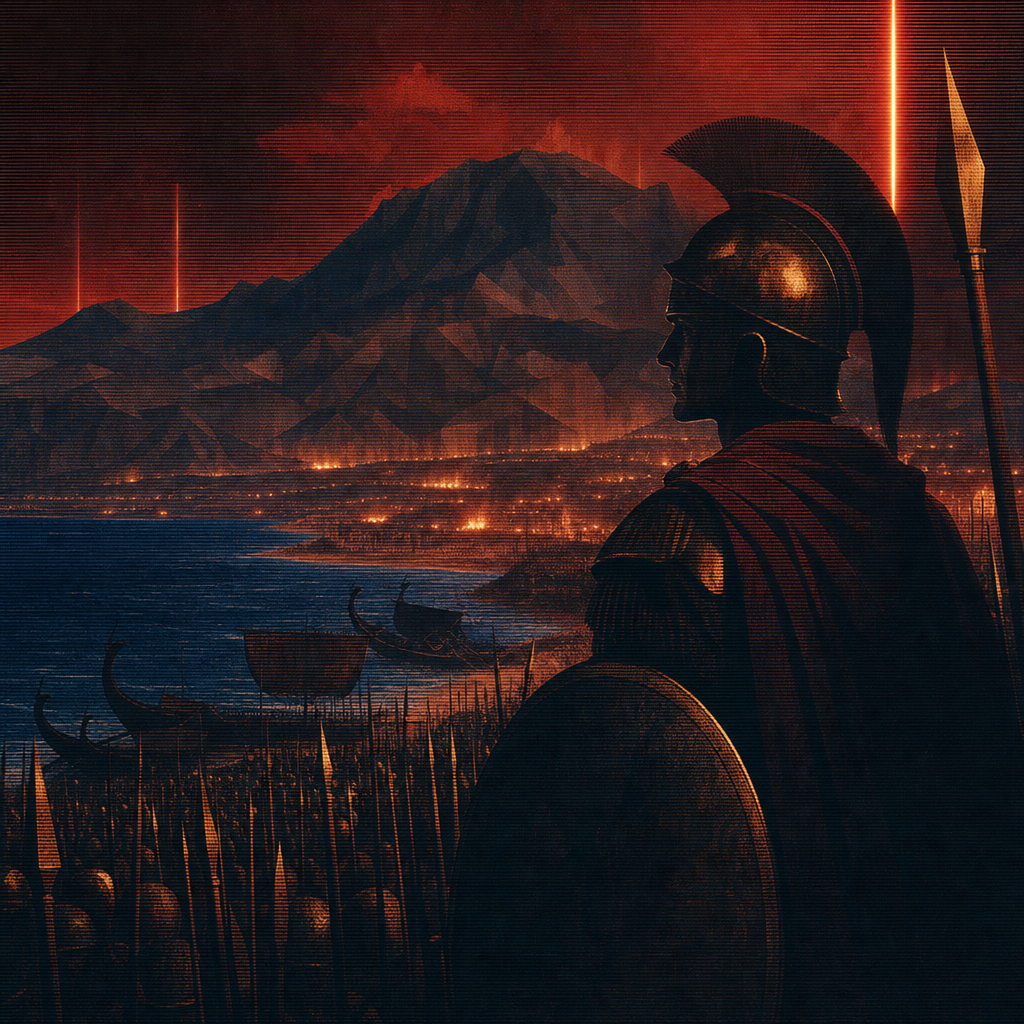
By the ships the other leaders of all the Achaeans slept through the whole night, overcome by soft sleep; but sweet sleep did not hold Atreus’ son Agamemnon, shepherd of the people, as he turned many things over in his mind. Just as when the husband of lovely-haired Hera flashes lightning, preparing a vast, torrential rainstorm, or hail, or driving snow when snowfall dusts the plowed fields, or somewhere the wide jaws of bitter war—so Agamemnon groaned again and again within his chest from the depths of his heart, and his spirit trembled inside him.
Read Ancient Greek Source (Iliad.10.1–Iliad.10.10)
Whenever he gazed out across the Trojan plain, he marveled at the many watchfires burning before Ilion, and at the sound of flutes and pipes and the din of men. But whenever he looked toward the ships and the army of the Achaeans, he tore the hair from his head by the roots in handfuls before Zeus on high, and groaned deeply in his glorious heart. And this plan seemed best to him in his mind: to go first of all the men to Neleus’ son Nestor, to see if Nestor might fashion some faultless plan with him that could ward off disaster from all the Danaans. Rising up, he pulled his tunic around his chest, bound fine sandals beneath his glistening feet, and then threw around himself the blood-red pelt of a great tawny lion, reaching to his feet, and took up his spear.
Read Ancient Greek Source (Iliad.10.11–Iliad.10.24)
In just the same way trembling held Menelaus, for sleep did not settle on his eyelids either: he feared that some harm might befall the Argives, who had come to Troy across the wide sea for his sake, intent on bold war. First he covered his broad back with a spotted leopard skin; then he lifted a bronze helmet and set it on his head, and took a spear in his strong hand. He set out to wake his brother, who ruled mightily over all the Argives and was honored by the people like a god. He found him putting his fine gear around his shoulders by the stern of his ship, and Agamemnon was glad to see him come.
Read Ancient Greek Source (Iliad.10.25–Iliad.10.35)
Menelaus of the strong war cry spoke to him first: “Why are you arming yourself like this, dear brother? Do you mean to send one of our comrades out as a spy against the Trojans? I am terribly afraid that no one will promise you to undertake this work—going out alone through the sacred night to spy on enemy men. That man will have to be bold-hearted indeed.”
Read Ancient Greek Source (Iliad.10.36–Iliad.10.41)
Lord Agamemnon answered him: “You and I have need of counsel, Menelaus, cherished by Zeus—shrewd counsel that will protect and save the Argives and the ships, since the mind of Zeus has turned. He has set his heart more on Hector’s sacrifices instead. For I have never yet seen, nor heard anyone tell of, one man contriving so many grim deeds in a single day as Hector, dear to Zeus, has done to the sons of the Achaeans, though he is merely a man, the dear son of neither a goddess nor a god. He has done deeds that I say will weigh on the Argives deeply and for a long time to come, such evils has he devised against the Achaeans. But go now, run swiftly along the ships and summon Ajax and Idomeneus, while I go to noble Nestor and urge him to rise, in case he is willing to go to the sacred company of the sentries and give them orders. They would listen to him most of all, for his own son commands the sentries, together with Idomeneus’ comrade-in-arms Meriones; to those two above all we entrusted the watch.”
Read Ancient Greek Source (Iliad.10.42–Iliad.10.59)
Then Menelaus of the strong war cry answered him: “How do you mean your command, and what are your orders for me? Shall I stay there with them and wait until you come, or run back after you once I have given them clear orders?”
Read Ancient Greek Source (Iliad.10.60–Iliad.10.63)
Agamemnon, lord of men, answered him: “Wait there, or we may miss each other as we go, for there are many paths through the camp. Call out wherever you go and tell the men to stay awake, naming each man by his father’s line and ancestry, showing honor to them all. Do not be haughty in spirit, but let us do the hard work ourselves as well; for thus upon us at our very birth Zeus laid a heavy burden of misery.” With those words and clear instructions, he sent his brother off.
Read Ancient Greek Source (Iliad.10.64–Iliad.10.72)
Then he went on his way to Nestor, shepherd of the people. He found him on a soft bed beside his shelter and his black ship; by him lay his richly worked gear—a shield, two spears, and a gleaming helmet. Beside them lay his glinting war-belt, which the old man buckled on whenever he armed for man-destroying war to lead his troops, for he did not yield to harsh old age. Propping himself up on his elbow and lifting his head, he spoke to the son of Atreus and questioned him: “Who are you, coming alone through the camp among the ships in the dark night, when other mortals are asleep? Are you looking for one of your mules, or one of your comrades? Speak out; do not come up to me in silence. What do you need?”
Read Ancient Greek Source (Iliad.10.73–Iliad.10.85)
Then Agamemnon, lord of men, answered him: “Nestor, son of Neleus, great glory of the Achaeans, you will recognize Atreus’ son Agamemnon, whom Zeus has plunged beyond all others into struggles without end, for as long as breath remains in my chest and my knees can still move. I wander like this because sweet sleep does not settle on my eyes; instead, war and the troubles of the Achaeans weigh on me. For I am terribly afraid for the Danaans, and my spirit is not steady; I am beside myself with dread, my heart leaps out of my chest, and my strong limbs tremble beneath me. But if you are ready to act—since sleep has not come to you either—come, let us go down to the sentries and see that they have not given in to exhaustion and drowsiness, fallen asleep, and completely forgotten their watch. Enemy men are camped close by, and we do not know at all whether they may resolve to fight even through the night.”
Read Ancient Greek Source (Iliad.10.86–Iliad.10.101)
Then the Gerenian horseman Nestor answered him: “Most glorious son of Atreus, Agamemnon, lord of men, surely Zeus the counselor will not fulfill for Hector all his plans, all that he now hopes for; instead, I think he will labor under even greater troubles, if only Achilles turns his heart away from his bitter anger. I will gladly follow you, and let us also wake the others—both Tydeus’ son, famed with the spear, and Odysseus, as well as swift Ajax and the brave son of Phyleus. And someone should go after those others too and summon them—godlike Ajax and lord Idomeneus—for their ships lie farthest away, not close at hand. But as for Menelaus, dear and respected though he is, I will fault him, even if you resent me for it, and I will not hide what I think, since he sleeps and has left the hard work to you alone. Right now he ought to be working his way among all the finest men, begging their help, for a need has come upon us that can no longer be borne.”
Read Ancient Greek Source (Iliad.10.102–Iliad.10.118)
Agamemnon, lord of men, answered him: “Old man, at other times I myself would urge you to blame him. Often he holds back and is reluctant to take on the work—not yielding to laziness or any foolishness of mind, but looking to me and waiting for my lead. Tonight, though, he woke well before I did and came to my side, and I have already sent him to summon the very men you ask after. So let us go; we will meet them in front of the gates among the sentries, where I told them to gather.”
Read Ancient Greek Source (Iliad.10.119–Iliad.10.127)
Then the Gerenian horseman Nestor answered him: “In that case, none of the Argives will resent him or disobey him whenever he urges any man on and gives commands.” With those words he pulled his tunic around his chest, bound fine sandals beneath his glistening feet, and pinned a crimson cloak around his shoulders, wide and folded double, thick with curly fleece. He took up a stout spear tipped with sharp bronze and set out among the ships of the bronze-armored Achaeans.
Read Ancient Greek Source (Iliad.10.128–Iliad.10.136)
First the Gerenian horseman Nestor roused Odysseus, a man equal to Zeus in counsel, from sleep with a call. The voice reached his senses at once, and he came out of his shelter and spoke to them: “Why are you wandering like this alone among the ships and through the camp in the sacred night? What urgent need has come upon us?”
Read Ancient Greek Source (Iliad.10.137–Iliad.10.142)
Then the Gerenian horseman Nestor answered him: “Zeus-born son of Laertes, resourceful Odysseus, do not be angry, for terrible grief has overpowered the Achaeans. Come with us, so that we may wake another as well—anyone who ought to join in taking counsel on whether to flee or fight.” So he spoke, and Odysseus of many counsels went back into his shelter, slung a richly worked shield around his shoulders, and went after them.
Read Ancient Greek Source (Iliad.10.143–Iliad.10.149)
They went on to Diomedes, son of Tydeus, and found him outside his shelter in his armor. Around him his companions were sleeping with their shields beneath their heads, while their spears stood upright on their butt-spikes, driven into the ground, and the bronze gleamed far off like the lightning of Father Zeus. The hero himself was asleep with the hide of a field ox spread beneath him, and under his head a bright woven rug was stretched. The Gerenian horseman Nestor stepped up beside him, nudged him with the heel of his foot to wake him, and urged him on, chiding him to his face: “Wake up, son of Tydeus! Why are you sleeping soundly all night long? Do you not hear how the Trojans sit on the rising ground of the plain close to the ships, and only a narrow strip of land still holds them back?”
Read Ancient Greek Source (Iliad.10.150–Iliad.10.161)
So he spoke, and Diomedes sprang up swiftly from his sleep and addressed him in winged words: “You are relentless, old man; you never stop working. Are there no other, younger sons of the Achaeans who could go everywhere through the camp and wake each of the kings in turn? There is no wearing you down, old man.”
Read Ancient Greek Source (Iliad.10.162–Iliad.10.167)
The Gerenian horseman Nestor answered him: “Yes, my friend, all that you say is fair and true. I do have faultless sons, and I have troops—many of them—and any one of them could go around and give the summons. But a desperate need has overpowered the Achaeans. For now it stands on a razor’s edge for us all: either grim destruction for the Achaeans, or life. So go now and rouse swift Ajax and the son of Phyleus, since you are younger—if you have any pity for me.” So he spoke, and Diomedes threw around his shoulders the pelt of a great tawny lion, reaching to his feet, and took up his spear. He set out on his way, and the hero roused those men from their quarters and brought them along.
Read Ancient Greek Source (Iliad.10.168–Iliad.10.179)
When they joined the gathered sentries, they did not find the commanders of the guard asleep; all of them sat wide awake in their armor. Just as hounds keep a hard, anxious watch around sheep in a fold when they hear a fierce-hearted beast coming through the mountain woods, and a great din of men and hounds rises around it, and all sleep is lost to them—so sweet sleep had vanished from their eyelids as they kept watch through that grim night; for they stayed constantly turned toward the plain, listening whenever they might hear the Trojans advancing. The old man was glad when he saw them, and he heartened them, addressing them in winged words: “Keep watch just like this, dear children, and let sleep seize no one, or we will become a joy to our enemies.”
Read Ancient Greek Source (Iliad.10.180–Iliad.10.193)
With that, he hurried across the trench, and with him followed the kings of the Argives who had been summoned to the council. Meriones and the splendid son of Nestor went along with them, for the kings themselves had called them to share their counsel. Once they had crossed the dug trench, they sat down in an open spot where the ground showed clear among the fallen corpses—the place where mighty Hector had turned back from slaughtering the Argives when night closed in around them. Sitting there, they spoke with one another.
Read Ancient Greek Source (Iliad.10.194–Iliad.10.202)
The Gerenian horseman Nestor began their counsel: “Friends, is there no man here who will trust in his own daring spirit to go among the great-hearted Trojans, in case he might catch some enemy on the outskirts, or perhaps overhear some report among the Trojans about what they are planning among themselves—whether they mean to stay right here near the ships, far from the city, or withdraw again to the city, now that they have overpowered the Achaeans? If he could learn all this and come back to us unharmed, great would be his glory under heaven among all people, and he will have a handsome gift as well: of all the chieftains who command our ships, every one will give him a black ewe with a lamb at her udder—no possession can match that—and he will always have a place at our feasts and banquets.”
Read Ancient Greek Source (Iliad.10.203–Iliad.10.217)
So he spoke, and they all fell hushed in silence. Then Diomedes of the strong war cry spoke among them: “Nestor, my heart and proud spirit urge me to slip into the camp of our enemies, the Trojans, who lie so near us. Yet if another man would come with me, there would be greater comfort and more confidence. When two go together, one spots before the other where the advantage lies; a man alone, even if he sees it, is slower in his thinking, and his counsel is thin.”
Read Ancient Greek Source (Iliad.10.218–Iliad.10.226)
So he spoke, and many wanted to go with Diomedes. The two Ajaxes, attendants of Ares, wanted to go; Meriones wanted to go, and Nestor’s son wanted it badly; Atreus’ son Menelaus, famed with the spear, wanted to go; and steadfast Odysseus wanted to slip into the throng of Trojans, for the spirit in his chest was always daring. Then Agamemnon, lord of men, spoke among them: “Diomedes, son of Tydeus, dear to my heart, choose whichever companion you yourself wish, the best of those who offer, since many are eager. And do not out of deference in your heart leave the better man behind and take a worse one, yielding to respect and looking to a man’s birth, not even if he is more royal.” So he spoke, for he feared for fair-haired Menelaus.
Read Ancient Greek Source (Iliad.10.227–Iliad.10.240)
Then Diomedes of the strong war cry spoke among them again: “If you tell me to choose a companion for myself, how then could I forget godlike Odysseus, whose heart and proud spirit are eager above all others in every labor, and whom Pallas Athena loves? With him beside me, we could both make our way back even out of blazing fire, since he excels in sharp thought.”
Read Ancient Greek Source (Iliad.10.241–Iliad.10.247)
Much-enduring, godlike Odysseus answered him: “Son of Tydeus, neither praise me too much nor fault me at all, for you speak of these things among Argives who know them already. Come, let us go, for the night is fast wearing away and dawn is near; the stars have moved onward, and more than two of the night’s three shares have passed; only the third share is still left.”
Read Ancient Greek Source (Iliad.10.248–Iliad.10.253)
When they had spoken, the two of them put on their dread armor. Steadfast Thrasymedes gave the son of Tydeus a two-edged sword (since Diomedes’ own sword had been left by his ship) and a shield; and on his head he set a helmet of bull’s hide, without boss or crest, which is called a low cap and guards the heads of vigorous young fighters. Meriones gave Odysseus a bow, a quiver, and a sword, and on his head he set a helmet made of leather: inside, it was stretched taut and firm with many thongs, while outside, the white teeth of a flashing-tusked boar ran in thick rows this way and that, well and skillfully set, and in the middle a lining of felt was fitted. Long ago in Eleon, Autolycus had stolen it from Amyntor, son of Ormenus, after breaking into his tight-built house; he gave it to Amphidamas of Cythera to take to Scandeia; Amphidamas gave it to Molus as a guest-gift, and he gave it to his son Meriones to wear; and now, set closely round, it covered the head of Odysseus.
Read Ancient Greek Source (Iliad.10.254–Iliad.10.271)
When the two of them had put on their dread armor, they set out and left all the chieftains behind on the spot. Close by the road Pallas Athena sent them a heron on their right; they did not see it with their eyes through the dark night, but they heard its cry. Odysseus rejoiced at the bird sign and prayed to Athena: “Hear me, child of aegis-bearing Zeus, you who always stand beside me in every labor, nor do I ever move unseen by you: show me your love now most of all, Athena, and grant that we come back to the ships in high renown after doing a great deed that will weigh heavily on the Trojans.”
Read Ancient Greek Source (Iliad.10.272–Iliad.10.282)
Second in turn prayed Diomedes of the strong war cry: “Hear me now too, child of Zeus, tireless one: go with me just as you went with my father, godlike Tydeus, into Thebes when he went ahead of the Achaeans as a messenger. He left the bronze-armored Achaeans by the river Asopus and brought a gentle word to the Cadmeans there; yet on his way back he devised grim deeds with you, bright goddess, when you stood beside him with a willing heart. Stand beside me willingly like that now, and guard me. And in return I will sacrifice to you a yearling heifer, broad of brow and unbroken, which no man has yet led beneath the yoke; her I will sacrifice to you, after plating her horns with gold.” So they spoke in prayer, and Pallas Athena heard them. When they had prayed to the daughter of great Zeus, they went forward like two lions through the black night, through the slaughter, across the corpses, through the armor and black blood.
Read Ancient Greek Source (Iliad.10.283–Iliad.10.298)
Nor did Hector let the proud Trojans sleep either, but he called together all the chieftains, all who were leaders and counselors of the Trojans. Calling them together, he laid out a shrewd plan: “Who would promise me to carry out this work for a great gift? His reward will be sure. For I will give a chariot and two high-necked horses—the finest that there are by the swift ships of the Achaeans—to whoever dares, winning glory for himself as well, to go close to the swift-sailing ships and find out whether the swift ships are guarded as they were before, or whether, beaten down already beneath our hands, the Achaeans are planning flight among themselves and have no will to keep watch through the night, worn out by terrible exhaustion.” So he spoke, and they all fell hushed in silence.
Read Ancient Greek Source (Iliad.10.299–Iliad.10.313)
Now among the Trojans was Dolon, a man rich in gold and bronze, the son of Eumedes the sacred herald. Dolon was ugly in appearance, yet swift of foot, and he was an only son among five sisters. He then spoke out to the Trojans and to Hector: “Hector, my heart and proud spirit urge me to go close to the swift-sailing ships and find out. But come, raise the scepter for me and swear to me that you will truly give me the horses and the chariot inlaid with bronze that carry the faultless son of Peleus. I will be no vain scout for you, nor fall short of your expectation; for I will go straight through the camp until I reach Agamemnon’s ship, where the chieftains must be holding council on whether to flee or fight.”
Read Ancient Greek Source (Iliad.10.314–Iliad.10.327)
So he spoke, and Hector took the scepter in his hands and swore to him: “Let Zeus himself be witness now, the loud-thundering husband of Hera, that no other man among the Trojans shall mount and drive those horses, but I say that you will glory in them for all time.” So he spoke, and swore a false oath, yet it spurred Dolon on. At once he slung his curved bow across his shoulders, put on over all the pelt of a gray wolf, set a weasel-skin cap upon his head, took up a sharp javelin, and set out from the camp toward the ships; nor was he ever to come back from the ships and bring word to Hector.
Read Ancient Greek Source (Iliad.10.328–Iliad.10.337)
Once he had left the throng of horses and men behind, he went eagerly along the road. Spotting him as he came on, Zeus-born Odysseus spoke to Diomedes: “Diomedes, here comes some man from the camp—I do not know whether he comes to spy upon our ships or to strip some of the corpses of the dead. Let us first allow him to pass us by a little way across the plain; then we can rush upon him and seize him quickly. And if he outruns us by his speed of foot, keep driving him away from the camp and toward the ships, lunging with your spear, so that he does not somehow escape toward the city.”
Read Ancient Greek Source (Iliad.10.338–Iliad.10.348)
With these words, the two of them turned off the road and crouched down among the corpses, while he ran quickly past in his heedlessness. But when he was as far ahead as the stretch of a furrow plowed by mules—for mules are far better than oxen at pulling a jointed plow through deep fallow soil—the two ran after him, and he stood still when he heard the thud of feet; for he hoped in his heart that comrades were coming from the Trojans to turn him back at Hector’s urging. But when they were a spear-cast away, or even less, he recognized them as enemies and fled with swift strides, and they immediately sprang in pursuit. As when two jagged-toothed hounds, skilled in the hunt, press relentlessly after a fawn or a hare through wooded ground, and it races ahead of them screaming, so the son of Tydeus and Odysseus, sacker of cities, cut him off from his army and pursued him relentlessly. And when he was just about to run in among the sentries as he fled toward the ships, Athena put fierce strength into the son of Tydeus, so that none of the bronze-armored Achaeans might boast of striking him first while he himself came second.
Read Ancient Greek Source (Iliad.10.349–Iliad.10.368)
Lunging with his spear, strong Diomedes shouted to him: “Halt, or I will overtake you with my spear, and I say you will not long escape sheer destruction at my hand.” He spoke and threw his spear, deliberately missing the man; over his right shoulder the point of the polished spear fixed itself in the earth. Dolon stood still, terrified and stammering—his teeth chattering in his mouth—pale with fear. Panting, the two men caught up with him and seized his hands; and bursting into tears, he said: “Take me alive, and I will ransom myself; for in our house there is bronze and gold and iron worked with much labor, and from that store my father would gladly give you a boundless ransom if he heard that I was alive beside the ships of the Achaeans.”
Read Ancient Greek Source (Iliad.10.369–Iliad.10.381)
Odysseus of many counsels answered him: “Take heart, and do not let death weigh upon your mind. But come, tell me this, and recount it truly: why are you coming like this alone from the camp toward the ships through the dark night, when other mortals are asleep? Are you out to strip some of the corpses of the dead, or did Hector send you out to spy on everything beside the hollow ships, or did your own spirit urge you on?”
Read Ancient Greek Source (Iliad.10.382–Iliad.10.389)
Dolon answered him, his limbs trembling beneath him: “Hector led my wits astray with many blind delusions: he promised me with a nod that he would give me the solid-hoofed horses of the proud son of Peleus and his chariot inlaid with bronze, and he ordered me to go through the swift black night to come close to our enemies and find out whether the swift ships are guarded as they were before, or whether, beaten down already beneath our hands, the Achaeans are planning flight among themselves and have no will to keep watch through the night, worn out by terrible exhaustion.”
Read Ancient Greek Source (Iliad.10.390–Iliad.10.399)
Smiling at him, Odysseus of many counsels said: “Truly your heart was reaching for great gifts—the horses of the battle-minded grandson of Aeacus; yet they are hard for mortal men to master and to drive, for any man other than Achilles, whom an immortal mother bore. But come, tell me this, and recount it truly: where did you leave Hector, shepherd of the people, when you came here? Where does his war gear lie, and where are his horses? How are the watches and sleeping quarters of the other Trojans arranged? And what are they planning among themselves? Do they mean to stay right there near the ships, far from the city, or withdraw again to the city, now that they have overpowered the Achaeans?”
Read Ancient Greek Source (Iliad.10.400–Iliad.10.411)
Then Dolon, son of Eumedes, answered him: “I will recount all this to you with complete truth. Hector is among all those who serve as counselors, holding council beside the burial mound of godlike Ilus, apart from the din; and as for the watches you ask about, hero, no chosen watch protects the camp or keeps guard. Wherever the Trojans have their watchfires, those bound by necessity stay awake and urge one another to keep watch; but the allies summoned from many lands are asleep, for they leave it to the Trojans to keep guard, since their own children and wives do not sit nearby.”
Read Ancient Greek Source (Iliad.10.412–Iliad.10.422)
Odysseus of many counsels answered him: “How is it then—do they sleep mingled with the horse-taming Trojans, or apart? Tell me clearly so that I may know.”
Read Ancient Greek Source (Iliad.10.423–Iliad.10.425)
Then Dolon, son of Eumedes, answered him: “I will recount all this as well with complete truth. Toward the sea lie the Carians and the Paeonians with curved bows, and the Leleges and Caucones and noble Pelasgians; and toward Thymbra are stationed by lot the Lycians and proud Mysians, with the horse-fighting Phrygians and the Maeonian chariot-warriors. But why do you question me closely on each of these things? For if the two of you are eager to slip into the Trojan host, there are the newly arrived Thracians apart, on the outer edge of all the rest, and among them is King Rhesus, son of Eioneus. His horses are the finest and largest I have ever seen—whiter than snow, and like the winds when they run. His chariot is finely worked with gold and silver, and he came bringing huge golden armor, a wonder to look upon; such gear is not fit for mortal men to wear, but for the immortal gods. Now take me to your swift-sailing ships, or bind me in pitiless cords and leave me right here, until you go and test my words for yourselves, to see whether I have spoken truthfully to you or not.”
Read Ancient Greek Source (Iliad.10.426–Iliad.10.445)
Strong Diomedes glared at him from beneath his brows and said: “Do not set your heart on escape, Dolon, even though your news is good, now that you have fallen into our hands. For if we ransom you now or let you go free, surely you will come back later to the swift ships of the Achaeans, either to spy on us or to fight us face to face; but if you lose your life here, cut down by my hands, never again will you be a trouble to the Argives.” He spoke, and Dolon was about to reach a strong hand to Diomedes’ chin to grasp it and beg for mercy, when Diomedes lunged with his blade, struck the middle of his neck, and sheared through both tendons; even as Dolon was speaking, his head mingled with the dust.
Read Ancient Greek Source (Iliad.10.446–Iliad.10.457)
They stripped the weasel-skin cap from his head, along with the wolf pelt, the recurved bow, and the long spear. Noble Odysseus lifted them high in his hand to Athena, goddess of spoils, and spoke in prayer: “Rejoice in these, goddess; for we will call on you first of all the immortals on Olympus. Now once more guide us to the horses and the sleeping quarters of the Thracian men.” So he spoke, and lifting the spoils high away from himself, he set them up in a tamarisk bush and placed a clear marker over them, pulling together reeds and lush branches of tamarisk, so that they would not miss the spot as they returned through the swift black night.
Read Ancient Greek Source (Iliad.10.458–Iliad.10.468)
Then the two of them pressed onward through the armor and black blood, and quickly reached the company of Thracian men. The men were sleeping, worn out with exhaustion, and their fine armor lay on the ground beside them in neat order, arranged in three rows, and by each man stood his pair of yoked horses. Rhesus slept in the middle, and beside him his swift horses were tethered by leather straps to the top rail of his chariot. Odysseus spotted him first and pointed him out to Diomedes: “Here is the man, Diomedes, and here are the horses that Dolon, the man we killed, described to the two of us. Come then, bring out your fierce strength; you must not stand idle in your armor. Untie the horses, or else kill the men yourself, and leave the horses to me.”
Read Ancient Greek Source (Iliad.10.469–Iliad.10.481)
So he spoke, and bright-eyed Athena breathed fierce strength into Diomedes, and he killed them right and left; a grim groaning rose from the men as they were struck with the sword, and the ground grew red with blood. Just as a lion comes upon an unguarded flock and springs on the goats or sheep with murderous intent, so the son of Tydeus fell upon the Thracian men until he had killed twelve. Whenever the son of Tydeus stood over a man and struck him with his sword, Odysseus of many counsels seized him by the foot from behind and dragged him aside, planning in his heart that the fine-maned horses might pass through easily and not shy in terror at stepping over corpses, for they were not yet used to them. But when the son of Tydeus reached the king, he robbed him, the thirteenth, of his honey-sweet life as he lay gasping; for by the design of Athena, Diomedes—son of Tydeus and grandson of Oeneus—stood over his head that night like an evil dream.
Read Ancient Greek Source (Iliad.10.482–Iliad.10.497)
Meanwhile steadfast Odysseus untied the solid-hoofed horses, bound them together with the straps, and drove them out of the camp, striking them with his bow, since he had not thought to take the shining whip in his hands from the richly inlaid chariot; and then he whistled to signal noble Diomedes. But Diomedes lingered, pondering what most ruthless deed he could do next: whether to seize the chariot, where the richly worked armor lay, and drag it out by the pole, or hoist it high and carry it off, or take the lives of still more Thracians. While he was turning these things over in his mind, Athena came and stood beside him and spoke to noble Diomedes: “Think now of your return to the hollow ships, son of great-hearted Tydeus, lest some other god rouse the Trojans as well and you have to flee back there.” So she spoke, and he recognized the voice of the goddess speaking; swiftly he mounted the horses, and Odysseus struck them with his bow, and they flew toward the swift ships of the Achaeans.
Read Ancient Greek Source (Iliad.10.498–Iliad.10.514)
Nor did Apollo of the silver bow keep a blind watch when he saw Athena attending the son of Tydeus. Angry with her, he plunged into the great press of the Trojans and roused Hippocoon, counselor of the Thracians and noble cousin of Rhesus. Starting up from sleep, when he saw the place empty where the swift horses had stood and the men writhing in the grim slaughter, he cried out in grief and called his dear companion by name. Clamor and a vast uproar rose among the Trojans as they rushed together, and they stared in awe at all the grim deeds the men had done before departing for the hollow ships.
Read Ancient Greek Source (Iliad.10.515–Iliad.10.525)
When those two reached the spot where they had killed Hector’s scout, Odysseus, dear to Zeus, reined in the swift horses, and the son of Tydeus leaped to the ground, placed the bloody spoils in Odysseus’ hands, and mounted the horses again. He lashed the horses, and the pair flew on, not unwilling, toward the hollow ships, for that was the way their own hearts wished to go.
Read Ancient Greek Source (Iliad.10.526–Iliad.10.531)
Nestor was the first to hear the drumming of hooves, and he spoke: “Friends, leaders and counselors of the Argives, will I be wrong, or speak the truth? Still, my heart urges me to speak. The pounding of swift-footed horses strikes my ears. If only Odysseus and strong Diomedes were this very instant driving solid-hoofed horses back from the Trojans! Yet I am terribly afraid in my heart that the bravest of the Argives have suffered some harm from the uproar of the Trojans.” The word was not yet fully spoken when the men themselves arrived. They stepped down to the ground, and their comrades, rejoicing, welcomed them with clasped right hands and warm words.
Read Ancient Greek Source (Iliad.10.532–Iliad.10.542)
The Gerenian horseman Nestor was the first to question them: “Come, tell me, much-praised Odysseus, great glory of the Achaeans, how the two of you took these horses—whether by plunging into the throng of the Trojans, or whether some god met you and gave them to you. They are wondrously like the rays of the sun. I always mix in battle with the Trojans, and I can say I never linger beside the ships, old warrior though I am; yet I have never seen or set eyes on horses like these. No, I think some god met you and gave them to you, for cloud-gathering Zeus loves you both, and so does the daughter of aegis-bearing Zeus, bright-eyed Athena.”
Read Ancient Greek Source (Iliad.10.543–Iliad.10.553)
Odysseus of many counsels answered him: “Nestor, son of Neleus, great glory of the Achaeans, a god, if he wished, could easily give even better horses than these as his gift, since the gods are far greater in power. But these horses you ask about, old man, are newly arrived Thracians; brave Diomedes killed their lord, and beside him twelve companions, all of them their best. A thirteenth man, a scout, we captured near the ships, whom Hector and the other proud Trojans had sent out to spy upon our army.” With these words he drove the solid-hoofed horses across the trench, laughing in triumph, and the other Achaeans went with him, rejoicing.
Read Ancient Greek Source (Iliad.10.554–Iliad.10.565)
When they reached the well-built shelter of the son of Tydeus, they tied the horses with well-cut leather straps at the horse manger, where Diomedes’ own swift-footed horses stood eating honey-sweet wheat. In the stern of his ship Odysseus placed the bloody spoils of Dolon, until they could prepare a sacred offering for Athena. Then the men themselves waded into the sea and washed the heavy sweat from their shins and necks and around their thighs. When the waves of the sea had washed the heavy sweat from their skin and their hearts were cooled and refreshed, they stepped into well-polished tubs and bathed. Once both had bathed and rubbed themselves sleek with olive oil, they sat down to their meal, and drawing honey-sweet wine from the mixing bowl filled to the brim, they poured libations to Athena.