Book 7: The Duel of Hector and Ajax
Ἰλιάς · Book 7 · Classix Modern English Reading Edition
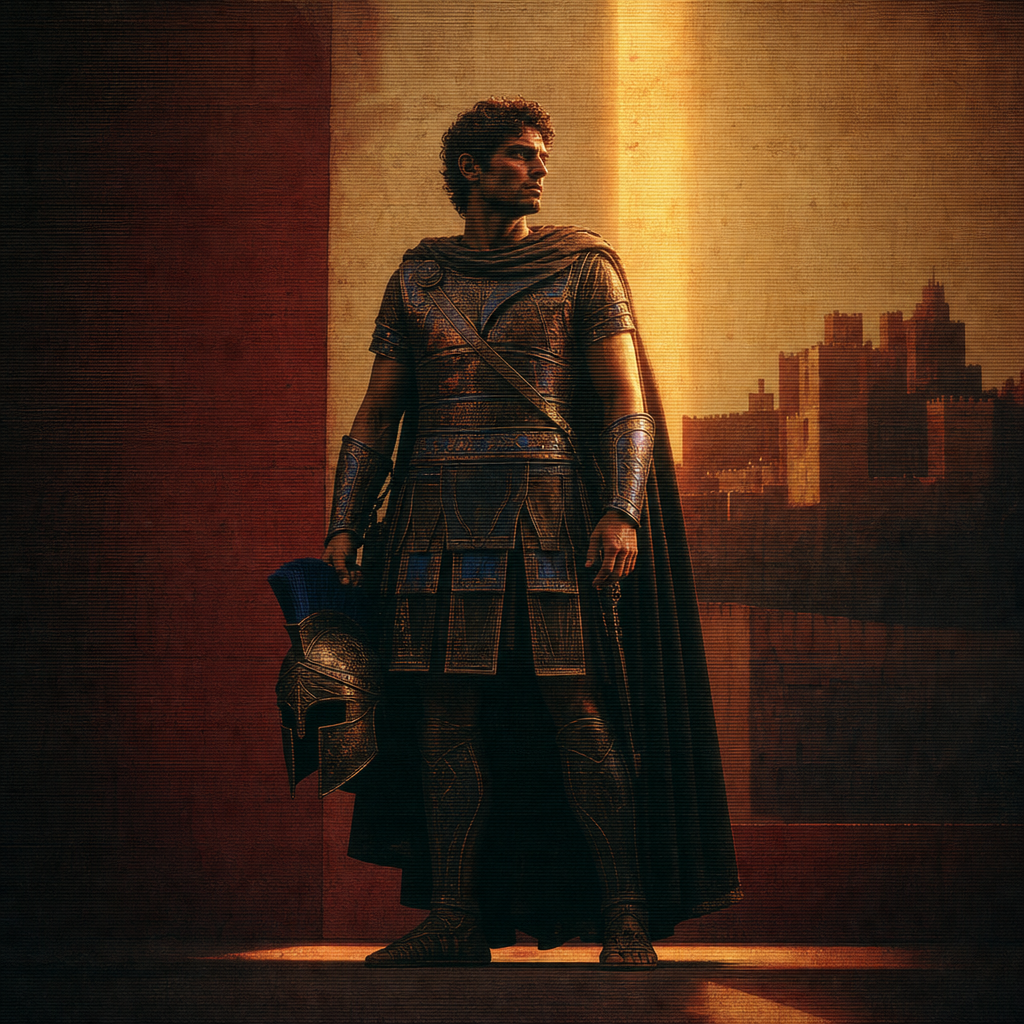
With these words glorious Hector rushed out through the gates, and his brother Alexander went with him; in their hearts both men were eager to wage war and fight. Just as a god grants a fair wind to longing sailors once they have grown weary of beating the open sea with polished fir oars and their limbs have gone slack with exhaustion, so those two appeared to the longing Trojans.
Read Ancient Greek Source (Iliad.7.1–Iliad.7.7)
There each killed his man. Alexander struck down Menesthius, who lived in Arne and was the son of Lord Areithous the club-fighter and large-eyed Phylomedusa; and Hector struck Eioneus with his sharp spear in the neck beneath the bronze rim of his helmet, and his limbs went slack. Glaucus, son of Hippolochus and leader of the Lycian men, hit Iphinous son of Dexius in the shoulder with his spear in the fierce battle as he vaulted behind his swift mares; he fell from the chariot to the ground, and his limbs went slack.
Read Ancient Greek Source (Iliad.7.8–Iliad.7.16)
When the bright-eyed goddess Athena saw them destroying the Argives in the fierce battle, she darted down from the peaks of Olympus to sacred Ilium. Looking down from Pergamus, Apollo rose to meet her, for he wanted victory for the Trojans. The two met beside the oak tree, and Lord Apollo, son of Zeus, spoke to her first:
Read Ancient Greek Source (Iliad.7.17–Iliad.7.23)
"Why have you come so eagerly from Olympus once again, daughter of great Zeus, driven on by your fierce spirit? Is it to tip the scales of battle and give victory to the Danaans? For you have no pity at all for the Trojans as they perish. Yet if you would listen to me, it would be far better. Let us halt the war and the fighting now for today; later they will fight again until they reach the end of Ilium, since it pleases the hearts of you immortal goddesses to sack this city."
Read Ancient Greek Source (Iliad.7.24–Iliad.7.32)
The bright-eyed goddess Athena answered him: "So be it, worker from afar. With that very thought in mind I too came down from Olympus to the Trojans and Achaeans. Come then, how do you mean to stop the men from fighting?"
Read Ancient Greek Source (Iliad.7.33–Iliad.7.36)
Lord Apollo, son of Zeus, answered her: "Let us rouse the strong spirit of horse-taming Hector, to see if he will challenge some man of the Danaans to fight him man to man in grim combat; then the Achaeans in bronze leg armor, stung by the challenge, might send a single champion out to fight brilliant Hector." So he spoke, and the bright-eyed goddess Athena agreed.
Read Ancient Greek Source (Iliad.7.37–Iliad.7.43)
Helenus, Priam's dear son, perceived in his spirit the plan that pleased the gods as they took counsel. He went and stood beside Hector and spoke to him: "Hector, son of Priam, equal to Zeus in counsel, will you listen to me? I am your brother. Make the rest of the Trojans and all the Achaeans sit down, and yourself challenge whichever of the Achaeans is best to fight you face to face in grim combat. For it is not yet your fate to die and meet your doom; so I have heard the voice of the ever-living gods."
Read Ancient Greek Source (Iliad.7.44–Iliad.7.53)
So he spoke, and Hector rejoiced greatly when he heard his words. Stepping into the space between the armies, grasping his spear by the middle, he held back the Trojan ranks, and they all sat down. Agamemnon likewise seated the Achaeans in their fine leg armor. Athena and Apollo of the silver bow also sat down in the likeness of vultures high in the tall oak of father Zeus who bears the aegis, taking pleasure in the men. Their ranks sat closely packed, bristling with shields and helmets and spears. Just as a ripple spreads across the sea when the West Wind newly rises, and the water darkens beneath it, so the ranks of the Achaeans and Trojans sat on the plain. And Hector spoke between both armies:
Read Ancient Greek Source (Iliad.7.54–Iliad.7.66)
"Hear me, Trojans and Achaeans in fine leg armor, so that I may speak what the heart in my chest commands me. The son of Cronus, enthroned on high, did not fulfill our oaths, but with dark intent decrees trouble for both sides until either you take strong-towered Troy or you yourselves are cut down beside your seafaring ships. Among you are the finest champions of all the Achaeans; now let whichever of them has the heart to fight me step forward from the rest to stand as champion against brilliant Hector.
Read Ancient Greek Source (Iliad.7.67–Iliad.7.75)
"Here are the terms I declare, and let Zeus be our witness. If that man kills me with the long-edged bronze, let him strip my armor and carry it to the hollow ships, but give my body back to be taken home, so that the Trojans and the Trojans' wives may give me in death my share of the funeral fire. And if I kill him, and Apollo grants me the glory, I will strip his armor and carry it to sacred Ilium to hang upon the temple of far-shooting Apollo; but his corpse I will give back to the well-benched ships, so that the long-haired Achaeans may give him solemn burial and heap up a mound for him beside the broad Hellespont. And someday one even of the men yet to be born will say, as he sails in his many-oared ship over the wine-dark sea: 'This is the mound of a man who died long ago, whom glorious Hector once killed as he fought as champion.' So someone will say someday, and my glory will never die."
Read Ancient Greek Source (Iliad.7.76–Iliad.7.91)
So he spoke, and they all fell hushed in silence; they were ashamed to refuse him, yet afraid to accept. At last Menelaus stood up and spoke among them, reproaching them bitterly as he groaned deep in his heart: "Ah, you empty boasters—Achaean women, no longer Achaean men! Surely this will be an outrage, a disgrace beyond all disgrace, if not one of the Danaans goes out now to face Hector. May the whole lot of you turn to water and earth where you sit, every man of you, spiritless and utterly without glory! I myself will put on my armor to face this man; above us, the cords of victory are held by the immortal gods."
Read Ancient Greek Source (Iliad.7.92–Iliad.7.102)
With these words he began putting on his fine armor. And then, Menelaus, the end of your life would have come to you at Hector's hands, since he was far stronger, if the kings of the Achaeans had not sprung up and caught hold of you. Atreus's son himself, wide-ruling Agamemnon, took your right hand and called you by name: "You are out of your senses, Menelaus, cherished by Zeus, and you have no need of such madness. Hold back, grieved though you are, and do not let rivalry drive you to fight a man stronger than yourself—Hector, son of Priam, whom other men shudder at too. Even Achilles, in battle where men win glory, shudders to meet this man, and he is far stronger than you. Go now and sit among the company of your companions, while the Achaeans raise up another champion to face him. Fearless though he is, and insatiable for the din of battle, I say he will gladly bend his knee in rest, if ever he escapes out of blazing war and the grim fighting."
Read Ancient Greek Source (Iliad.7.103–Iliad.7.119)
So spoke the hero and turned his brother's mind, urging what was right, and Menelaus obeyed. His glad attendants then took the armor off his shoulders, and Nestor rose among the Argives and spoke to them: "Alas, a great grief has truly come upon the Achaean land. Loudly would the old horseman Peleus groan, that noble counselor and speaker of the Myrmidons, who once rejoiced greatly in his house as he questioned me, asking the lineage and birth of all the Argives. If he were to hear that all of them are cowering now before Hector, again and again he would lift his hands in prayer to the immortals that his spirit might leave his limbs and go down into the house of Hades.
Read Ancient Greek Source (Iliad.7.120–Iliad.7.131)
"Father Zeus, Athena, and Apollo, I wish I were as young as when the gathered Pylians and spear-fighting Arcadians battled beside the swift-flowing Celadon, by the walls of Pheia around the streams of Iardanus. Among them Ereuthalion stood forth as champion, a godlike man wearing on his shoulders the armor of Lord Areithous—noble Areithous, whom men and women with beautiful sashes called the club-fighter, because he fought neither with bow nor with long spear, but broke the battle lines with an iron club. Lycurgus killed him by craft, not by strength at all, in a narrow pass where his iron club could not ward off ruin; for Lycurgus was too quick for him and pinned him through the middle with his spear, so that he crashed backward to the ground. Then Lycurgus stripped the armor that brazen Ares had given Areithous, and afterward wore it himself into the toil of Ares. But when Lycurgus grew old in his halls, he gave it to his dear comrade-in-arms Ereuthalion to wear; and wearing that armor, Ereuthalion challenged all our best fighters.
Read Ancient Greek Source (Iliad.7.132–Iliad.7.150)
"They trembled hard and were afraid, and no one dared face him; yet my own enduring spirit drove me on in its boldness to fight him, though by birth I was the youngest of them all. I fought him, and Athena granted me the glory. He was the tallest and strongest man I ever killed, for he lay sprawled huge upon the ground, stretched wide this way and that. If only I were that young now, and my strength were still firm! Then Hector of the flashing helmet would soon meet his fight. Yet among you who are the finest of all the Achaeans, not even you are eager to go gladly against Hector."
Read Ancient Greek Source (Iliad.7.151–Iliad.7.160)
So the old man rebuked them, and nine men in all stood up. Far first to rise was Agamemnon, lord of men; after him rose Tydeus's son, strong Diomedes; after them the two Ajaxes, clothed in fierce valor; after them Idomeneus and Idomeneus's comrade-in-arms Meriones, a match for man-slaying Enyalius; after them Eurypylus, the splendid son of Euaemon; and up rose Thoas son of Andraemon and brilliant Odysseus. All of them were willing to fight brilliant Hector. Then once again the Gerenian horseman Nestor spoke among them: "Now cast lots from first to last to see who is chosen; for whichever man it is, he will help the Achaeans in their fine leg armor, and he will gladden his own heart too, if ever he escapes out of blazing war and the grim fighting."
Read Ancient Greek Source (Iliad.7.161–Iliad.7.174)
So he spoke, and each man marked his own lot and threw it into the helmet of Agamemnon, son of Atreus. The troops prayed and lifted their hands to the gods, and looking up into the wide sky, one after another would say: "Father Zeus, let the lot fall to Ajax, or to the son of Tydeus, or to the king of gold-rich Mycenae himself." So they spoke, and the Gerenian horseman Nestor shook the helmet, and out of it leaped the very lot they themselves wanted—the lot of Ajax. A herald carried it all through the crowd, showing it from left to right to all the Achaean champions. Not recognizing the mark, each of them disowned it in turn. But when the herald, carrying it through the crowd, came to the man who had scratched his mark on it and cast it into the helmet, glorious Ajax held out his hand, and the herald stood close and dropped it into his palm. Looking at it, Ajax recognized the mark on the lot, and his heart rejoiced.
Read Ancient Greek Source (Iliad.7.175–Iliad.7.189)
He threw it to the ground beside his foot and said: "Friends, the lot is truly mine, and I myself rejoice in my heart, since I think I will defeat brilliant Hector. Come then, while I put on my war gear, pray to Lord Zeus, son of Cronus—silently to yourselves, so the Trojans do not hear, or openly, since we fear no one at all. For no man by his own will shall drive me back by force against my will, nor by any skill in fighting, since I trust I was not born and raised so untrained in Salamis."
Read Ancient Greek Source (Iliad.7.190–Iliad.7.199)
So he spoke, and they prayed to Lord Zeus, son of Cronus. Looking up into the wide sky, one after another would say: "Father Zeus, ruling from Ida, most glorious, greatest, grant Ajax victory and let him win shining glory; or if you love Hector too and care for him, bestow equal strength and glory upon them both." So they spoke, and Ajax armed himself in dazzling bronze. When he had clothed his body in all his armor, he surged forward like monstrous Ares marching to war among men whom the son of Cronus has brought together to fight in the fury of soul-devouring strife. Such was huge Ajax, the bulwark of the Achaeans, as he rose up smiling with a grim face, taking long strides and brandishing his long-shadowed spear. The Argives rejoiced as they looked at him, while a terrible trembling crept into the limbs of every Trojan, and even Hector's own heart pounded within his chest; yet there was no way now for him to flinch or slip back into the crowd of his troops, since he himself had issued the challenge to battle.
Read Ancient Greek Source (Iliad.7.200–Iliad.7.218)
Ajax came near, carrying his shield like a tower, faced with bronze and seven oxhides thick. Tychius, who lived in Hyle and was by far the finest leather-worker, had labored to make it for him. He made the gleaming shield from seven hides of well-fed bulls and hammered bronze over them as an eighth layer. Holding this before his chest, Telamonian Ajax stood right beside Hector and spoke to him with a threat: "Hector, now you will know clearly, man to man, what sort of champions the Danaans have among them besides Achilles, the lion-hearted breaker of men. He lies among his curved, seafaring ships, nursing his rage against Agamemnon, shepherd of the people; yet there are men among us fit to meet you face to face, and many of us. Come, begin the fight and the combat."
Read Ancient Greek Source (Iliad.7.219–Iliad.7.232)
Great Hector of the flashing helmet answered him: "Ajax, Zeus-born son of Telamon, commander of armies, do not try to test me as if I were some weak boy or a woman who knows nothing of the work of war. I know battles well, and the slaughter of men. I know how to wield my shield of seasoned oxhide to the right and to the left, and how to fight steadfastly behind it; I know how to charge into the din of swift mares, and I know how to tread the dance of fierce Ares in close combat. Still, a man like you I have no wish to strike by watching for a sly opening, but openly, if I can hit my mark."
Read Ancient Greek Source (Iliad.7.233–Iliad.7.243)
He spoke, balanced his long-shadowed spear, and hurled it. He struck Ajax's formidable seven-hide shield on the outermost bronze layer, the eighth one mounted over it. The unyielding bronze spearhead tore through six layers, but was stopped in the seventh hide. Next Zeus-born Ajax hurled his long-shadowed spear and struck the son of Priam on his well-balanced shield. Right through the shining shield went the heavy spear, forcing its way through the finely worked breastplate; straight on beside the flank the spear sheared through his tunic, but Hector twisted aside and escaped black death. Both men wrenched their long spears free at once with their hands and fell on each other like raw-flesh-eating lions or wild boars whose strength is not easily broken. Priam's son stabbed the center of Ajax's shield with his spear, yet the bronze did not break through; its point bent back. Ajax lunged in and stabbed Hector's shield; the spear drove clean through, jolting Hector back in the middle of his rush, and grazed his neck so that dark blood welled up.
Read Ancient Greek Source (Iliad.7.244–Iliad.7.262)
Even so, Hector of the flashing helmet did not break off the fight, but stepped back and with his strong hand seized a stone lying on the plain—black, jagged, and huge. With it he struck Ajax's formidable seven-hide shield squarely on the central boss, and the bronze rang out all around. Next Ajax lifted a far bigger stone, whirled it, and flung it, putting immeasurable force behind the throw. He crushed the shield inward with the millstone-sized rock and buckled Hector's knees; Hector was stretched flat on his back, driven hard against his shield, but Apollo quickly set him on his feet.
Read Ancient Greek Source (Iliad.7.263–Iliad.7.272)
And now they would have been striking at each other at close quarters with their swords, had the heralds, messengers of Zeus and of men, not come forward—one from the Trojans, one from the bronze-armored Achaeans, Talthybius and Idaeus, both men of sound judgment. They held their staffs between the two warriors, and the herald Idaeus, skilled in wise counsel, spoke to them: "No more, dear sons: do not wage war or fight any longer. Cloud-gathering Zeus loves you both, and both of you are great spearmen—that much all of us know. Night is already falling; it is good to yield to the night as well." Telamonian Ajax answered him: "Idaeus, tell Hector to say those words. He was the one who challenged all our best men to battle. Let him lead the way, and I will readily follow whatever he does."
Read Ancient Greek Source (Iliad.7.273–Iliad.7.286)
Great Hector of the flashing helmet answered him: "Ajax, since a god has given you stature and strength and clear sense, and with the spear you are the finest of the Achaeans, let us stop the fighting and the deadly struggle now for today; later we will fight again, until a god parts us and grants victory to one side or the other. Night is already falling; it is good to yield to the night as well, so that you may bring joy to all the Achaeans by the ships, above all to the kinsmen and companions who are yours; and I, throughout the great city of Lord Priam, will bring joy to the Trojans and the Trojan women in their trailing robes, who will enter the sacred assembly in prayer for me. Come, let the two of us give each other gifts of renown, so that any man of the Achaeans or Trojans may say: 'They fought each other in soul-devouring strife, and then parted joined in friendship.'"
Read Ancient Greek Source (Iliad.7.287–Iliad.7.302)
With these words he gave him a silver-studded sword, presenting it together with its scabbard and well-cut sword belt, and Ajax gave a war belt shining with crimson. The two men parted: one went back to the Achaean host, while the other went to the throng of Trojans, who rejoiced when they saw him coming back to them alive and whole, escaped from the fury and the invincible hands of Ajax; and they led him toward the city, having despaired of his safety. On the other side, the Achaeans in fine leg armor led Ajax, exulting in his victory, to brilliant Agamemnon.
Read Ancient Greek Source (Iliad.7.303–Iliad.7.312)
When they reached the shelters of the son of Atreus, Agamemnon, lord of men, sacrificed an ox for them, a five-year-old bull, to the almighty son of Cronus. They flayed the carcass, prepared it, and jointed the whole beast; they sliced the meat skillfully, pierced it on spits, roasted it with care, and drew all the pieces off. When they had finished their work and made the feast ready, they dined, and no man's appetite lacked an equal share. The hero, Atreus's son, wide-ruling Agamemnon, honored Ajax with the full-length chine of beef. When they had satisfied their desire for drink and food, the old man Nestor, whose counsel had proved best before, was first of all to begin weaving a plan for them. With their good in mind, he addressed them and said:
Read Ancient Greek Source (Iliad.7.313–Iliad.7.326)
"Son of Atreus and you other leaders of all the Achaeans, many long-haired Achaeans now lie dead, whose dark blood fierce Ares has scattered around the fair-flowing Scamander, while their souls have gone down to Hades. Therefore at dawn you must halt the Achaeans' fighting, and we ourselves will assemble and wheel the dead back here with oxen and mules; then we will burn them a short way out in front of the ships, so that each man may carry the bones home to a dead man's children when we return to our native land. Around the pyre let us heap up a single burial mound for all in common, raising it from the plain, and right beside it let us quickly build high towers as a defense for our ships and for ourselves. In them let us make well-fitted gates, so that through them there will be a road for driving horses; and outside, close by, let us dig a deep trench running all around to hold back horses and troops, so the assault of the proud Trojans may never bear down upon us." So he spoke, and all the kings approved his words.
Read Ancient Greek Source (Iliad.7.327–Iliad.7.344)
Meanwhile, the Trojans held an assembly high on the citadel of Ilium, fierce and turbulent, beside Priam's doors; and wise Antenor began to speak among them: "Hear me, Trojans and Dardanians and allies, so that I may speak what the heart in my chest commands me. Come then, let us give Argive Helen and the possessions with her to the sons of Atreus to take away. Right now we are fighting after breaking our sworn oaths; therefore I do not expect anything to turn out well for us unless we do this."
Read Ancient Greek Source (Iliad.7.345–Iliad.7.353)
He spoke and sat down, and among them rose brilliant Alexander, husband of lovely-haired Helen, who answered him with winged words: "Antenor, what you say is no longer pleasing to me; you know how to devise a better speech than this. But if you truly speak this in earnest, then the gods themselves have destroyed your wits. Now I will speak out among the horse-taming Trojans: I declare flatly, I will not give back the woman; but all the possessions I brought from Argos to our home I am willing to give back, and to add others from my own house."
Read Ancient Greek Source (Iliad.7.354–Iliad.7.364)
He spoke and sat down, and among them rose Priam, descendant of Dardanus, a counselor equal to the gods. With their good in mind, he addressed them and said: "Hear me, Trojans and Dardanians and allies, so that I may speak what the heart in my chest commands me. Now take your supper throughout the city as before, keep watch, and let each man stay awake on guard. At dawn let Idaeus go to the hollow ships to tell the sons of Atreus, Agamemnon and Menelaus, the proposal of Alexander, on whose account this strife arose; and let him speak this shrewd word as well, to ask if they are willing to cease from harsh-sounding war until we have burned the dead. Afterward we will fight again, until a god parts us and grants victory to one side or the other." So he spoke, and they listened readily to him and obeyed; then they took their supper throughout the army by companies.
Read Ancient Greek Source (Iliad.7.365–Iliad.7.380)
At dawn Idaeus went to the hollow ships. He found the Danaans, attendants of Ares, in assembly beside the stern of Agamemnon's ship; and standing in their midst, the loud-voiced herald spoke out among them: "Son of Atreus and you other leaders of all the Achaeans, Priam and the other noble Trojans ordered me to tell you—if it might be pleasing and welcome to you—the proposal of Alexander, on whose account this strife arose. All the possessions that Alexander brought to Troy in his hollow ships—would that he had perished first!—he is willing to give back, and to add others from his own house; but the wedded wife of glorious Menelaus he says he will not give back, though the Trojans certainly urge him to do it. And they told me to speak this word as well, to ask if you are willing to cease from harsh-sounding war until we have burned the dead. Afterward we will fight again, until a god parts us and grants victory to one side or the other."
Read Ancient Greek Source (Iliad.7.381–Iliad.7.397)
So he spoke, and they all fell hushed in silence. At last Diomedes, good at the war cry, spoke among them: "Let no one now accept Alexander's possessions, nor Helen either; it is plain even to a complete fool that the cords of destruction are already tied fast to the Trojans." So he spoke, and all the sons of the Achaeans shouted aloud, admiring the speech of horse-taming Diomedes. Then lord Agamemnon spoke to Idaeus: "Idaeus, you hear for yourself the answer of the Achaeans, and so it pleases me as well. As for burning the dead, I do not begrudge it at all; for once men have died, no one should begrudge their bodies the swift comfort of the funeral fire. Let loud-thundering Zeus, Hera's husband, witness our oaths." Speaking so, he lifted his scepter high to all the gods, and Idaeus went back to sacred Ilium.
Read Ancient Greek Source (Iliad.7.398–Iliad.7.413)
The Trojans and Dardanians were sitting in assembly, all gathered together, waiting for Idaeus to return. He came and stood in their midst and delivered his message, and at once they made ready for both tasks, some to bring in the dead, others to go after firewood. On the other side the Argives hurried from their well-benched ships, some to bring in the dead, others to go after firewood. The sun was newly striking the fields, climbing the sky from softly flowing, deep-running Ocean, when the two sides met one another. There it was hard to recognize each fallen man; but they washed away the clotted blood with water and, shedding hot tears, lifted them onto the wagons. Great Priam did not allow them to wail aloud; so in silence they heaped the bodies on the pyre, grieving at heart, and once they had burned them in the fire, returned to sacred Ilium. In the same way on the other side, the Achaeans in fine leg armor heaped the bodies on the pyre, grieving at heart, and once they had burned them in the fire, returned to their hollow ships.
Read Ancient Greek Source (Iliad.7.414–Iliad.7.432)
When dawn had not yet broken and the night was still gray with twilight, a chosen body of Achaeans roused themselves around the pyre. Around it they heaped up a single burial mound for all in common, raising it from the plain, and right beside it they built a wall and high towers as a defense for their ships and for themselves. In them they set well-fitted gates, so that through them there would be a road for driving horses; and just outside the wall they dug a deep trench, broad and vast, and planted sharp stakes within it. So the long-haired Achaeans labored at their work.
Read Ancient Greek Source (Iliad.7.433–Iliad.7.442)
Meanwhile the gods, sitting beside Zeus the lord of lightning, gazed at the great work of the bronze-armored Achaeans. Poseidon the earth-shaker was the first to speak among them: "Father Zeus, is there any mortal left on the boundless earth who will still tell the immortals his mind and counsel? Do you not see how the long-haired Achaeans have built a wall to guard their ships and driven a trench around it, without offering splendid hecatombs to the gods? Now the fame of this wall will reach as far as the dawn spreads light, and men will forget the wall that Phoebus Apollo and I toiled to build for the hero Laomedon." Greatly provoked, cloud-gathering Zeus answered him: "What a thing to say, Earth-shaker of wide power! Some other god might well fear this scheme—one far weaker than you in hands and strength. No, your fame will reach as far as the dawn spreads light. Come then: once the long-haired Achaeans depart with their ships for their dear native land, break down the wall and sweep it all into the sea, and cover the great beach with sand once more, so that the great wall of the Achaeans is wiped away for you."
Read Ancient Greek Source (Iliad.7.443–Iliad.7.463)
So the gods spoke of these things to one another. The sun went down, and the Achaeans' work was finished; they slaughtered cattle beside their shelters and took their supper. Many ships from Lemnos had put in to shore bringing wine, sent by Jason's son Euneus, whom Hypsipyle bore to Jason, shepherd of the people. As a separate gift for Atreus's sons, Agamemnon and Menelaus, Jason's son had given a thousand measures of wine to be brought. From those ships the long-haired Achaeans traded for wine—some with bronze, some with gleaming iron, some with hides, some with live cattle, and others with enslaved captives—and they set out a rich feast. All night long the long-haired Achaeans feasted, as did the Trojans and their allies throughout the city; and all night long Zeus the counselor plotted disaster against them, thundering terribly. Pale fear seized them, and they poured wine from their cups onto the ground, nor did any man dare to drink before pouring a libation to the almighty son of Cronus. Then they lay down and took the gift of sleep.